
Confessions From the Underground #7: Writer’s Block
**This column originally appeared in our May 2025 issue**
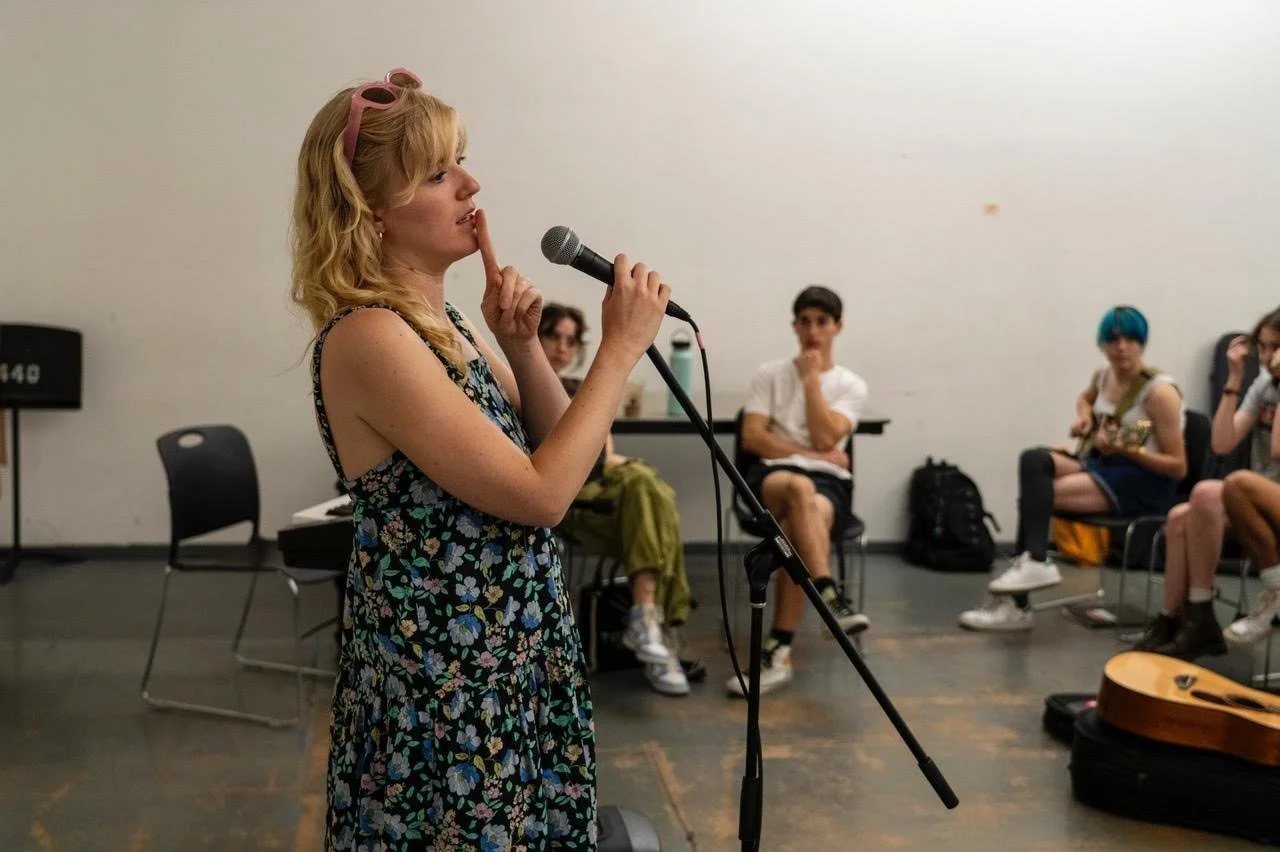
Photo by Tom LeGoff
For artists, it is not uncommon to be met with resistance while creating, whether it be internal or external. This, of course, is commonly described as writer’s block, a term which my guest Melissa Carter adeptly refutes below. Based in New York City, Melissa is a member of one of my favorite bands, Rosalind—a trio of self-proclaimed ‘witchy’ songwriters making gorgeous, dream-pop—as well as her own solo endeavor, Hattie. But most relevant for the purposes of this article, she is the founder of Making Audio Magic, a mentorship company she’s started for songwriters both new and seasoned. In addition to one-on-one sessions, she recently began offering a group-based workshop program called Song Craft, with the goal of guiding participants to writing songs they love and overcoming the creative resistances in their way. It’s always eye-opening to learn how other songwriters view the process, and this was no exception. Our conversation below is full of insight and inspiration, and would be a great read paired with either of Melissa’s projects in your headphones… hint, hint.
TJ Foster: To begin, can you walk me through your workshop program, Song Craft? The format, what you cover and how you cover it?
Melissa Carter: Yeah! It's basically my process that I've put together over many years. And there's two versions of Soundcraft so far. There's the intro course, which is four weeks, and then there's a six week one, which I haven't done yet, but that'll be running starting on April 27. The crux of it is really about, how do we find our voices as songwriters? And how can we be in relationship with our creativity so we don't feel like we're the driver, but rather connecting with something that's potentially outside of us? Whether that's like, flow state, or you could call it creative practice, or you might call it a muse. Or if you’re into the way that the Romans used to think about it—we're not the genius, but we have a genius.
Also, how do we use our songs to process our lived experience so that we can move through whatever's going on in our lives rather than hold on to it? From there, there's the nuts and bolts of what makes good lyrics, what makes an interesting melody, and what works in terms of harmony and chord progressions. But I'm less interested in that. Especially for Song Craft, and also for me as a songwriter; I'm kind of admitting that I don't care about all of that stuff at the forefront. It's important. But to be fair, the more time you spend on it and practice, you build the muscle of writing songs. You kind of know what works if you can train your ear so you don't have to always be thinking about the theory of it all.
TF: What inspired you to start this program?
MC: I graduated from my Master's program, which was in music production and audio engineering, and I was like, “What am I going to do with this?” I obviously like making music; I have my own artist project (Hattie). I have Rosalind as well. But, I wanted to do something more.
I've been teaching songwriting for years; I run a high school songwriting intensive in the summers, and I've taught lessons here and there. It's always been something that people have asked me to do, but I never really put together formally. Then a year ago, I had vocal surgery. In the wake of that, I really was asking, “How do I spend my time on what matters to me, and how do I offer something that is really what I'm here to offer?” And Song Craft came out of that.
TF: That’s awesome. And one of the things I saw you touch on in the workshop is this idea of creative unblocking. Where do you think writer's block comes from ultimately? Is it a mental thing? Is it emotional? Or is it a creative thing?
MC: One of my mentors, Michelle Pellizzon who runs this amazing company called Holisticism, always says she doesn't believe that writer's block exists. And the more that I've been working with her, the more I think she's right. I think creative resistance exists—we ourselves are not blocked, but we can experience resistance in a bunch of different forms. Maybe we just can't seem to find the time in our day to sit down to write or practice or play our instrument. Or maybe we are afraid that if we sit down to write, we'll discover that we're actually good, and that's scary because it means we could fail. Or we'll discover that we're bad and our songs aren't worth sharing. So if writer's block was anything, it would be the thing or the number of things that we're in relationship to that cause friction or resistance. But usually what I find, actually 100% of the time, is if you sit down to do it and you show up consistently—maybe that's three times a week for 10 minutes, maybe it's every day for five minutes—eventually something's going to come out. You might not like what comes out. It’s really like what Ed Sheeran says—I don't know if he came up with this, but this is the only source that I can find—he talks about letting the dirty water run. We're not blocked. We're just afraid to let the dirty water run.
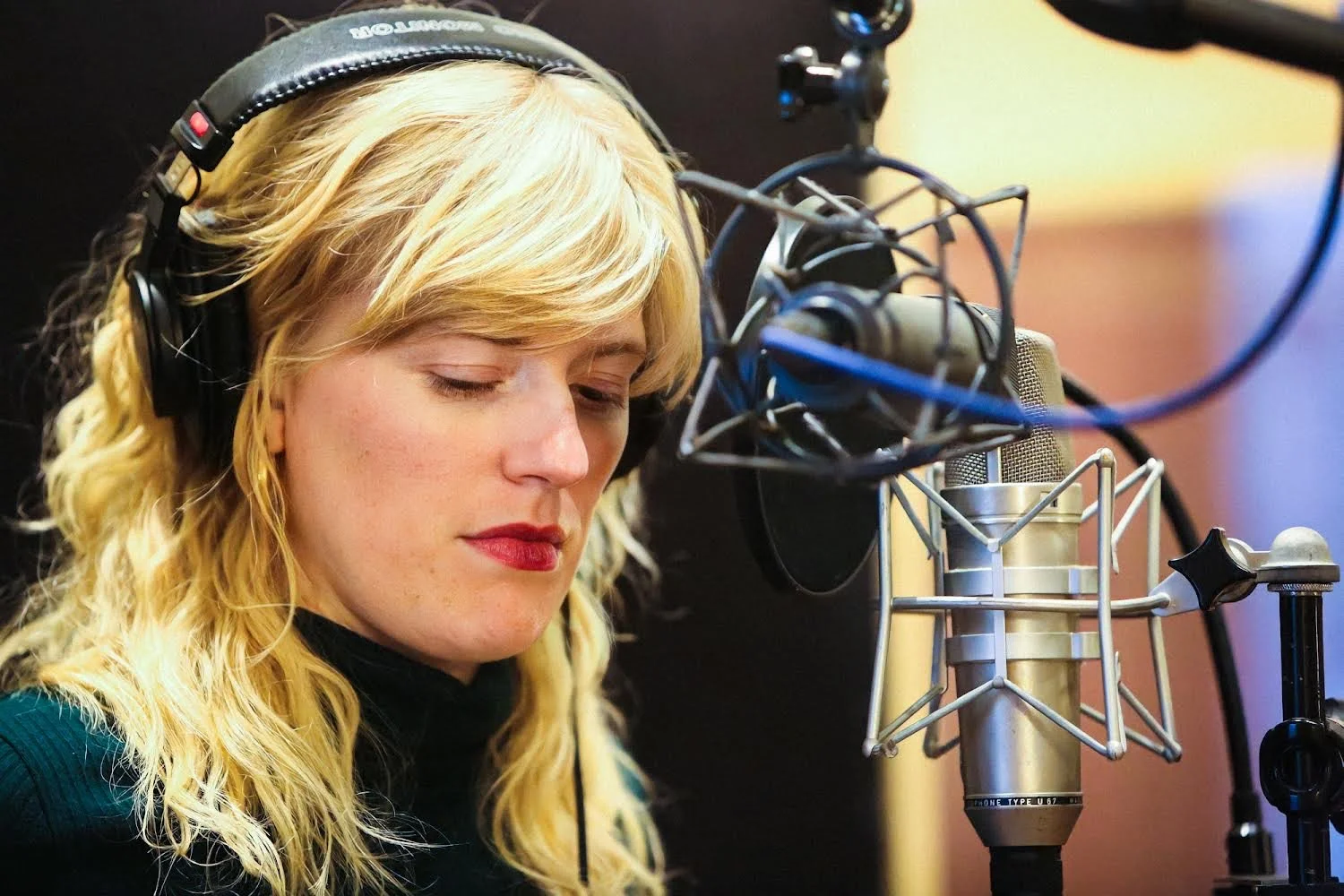
Photo by Emil Benjamin
TF: Can you think back to any instances when you did feel blocked? How did that manifest for you?
MC: If we're calling it blocked, I was blocked for years. I started writing songs when I was a teenager – and this is really where Song Craft comes from – to heal and process anything that happened to me. That was what songs were for. I didn't realize that was special in any way, that not everybody did it. So for maybe ten years from that point, I was too afraid to put any music out because I was afraid that it wouldn't be good enough, or it wasn't where I wanted it to be. I think Julia Cameron in The Artist’s Way… have you read this book?
TF: No, but you're the second or third person who's referenced it to me in these conversations! I have to read this book.
MC: She's like, the godmother of creative practice, and she's coined a lot of these terms. When you talk about The Artist's Way, you're talking about blocked artists going through a process of becoming unblocked, and that's the way that she frames it. But I think she calls them shadow artists, where you kind of do everything in the dark. That was one instance and then two—this is kind of counter to my previous point—I didn't have the tools to write the kind of music that I wanted to write, because I didn't understand the nuts and bolts of how songs could be put together. I would get stopped because I would just be writing the same chord progression, and I wouldn't know how to move away from that. Or I didn't trust that the melody that I was writing was good enough, because I think on some level, I was wanting more experience and knowledge.
TF: That makes sense. Absolutely. For the people who attend the workshops, are there any common triggers you’ve heard about?
MC: Yeah, a lot of the students talk about how they don't feel like their ideas are their own because they don't have experience. For the students who can't play an instrument, for example, I will say, “Write a melody to a beat of some kind,” like something on Splice or the Demo app. Have you heard of this app?
TF: No! Do tell.
MC: It's kind of cool. Basically, you can plug in chords and [choose the main] instrument – it could be guitar or piano. You can decide the feel in terms of drums and it will then plug and play chords with a whole band behind you for you to write to if you don't play an instrument. It's awesome for people who don't have that in their arsenal of skills yet.
I've had a few students mention that they don't feel like it's their idea because they can't play it, but they're still writing the melody and they're writing the lyrics. That's something where they feel like they're borrowing from a song that they already know, because it just maybe feels too easy.
There's also a big—as is true with any skill—learning gap of, “How do I take my ideas and put them into this form that's really specific?”
TF: That’s an interesting point about borrowing material, because at some level, at this point in music history, we're all kind of borrowing to some extent, right? There's only a finite number of notes and chords and ways you can put them together. I've thought about that before too – when something sounds too familiar. Because of course it does! I'm playing a song in, say, D major. There's millions of other songs that are in D major, right? At some point, some combination is going to sound like something else.
MC: It is. Or sometimes you realize, like, that's actually David Bowie, and I can't sing that melody because it's not mine! I had a funny experience with a song that's kind of new to me, called “The Rays,” which I haven't released yet. In the chorus, I was singing a melody for a while that was literally a melody from Hamilton. (laughs)
TF: As I was preparing for this, I was thinking about what my relationship with “writer's block” is. I kept coming back to this one thought, kind of related to what we were just talking about, where everything starts to feel a little derivative. I'll pick up my instrument and it's like muscle memory, where you go to the same chord patterns or progressions, or when I get to the point of writing lyrics, I feel like I've written about this particular thing 100 times already.
MC: For students of mine who have been doing it for a couple of years, or even a year, everybody in that place, without fail, has been like, “I play the same chord progression over and over again whenever I sit down to write,” or “I don't know how to not do ‘X’ thing that I always do.” And in a way… I don't know if you've had this experience, but the early songs that I was writing talked to each other. And I think that's a beautiful thing. For example, the Rosalind song “Pin in the Map” and a Hattie song, “Venus Was in Retrograde,” share a lyric. They're about the same person. I didn't mean to do that but of course it happened because it's about the same person in my life at different moments. And at first [I thought] maybe I should change that. But then I thought, “No, that's kind of beautiful.”
TF: Honestly, I love those types of things when I catch them on a recording. Because you're writing at two different points in your life, that perspective is a little bit different. And being able to put that lyric into two different lenses or whatever is awesome.
MC: I feel like you have that too actually, with E.R.I.E.
TF: I've done a couple things intentionally where I'll call back to older songs, or even reprise something from an earlier song on the same record. Honestly, it’s more from a sonic perspective, an Easter egg of sorts. Not to mention the fact that, oftentimes, when I'm writing lyrics, it takes a while for the real meaning to come to me. I've had songs that I'll go and play five, six years after the fact, and I'm like, “Oh shit, that's what I meant!”
MC: That's the thing too: I feel like our songs have something to teach us. It's something that I think about a lot.
I think some people do sit down and it's a blank page. Can't get anything more than a few words and a couple chords, and that's okay, if that's what's happening. You just have to keep sitting down, I think. And unfortunately, there isn't a shortcut beyond that, other than, like, write the worst song, or the silliest song, that you possibly can. This is an exercise that I did in School of Song. Do you know this?
TF: No!
MC: You would like this. It's songwriting classes with the greats of our time. Laura Marling is doing a workshop with them right now. They’ve had the guy from Fleet Foxes, David Longstreth from Dirty Projectors, etc. I did one with [Eric Johnson], frontman of Bonny Light Horseman and Fruit Bats. He did this exercise that was to write a song comprised of your text messages. Take five to ten texts and use those as your lyrics. Or you can use them as fodder and change the words if you want to. But if you just want to worry about melody and chords, then those are your lyrics.
The point is, give yourself an exercise like that if you're super blocked. But otherwise, I think often what happens is that we don't trust that our songs have something to teach us, and then we just look at what we have written and think it is trash. We're actually not blocked. We're just judging ourselves.
TF: You kind of already answered this to an extent, so forgive me, but do you believe in writing through the ‘block,’ or stepping away from it and coming back later?
MC: I’m somebody who is a bit ‘neuro-spicy’ in the way that my brain works. I get super distracted. For example, if I'm being totally honest, I still have not figured out how to have a practice routine that feels good for me. I do anything to avoid practicing. Songwriting for me is the same. I definitely write through the block. But I’m also a huge fan of taking your time, and especially as a song gets further along, listening with fresh ears is really important.
TF: What about the differences between writing for yourself and writing for a group? Are there different mechanisms that you use to take a song from point A to point B?
MC: I love collaboration, and I bring that both into Hattie and, of course, it's embedded in Rosalind. I think the beautiful thing about Rosalind is we’re a trio, and on our first record each person got a certain number of songs where we were the lead writer, as you know. The lyrics and melodies were really not touched too much. There were maybe some edits here and there, but that’s the heart of the song. Now let's flesh out the production, or let's move song sections around. The support came in the editing phase, which is amazing because that's the place where I would say 99.99% of people get stuck and don't finish songs or just get tired of it.
For Hattie what I enjoy is, if the song's not ready, I just let it rest. And then I work with people who can help me get it ready. For some people, that’s a gruelingly slow process. But for me, that's my process, yeah? Allowing songs to be ready as they are.
TF: That’s awesome I could definitely talk to you about this for hours, but in the interest of time, I always like to kind of end these conversations with a nugget of wisdom, even though you’ve already given me more than one. But what advice would you give to songwriters—new or seasoned—that might feel stuck?
MC: I would say, first, find another hobby outside of songwriting that you can also pour your attention into. For me, I've recently been excited about getting into wheel throwing, which is ceramics. It helps me think about how I want to be working in relation to my songs. If you’re a seasoned songwriter, that would be my recommendation.
If you're new, just let it be bad. You might not want to hear that, but it's the best starting point. Just write a bunch of bad songs and definitely, quantity over quality.
For more info on Melissa’s classes, visit https://www.melissakaitlyncarter.com/classes
