
Confessions From the Underground #11: Representation, Part One
**This column originally appeared in our September 2025 issue**
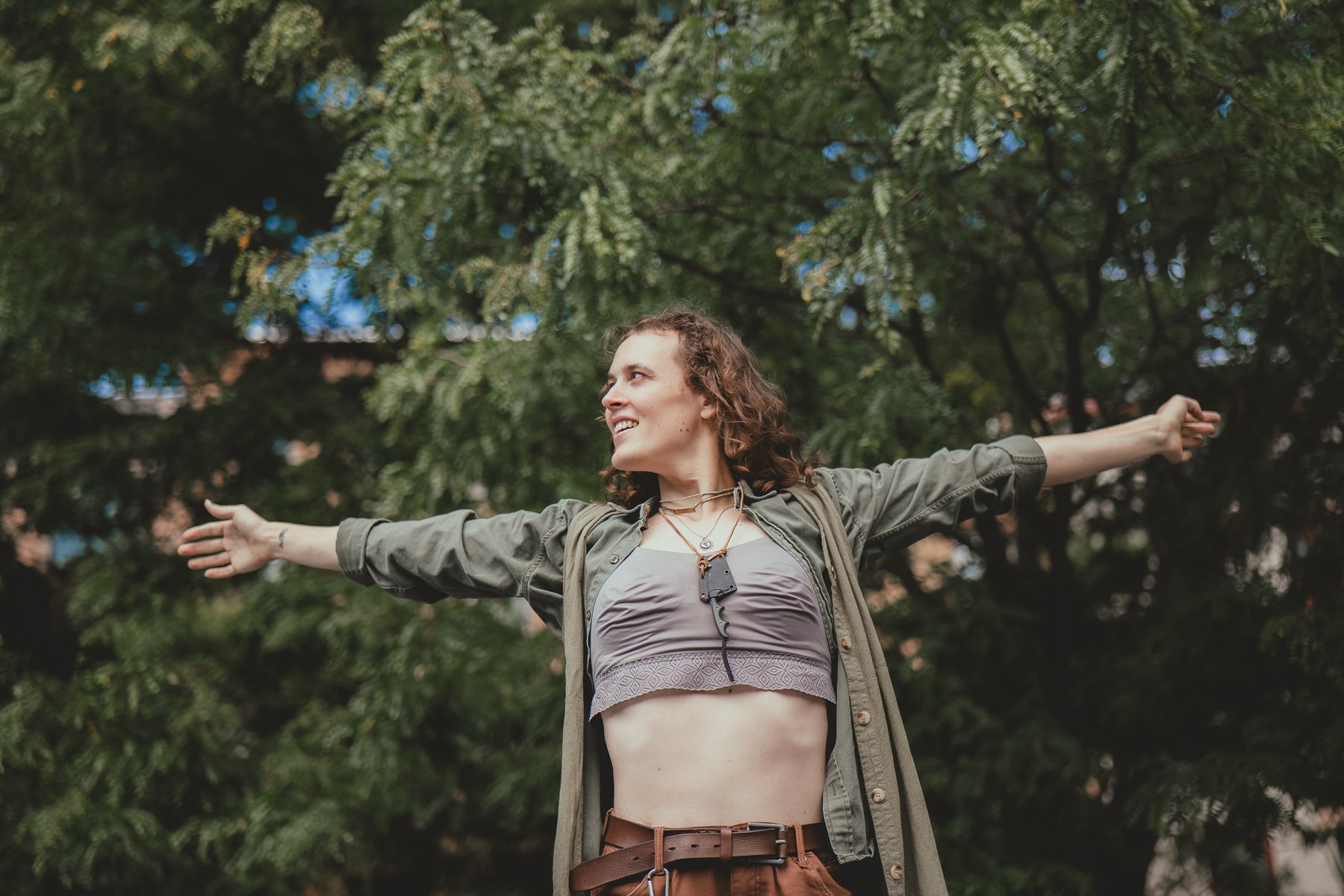
JJ’s Okay by Debi Gustafson
For anyone just joining us, this is the column where I have the pleasure of doing a deep dive on a certain topic with folks who are way more eloquent than I. This month, we’re breaking the formula ever so slightly, with not one but two interviewees gracing us with their presence. I was approached via email by reader Sophie Bille with an idea for an article around trans representation in our local music scene. Sophie was kind enough to connect me with local artists Lina Franzine and JJ’s Okay. Our conversation around gender representation was so long and insightful, it’s made me break my own formula once again. In order to maintain the integrity of the chat, I’ve had to split this into two parts. Without further ado, here is the first half of our discussion, with the grand conclusion coming in next month’s issue.
TJ Foster: It’s so nice to meet you both, thank you for doing this! To begin with, to the extent that you're comfortable, I'd love for you each to tell me about your own individual journeys, both as people and musicians.
Lina Franzine: That's a big question. Let's start with the basics. I am a transgender woman. That's fairly new in the grand scheme of my life—I'm a year and a half in on being out publicly. I grew up on Long Island. I spent a few years in Florida and thankfully I wasn't aware of my queerness at that time, because that would have been really difficult. I came back to Long Island for high school, my first attempt at college and a few years of work before I realized I was a girl, and that was complicated for my family situation and my employment situation. I was applying to schools and I had friends in the Capital Region, so I was focusing on UAlbany.
I've been a musician pretty much my whole life. I was in chorus as a kid, and I always thought that was funny, because I was the only “boy” in chorus.
JJ’s Okay: I love that—’quote-unquote boy’. (laughs)
LF: It was funny because my voice started to change, and that was when I stopped doing it. I didn't think of it this way back then, but when I look back at that piece of my history now, that was one of the first times where it became clear that my interests and my perceived gender in the world weren't going to align with each other.
JJ: What was the first moment you knew that god was abusing you?
LF (sarcastically): Oh, I think I've known that for a long time.
JJ (chuckling): I'm sorry. I just had to.
TF: That was a great question. I think I'm gonna let you handle the rest of these. (laughs) Go ahead, Lina.
LF: I loved guitar and always wanted to learn it. I got a few lessons when I was in middle school, and then started teaching myself all the classic rock songs that my dad made me listen to.
The first time I went to college, I went for engineering, but I pivoted to music. I had already started doing the singer-songwriter thing, and that developed into gigging. Eventually I dropped out of college, but kept gigging—I was just playing songs I was into, like The Beatles and Billy Joel, in addition to writing my own. I thought, “That's going to be my career.” I was doing okay; I was making money, teaching lessons, working sound at a jazz club. Then COVID happened, and it all kind of came crashing together with my transition. I started writing about how I was feeling, I moved up here and now, all of a sudden, I've got this completely different version of my singer-songwriter thing where I'm playing—you'll have to censor this one—tr*nny rock. Now I split my attention between trying to survive in this awful moment economically, socially, and politically, playing music when I can, and going to school. That's my entire life story, very truncated.
JJ: Music has always been a part of my life since I was literally a bouncing baby. My mom and dad would tell me stories later in life that, whenever a car would go by with really heavy subwoofer bass, I would bounce up and down and shake my ass to the feel of these cars going by before I even knew how to talk. My mom was a vocal major, and my dad was a drummer, so we had a music room in my house my whole life, growing up on a farm near Seneca Lake.
The progression of my musical experience started with piano, then drums, then around the age of 10 or 11, I asked my mom for guitar lessons. I was very privileged to have that experience, and parents who were willing enough to shell out for private lessons – it made a really big difference. Guitar, throughout my life, has been a bit of companionship. It was always something that, when I was having a rough time, I would sit down, and it was like writing in my journal. Even if I didn't have the words to express myself, it helped me through some difficult emotional experiences. I guess that's actually a pretty good tie into queerness, because learning to integrate my own emotions and experiences in my body ended up being a very important part of recognizing my transness. It was a foundational process of being able to hold space for a lot of difficult thoughts and emotions in a way that I didn't feel safe in most of my past, which is why it took me until I was 28 to realize that I was trans.
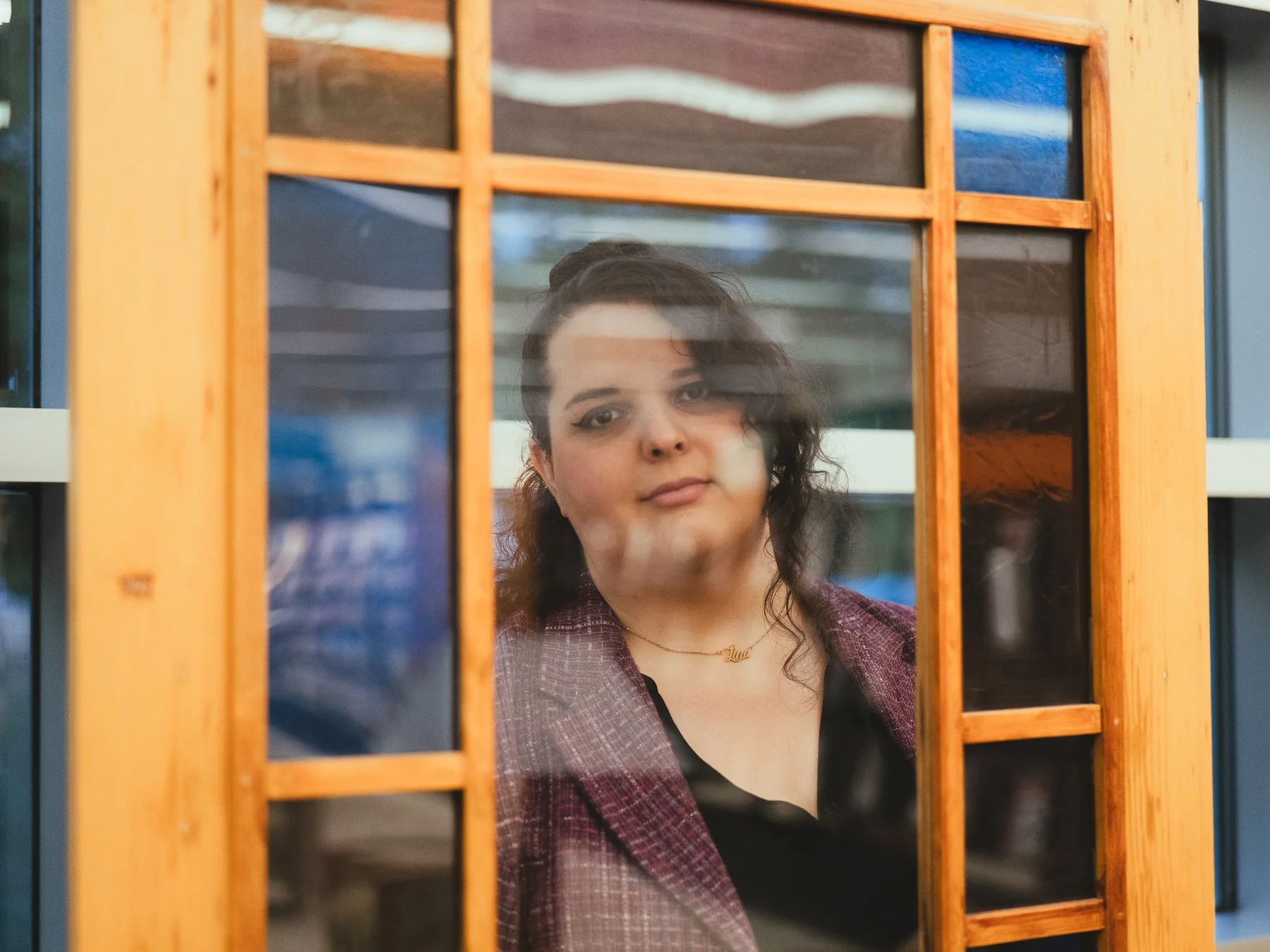
Lina Franzine by Debi Gustafson
TF: You kind of touched on this, but how would you say that music has given you the space to express your gender, your identity, in ways that maybe other parts of life don’t?
JJ: Music is interesting to me because I've had so many emotional epiphanies and personal epiphanies unrelated to gender. I've written songs primarily about difficult experiences that I've had in my life, mostly relationally and romantically, and a lot of times there's this premonition where I will sing something that I don't fully understand, but it comes from a more complete experience of associating words and letting them flow more freely. When it comes to assembling a song, I'm not trying to make everything highly logical. I like everything to connect and make a story, but also the words are coming from this ether, this other space, and getting arranged by me. Sometimes it allows the truth to come through in a way that allows me to learn from myself, or a part of me that knows better—and that is endlessly fascinating.
TF: Yes! I love how our songs can teach us things we might not recognize in the moment. Then you listen or perform later—even years—and suddenly the song makes sense.
JJ: I think there's also a scientific element to it where, in order to process trauma, we often have to integrate both parts of our brain, which is something that happens a lot when it comes to music. I was often not encouraged to live in a space that allowed me to fully process things. Music has enabled me to be honest about just how intensely I have experienced various parts of my life.
LF: I have looked at my journey as a musician as integral to figuring out my gender stuff. At every single point in my transition and leading up to it, I can pinpoint moments that are musically related. There’s this song that I wrote partially before I realized I was trans, and then I rewrote/finished after, called “Belinda.” It's kind of my flagship song. I still have to finish recording it. But I look at, like, [being in] chorus as a kid, as an unknowing way of identifying with the other girls. Later in life, as I started playing open mics and gigs, it turned out that all of my friends I made in the scene were mostly queer women. I related to [them] more than I related to anybody in my life.
The fun, sort of corny, “oh, I should have known” part is that, as I started getting more comfortable expressing myself in the world, I stopped singing so masculine and started singing more femme. As I'm getting more comfortable with who I am in the world, my voice got lighter. If I listen to the last recording I did before my transition, there’s a difference in the tonality of my voice and the way I was willing to express it. Even the album art was this black and white drawing of myself with short hair—I drew wrinkles on my face. It was a very negative self image.
Towards the end, [the art and promo for my final single] was all pink. You started to see the songs I'm covering shift to Ingrid Michaelson or Sara Bareilles. I began writing songs that sounded a little more like theirs. By the time that we reach the pandemic, I'm covering Britney Spears, like, “Haha, so funny for me, big man with a beard up there doing my best impression.” And everybody's like, “Oh, that's so funny.” But actually, I want to die. I'm playing this because I want to sing songs by women, and if people don't see me that way, it hurts. That doesn't even get to the songs that I was writing, but they started to make sense. It just goes to show you, this stuff doesn't come out of nowhere. It just takes time for you to realize what it is.
TF: Now, kind of a broad question about the current state of music, or even art in general. I'd love to know what accurate and authentic representation would look like to you. From a completely outside perspective, it feels like things have gotten a little better? But I don't feel like we're obviously there yet.
JJ: I want everyone to watch a video essay by a trans creator on YouTube, I’m blanking on the name…
LF: Lily Alexandre?
JJ: Yes! It ties into the concept of trans visibility in a way that has a practical and poetic depth. The takeaway here is we're in a really fucking weird and scary time to be a trans person in America. I think many people who aren't on the far right or a centrist in the current political climate have some awareness of that, but it might not be for the reasons they expect. There's been some unfortunate trends in the way that the trans experience has been characterized to the general public over the last 10 or 20 years that have sought to be positive but aren't grounded in what it means to live as a gender non-conforming or gender expansive person, to the point where the idea that trans girls can also be lesbians, is mindblowing! So much so that it's a joke to conservatives.
I think the representation that matters ultimately needs to be fully accepting of every individual. And I'm a baby trans. I came out at the beginning of this year, so I feel a little uncomfortable speaking for trans people, but that is the experience that most marginalized identities go through. You're either forced to speak for everybody, or you can’t and there's no in between. The representation that really matters is being able to let people be the people they are, speak to their experience, and let it not be seen as entirely representative of an entire group, but also not be discounted as not being able to be, if that makes sense.

JJ’s Okay by Debi Gustafson
TF: It does. It’s a really fine tightrope of a line.
JJ: For me, it's been great in that I don't have any more waiting in my life. Once I realized this is me, it's like, who cares if there's a worse or better time? It doesn't matter, because I'm here right now, and I have no interest in being anything other than myself. I think it's important to not romanticize the concept of being bold enough to be yourself. When I hear, like, “You’re so brave!”—it’s kind of the stereotypical phrase from well-meaning liberals—my response to that is sadness... you don't need to thank me for finally realizing that I am willing to be something that I always have wanted to be. And you also deserve to experience the freedom that comes from evolving beyond all our artificial limitations.
TF: That’s a thing I’m assuming you’ve each heard? Is it common?
JJ: Oh yeah, it's a very common experience. Especially with trans women. The other part of this, when it comes to [media] representation, the experience of being [canonically] trans is sometimes not really offered to trans men. Trans masc people and nonbinary people often struggle to get any representation whatsoever. So shout out to my NBs and trans mascs. We see you.
LF: One of the things that Lily Alexandre talks about in that video, is that there's almost two kinds of trans art. I mean, there's more than two kinds, but there's what we do for us and what we do for everyone else. Right now, there's an argument to be made that what we do for us should be the focus, because you get to talk about the experience in a way that's deeper and requires no explanation to outside parties. A lot of transfem artists are known for making this kind of grating, electronic, hyper-pop music that the average person might listen to and be like, "Oh my God, that's a lot." I, as a trans woman, might recognize the artist, or might recognize that type of sound as being associated with the trans community, and be more inclined to listen to the lyrics and get something very specific to my experience out of it. The fact that the sound isn't so easy to listen to becomes a method of natural gatekeeping against transphobes and even just people who aren't going to get it.
On the other hand, you have people like Dylan Mulvaney, right? She's very, very famous in a mainstream way, and she collects a lot of hate. She presents a version of the trans experience that's very sort-of Ellen Degeneres Show-ready. It's reaching a vast audience, and I love her, but at the same time, I don't really get anything out of Dylan as far as representation, because I'm nothing like her, and my version of womanhood is so different.
Be sure to pick up next month’s issue for the rest of our conversation, and follow Lina and JJ on Instagram at @lina.on.me and @heyheyitsjjokay respectively.
