REVIEW: An Uneven Script Undercuts Beautiful Performances in “The Last American Newspaper”
09/29 @ Capital Repertory Theatre, Albany
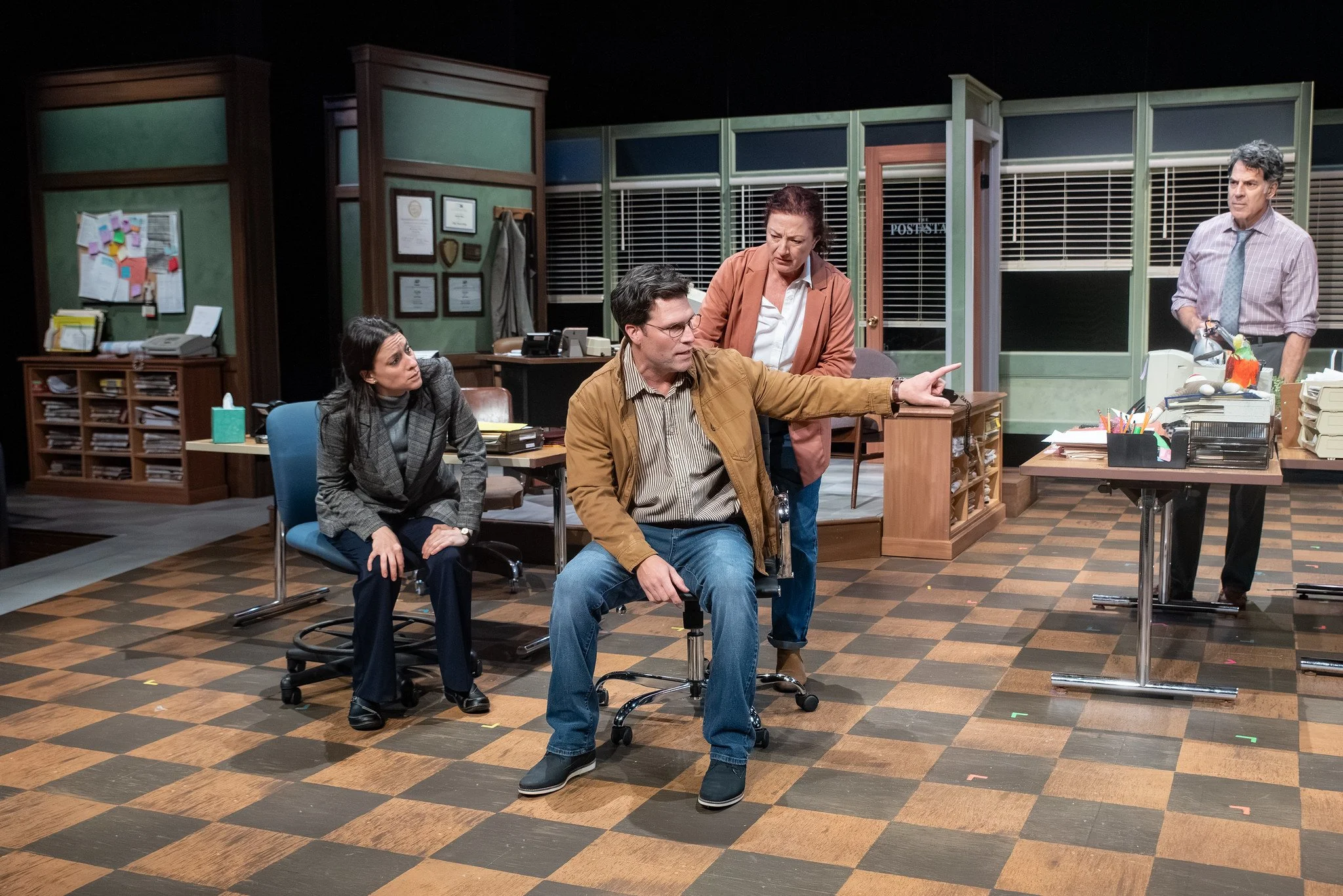
Photos by Kevin Montano, Proctors Collaborative
“If two of the greatest theatre writers to ever live had difficulty with a structure of decades-spanning vignettes, god help the rest of us.”
Albany’s Capital Repertory Theatre kicked off the 2026–27 season with the world premiere of Ken Tingley’s The Last American Newspaper.
Adapted from his own memoir of the same title, The Last American Newspaper follows Tingley over the course of the 20 years in his tenure as the former editor of the Glens Falls Post-Star, navigating small-town politics, publishing nightmares, and the ever-changing landscape of print journalism (with some major wins along the way) as he and his ever-dwindling staff cover local and national news stories.
Miriam Weisfeld, now in her second season as Artistic Director of Capital Rep, commissioned the play along with her associate directors at the Adirondack Theatre Festival, and it was Weisfeld who personally mentored Tingley in playwriting throughout the show’s development, which included readings in Albany and New York City as well as sold-out performances at the Adirondack Theatre Festival. Despite the years of development and the apparent enthusiasm for the production on the part of its cast of seven skilled and energetic actors, however, no amount of onstage fervor could save the script from its own weak architecture and heavy-handed moralizing and back-patting at the expense of the characters’ emotional development and a true, large-form narrative arc.
The majority of the script’s troubles could be fixed by simply condensing the amount of historical time the show covers. In an attempt to detail two decades of happenings in roughly 10 scenes over an hour and 45 minutes, The Last American Newspaper sacrifices emotional stakes for historical ones. The first act focuses on several important news stories and political issues: the 1999 Columbine High School massacre, a 2009 railroad car leak in Ft. Edward, NY, and a series of stories about LGBTQ+ youth in upstate NY (with a seemingly-obligatory mention of Matthew Shepard). While the characters fight for the right to publish stories about these then- (and unfortunately still-) controversial topics, the stories themselves and their relevance to contemporary life were trivialized by the vignette-like structure of the show.
Each news story was restricted to its own scene without much attempt to create an overarching narrative except asserting, with a kind of self-congratulation, the importance of journalists, as Tingley’s character does many times in the first act. This is not to say that the assertion is incorrect. But in a medium where the rule is “show, don’t tell,” being repeatedly spoonfed the thesis of the production comes to feel insulting after a while. Furthermore, that no one scene could be much longer than 10 or 15 minutes (presumably in an attempt to fit in all the news items) left little possibility for the characters to form meaningful relationships with each other, meaning the actors had little room to “play,” emotionally speaking. Fewer plot points would have allowed breathing room, both figuratively and literally, as the show repeatedly eschewed silence (where tension lives) in favor of words.
During intermission I overheard an audience member, a journalist himself, say, “Everyone else here is going to see a different play, but it’s really going to hit home to those who know.” While the man was lauding the production’s verisimilitude, he inadvertently exposed another underlying issue: the script’s conflation of plot-driven drama with character-driven drama. The former relies on the audience having an emotional connection with the backdrop of the play. If I’m a journalist, I will probably relate to the day-to-day struggles of the newsroom. Equally true: if I’m Gen X or older, I will have already formed a reaction to Columbine and the like because I was there; I’ll have a personal connection to it. It is, in some sense, an easy way to ensure engagement. The latter, however, requires the script to build, sustain, and resolve tension between characters, about which any audience member can become invested in because people (for the most part) possess and employ empathy as a means of understanding and interacting with others, even fictional characters. The former is a news article, the latter is a play. And the latter is a difficult thing to accomplish.
On my ride home, I thought about Sondheim and Furth’s Merrily We Roll Along, infamously, a Broadway flop, the plot of which also spans 20 years. If two of the greatest theatre writers to ever live had difficulty with a structure of decades-spanning vignettes, god help the rest of us.
There were moments of brilliance, however. Two scenes — one at the end of each act — made me believe in Tingley as a playwright. In both, Tingley (the character) and his team are fighting editorial overreach by their publishers. As the publishers, motivated by profits, insisted that the paper publish happier stories and fewer controversial, “liberal” stories, the newsroom pushed back, asserting not only their moral high ground but the idea that the community needs a mirror held up to itself for the good of its people. These moments featured personal stakes for the characters, not the paper or the profession. And in genuine displays of “show, don’t tell,” the real-life Tingley allowed the audience to themselves extrapolate and superimpose those stakes (which were impeccably fleshed out; I believed every word in those scenes) onto real-life contemporary fights between the press and Republican-controlled governments at all levels.
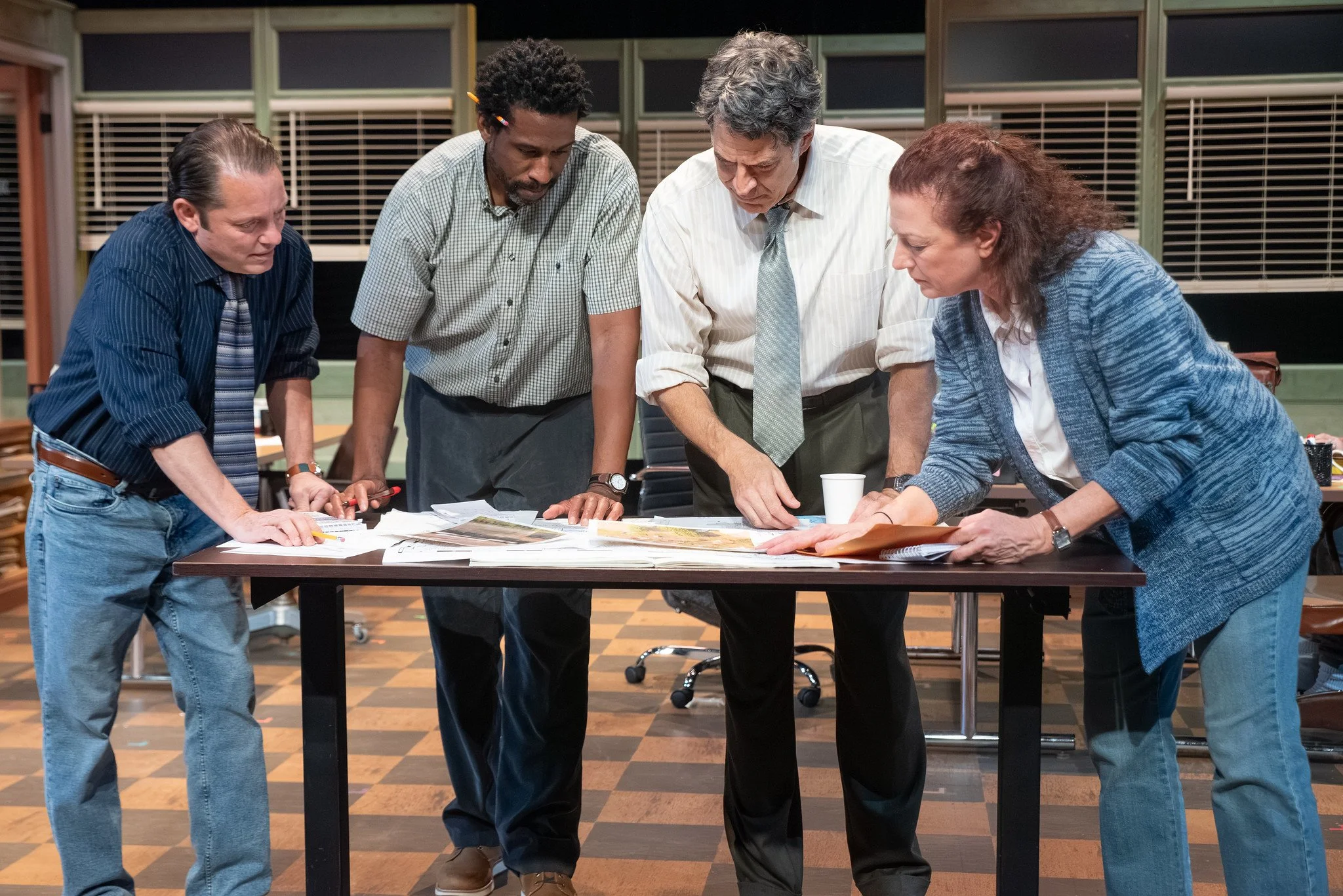
At the same time, the audience watched the actors at their best as their characters fought for higher ideals, now with something to really play in these scenes. A big shout out to William Oliver Watkins as Will Doolittle as he wrestled with keeping his job at the risk of losing personal integrity. Another round of applause goes to David Girard as Deplorable Guy, a man who angrily (perhaps drunkenly) pays a visit to the news room to curse out Doolittle and the City Editor (played by Lise Bruneau). Here, Tingley as playwright perfectly balanced depicting Deplorable Guy as both a laughworthy nutjob (he later flings a newsprint-wrapped pile of feces into the office) and a real citizen of upstate New York with opinions and feelings he believes are valid just like the rest of us.
Late in the second act, a callback to Columbine was a welcome bookend and gave Christopher Innvar (as Tingley) a moment of self-reflection, rendered with captivating pathos. These moments of emotional truth, enjoyable as they were, were noticeably incongruous with the rest of the script. Not that they should have been flattened. Instead, I wish the other scenes had been elevated to their level. Still, they were clear evidence that Tingley is a gifted writer of multiple forms.
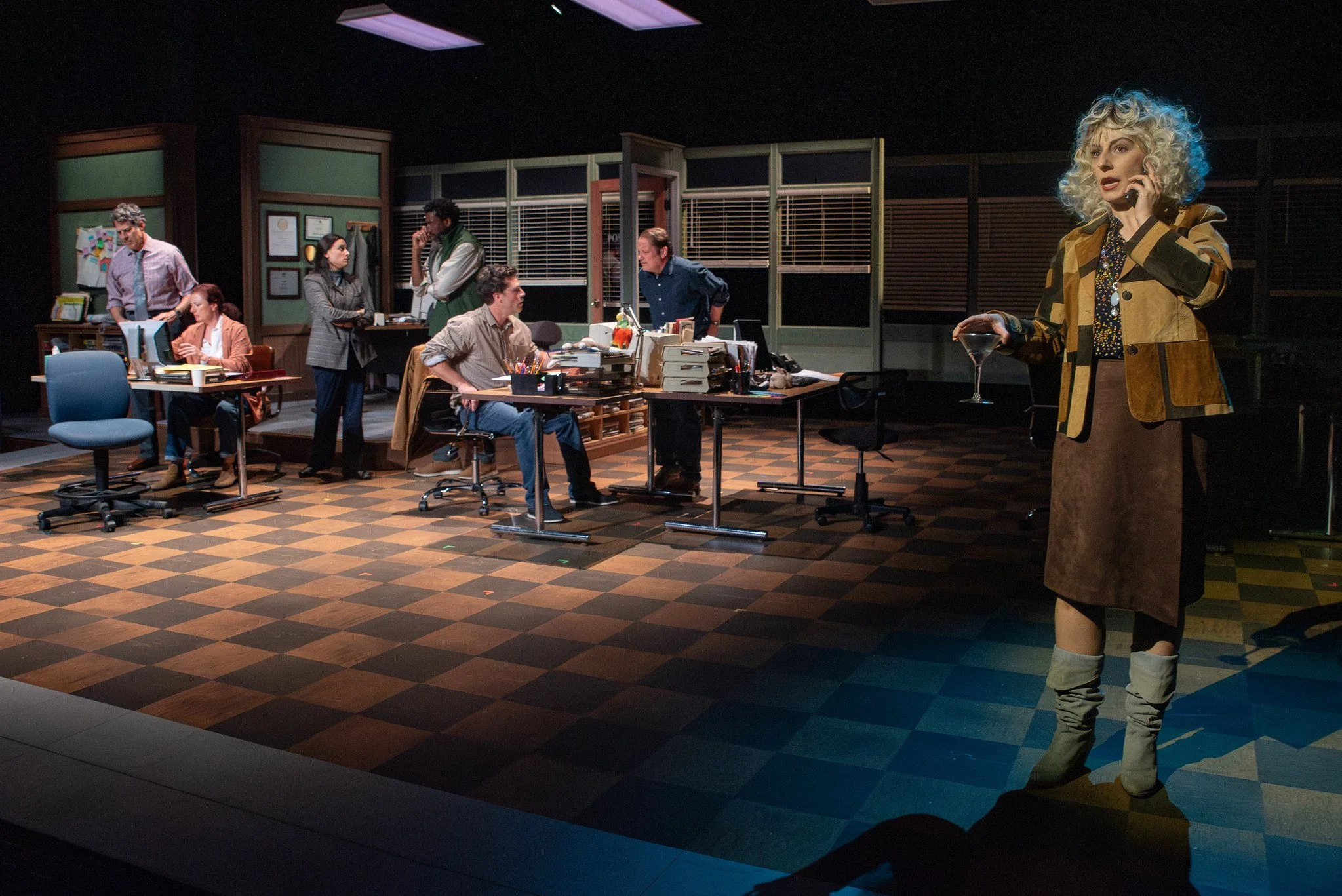
I also appreciated Brian Prather’s scenic design, which, while a realistic depiction of a drab office setting cluttered with papers and now-outdated technology, made interesting use of color through brightly-hued sticky notes and marker strokes on corkboards and newspages scattered about the stage, highlighting the fact that despite any personal or political turmoil, the news stories are the most important things to these characters. Evdoxia Ragkou’s off-kilter sound design was also a delight, primarily heard as chaotic interstitial soundscapes between scenes featuring era-appropriate pop songs mashed up with sound bites from television news, phones ringing off the hook, and reporters murmuring anxiously.
Given my criticisms, I feel a responsibility to clarify that any issues I take with the script of The Last American Newspaper, do not reflect a belief that Tingley is incapable of adapting his writing style to the needs of the Theatre. My two favorite scenes, described above, are proof that inside of discrete moments he is an adroit craftsman, tuned in to people’s emotional realities. Thus, as this was Tingley’s first foray into theatrical structure, any responsibility for the script’s failings falls on the shoulders of those who shepherded the work throughout its development. Basic (and time-tested) playwriting conventions were ignored, to the detriment of not only the script but of the actors and director, who were handed a challenge, and not in a good way. It is unfortunate that a play this promising, given current national discussions of life on the edge of fascism, was not given the proper tools to succeed, leaving the themes contained therein cheapened and diminished. Still, for its commanding performances and timely message, The Last American Newspaper is a fitting opening for Capital Rep’s latest theatrical season.
“The Last American Newspaper” runs through October 18 at Capital Repertory Theatre in Albany, NY. For tickets and more information, visit: https://secure.proctorscollaborative.org/overview/the-last-american-newspaper-2026.