
10/15-18 @ Swyer Theatre, The Egg, Albany
Photos by Elissa Ebersold
“Above all, ‘Burnout Paradise’ is the antidote to a form of artistic expression motivated by an economy that relies on people’s vulnerability to perpetuate itself.”
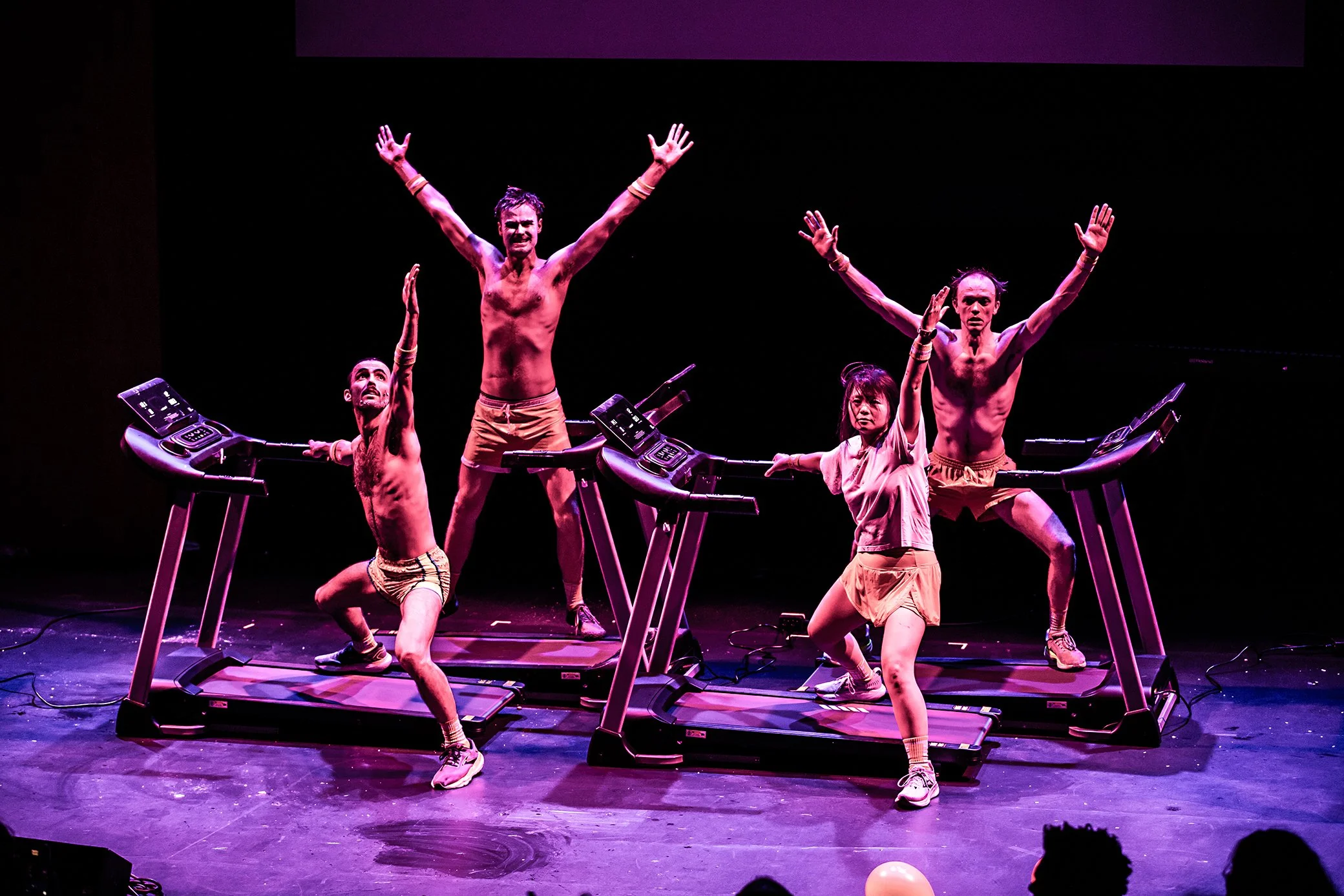
Earlier this month, Australian performance group Pony Cam Collective presented their one-hour, five-performer, four-treadmill production, “Burnout Paradise,” for four nights in the Swyer Theatre at Albany’s The Egg Performing Arts Center. Part performance art, part distance running, and part domestic life speed-run with “Price Is Right” levels of audience excitement, “Burnout Paradise” holds a mirror up to the world, critiquing the ways capitalism affects every part of daily life, on macro and micro scales.
I admit that I was drawn to the production in part by its marketing, which is to say that in a sea of social media advertisements, Pony Cam managed to do the impossible: use Instagram to get me out of my house on a weeknight. Both my partner and I thoroughly enjoyed ourselves, commenting on the ride home that it was one of the most entertaining and unusual theatrical experiences we’ve had in a long while, but in the week or so since our night out, what was at first a feeling of pleasure for having experienced the show has been supplanted by a rising feeling of astonishment.
Pony Cam’s performances have fortuitously coincided with the publication of an essay by Aria Dean in Artforum titled “Experience Machine,” in which the author describes a bi-coastal emergent genre of theatrical production she names “New Art theatre” (NAT from here on out for brevity). Attending NAT productions, Dean explains, feels “more akin to being ‘at’ something than ‘seeing’ something.” She posits that this feeling stems from the current state of marketing and larger economic structures that have replaced traditional goods and services with personalized social experiences.
Such experiences she likens to the algorithmically tailored social media feeds that have come to shape almost every aspect of our lives. Dean further defines the NAT experience as one that takes as its subject the very fact that an audience is present, thus replacing the primacy of traditional Theatre’s “contemplation and reflection” with not simply the relationship between audience and performer, but the fact that an artificial social situation, or “social space,” has been established in the first place.
If I understand Dean correctly, then one can boil down the numerous cogent arguments in her essay to the following: NAT’s raison d'être is merely to have an audience present without reflecting or commenting on that notion or any other content therein. Or, if we’re calling a spade a spade, NAT has little to no substance beyond its own existence. “Burnout Paradise” on the other hand, while certainly constructing a social space — you could even call it a “social experiment” because while I hate that expression, the show might appear that way to those who haven’t seen it based on its marketing alone — the show is antithetical to NAT in almost every way, with clearly communicated layers of commentary on domestic and public life on scales both household and global.
It is for this reason and the flurry of online chatter about Dean’s article that I feel compelled to offer a larger analysis of the production beyond a traditional review in hopes that, should you have the chance, you will seek out more theatre like “Burnout Paradise” and understand when someone is trying to sell you the opposite.
***
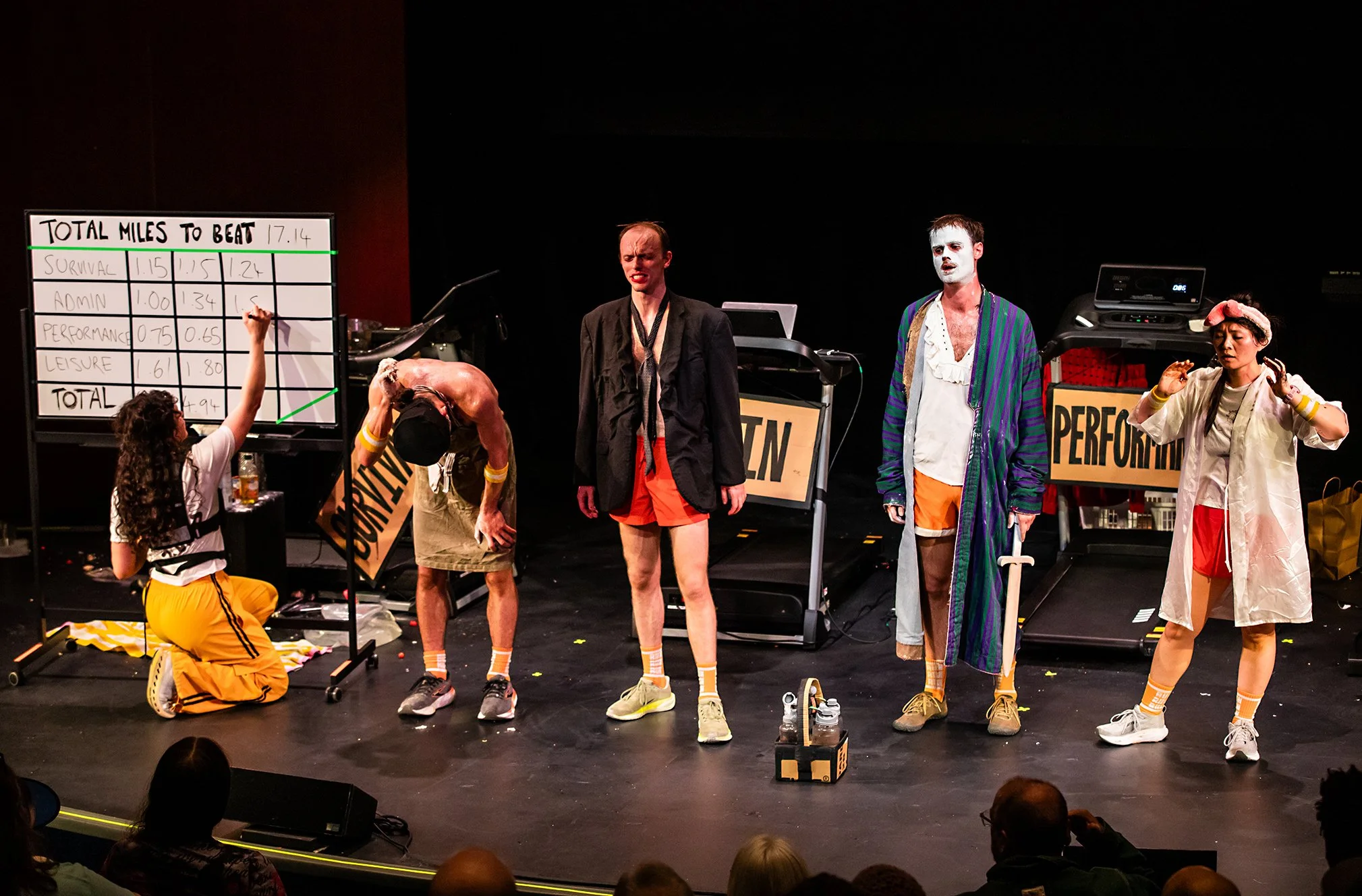
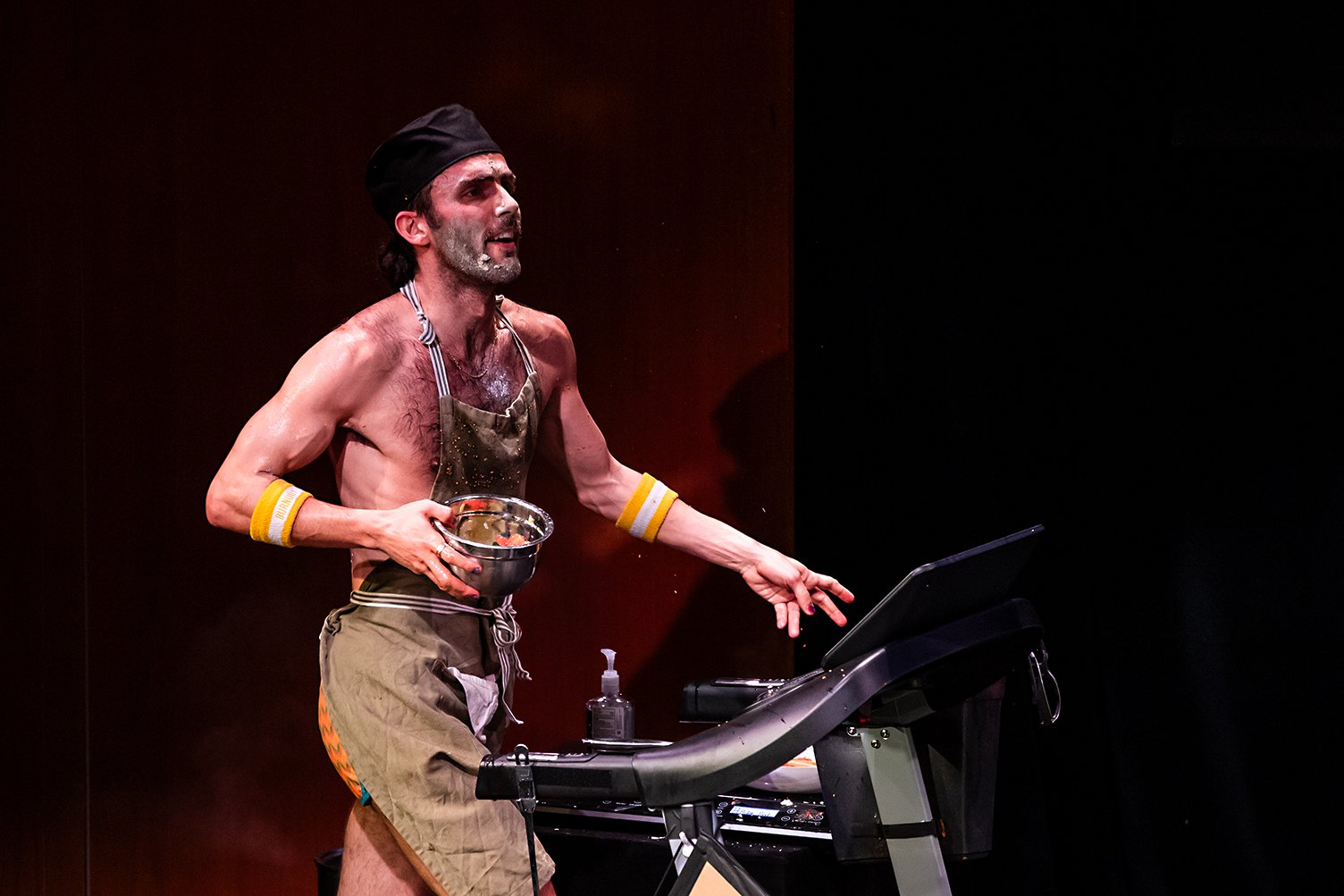
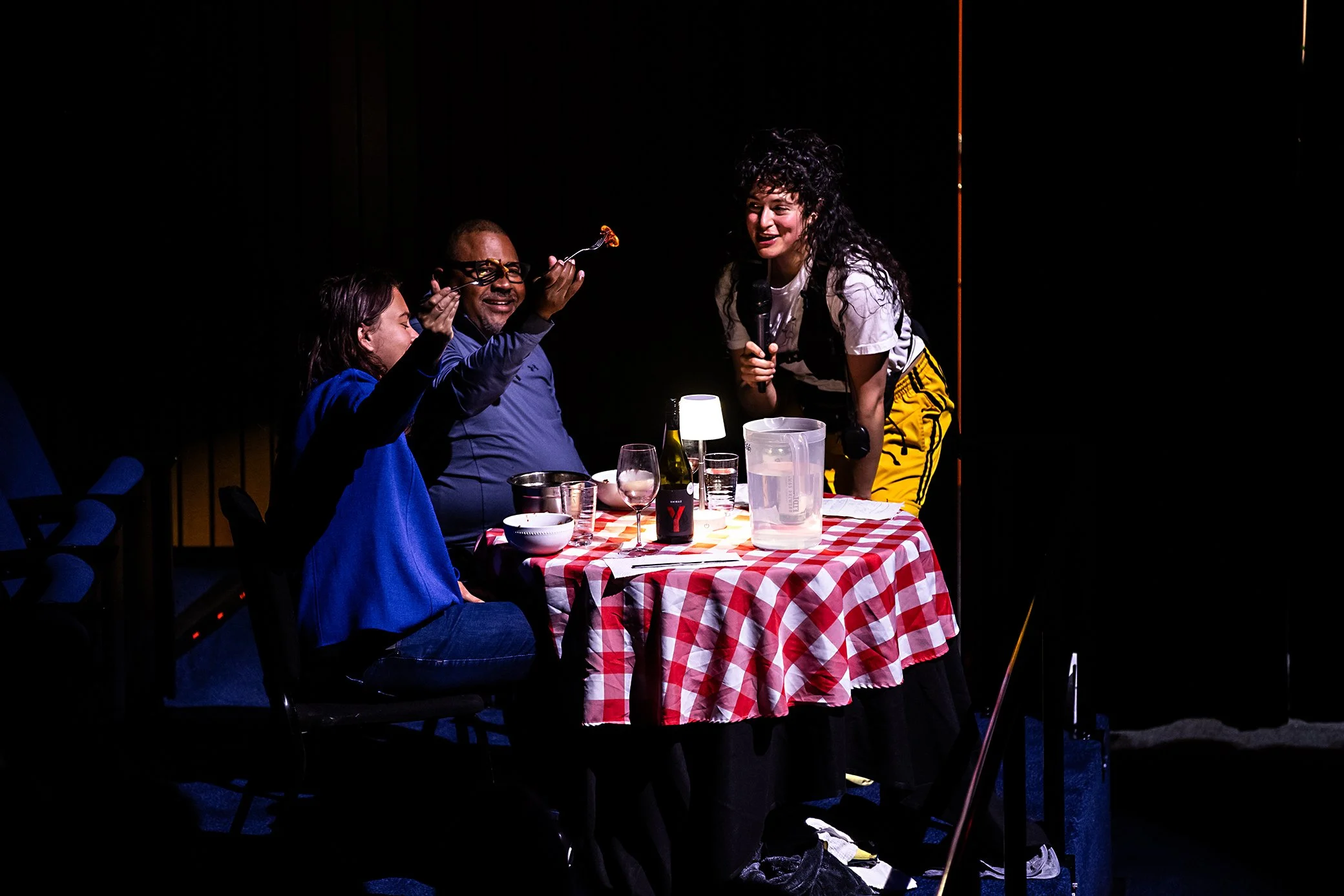
First, the set-up: Four performers/runners and one emcee are warming up and chatting with the audience as they file in. The stage is largely taken up by four identical treadmills with large cardboard signs on them that read, left-to-right: “SURVIVAL,” “ADMIN,” “PERFORMANCE,” and “LEISURE.” Upon the start of the performance (although in some sense the performance began as soon as the doors opened to the public), the emcee (Ava Campbell), along with the others (also left-to-right on the treadmills: Hugo Williams, Chan Lin, Dominic Weintraub, and William Strom), took turns addressing the audience, introducing themselves and laying bare the premise of the production: “Burnout Paradise is a series of four tasks,” all of which are to be completed while the four performers/runner jog continuously during four consecutive rounds of 12 minutes, changing stations each round. SURVIVAL: Cook and serve a three-course meal to a pair of audience members selected to sit at a special dinner table. ADMIN: Complete and submit an entire arts grant application. PERFORMANCE: Each performer is to enact their own mini performance art piece. LEISURE: Complete a double-sided whiteboard’s worth of “day-off” tasks. On top of those four, a fifth: beat their as-of-that-show personal distance record (17.14 miles collectively the night I saw it). The consequence of failing? Everyone in the audience gets their tickets refunded.
Once the emcee (Ava Campbell) kicked off the first round, the performers began asking for assistance from the audience. Williams asked for a sous-chef who then catered to every whim of the rotating SURVIVAL performer for the entirety of the performance, pouring, stirring, flipping, serving, and running back and forth from their seat to the stage each time “Sous-chef!” was yelled. The rest of the audience loved this, maybe not-so-secretly thankful it wasn’t them. Simultaneously, Lin (ADMIN) called on the audience to take photographs and email them to Pony Cam’s Gmail account so she could upload them to the application while she herself began filling in some of the basic information about Pony Cam. Strom (LEISURE) asked for people to call out tasks from the whiteboard for him to complete, and soon people were called on stage to hold a wine glass while he poured himself some Shiraz. Other audience members were called on to hold a tiny hoop for him to sink a three-pointer from deep, among other deeply silly assignments. Weintraub (PERFORMANCE), while not directly calling for help, was certainly motivated by audience cheers as he somehow managed to change out of his shorts and underwear into a Speedo as part of a “devised piece” of micro-theatre about his childhood, never once revealing his genitalia. (If I’m being honest, that may have been the most impressive thing I saw all night). And as a reminder: all of this (and more) happened as everyone ran. So fast. Everyone was out of breath after they’d collectively run over four miles (their totals were tallied on a whiteboard after every round).


It’s difficult to describe the slow descent into chaos that happened over the next three rounds. I was soon unable to focus on the entirety of the action; it was just too much. Instead, as I think everyone else did, I had to choose how I was going to spend my time watching the proceedings. I was particularly taken with the LEISURE station with its tasks being relatively quick to complete. Someone shotgunned a beer. Someone else shaved the performer’s chest. Juggling, apple bobbing, gift wrapping. A RAVE. There was even time enough for a round of bingo (in which I partook, consuming my attention for several minutes).
My heart was also with the couple (not an actual couple; they were each ripped from the partners they’d come to see the show with) at the cozy dinner table. They were having their own experience, and I really hoped they were having a good time; at least they got food and wine. Actually, anyone could have had anything at any time. The emcee was not only passing around cups of Glacier Freeze Gatorade to the audience, but she made it very clear at the top of the show that anyone, for any reason, could come on stage and get themselves involved with the performance. What was stopping a third person from joining the couple?
I tried following ADMIN, but at times it was too tedious (filling out grant applications under normal circumstances is tedious), although at one point I emailed my CV to Pony Cam for them to upload to the online form.
As the evening went on and the performers grew more exhausted, more and more help from the audience was needed, and more and more attention was needed to keep track of it all. Yet, with everything going on, I was never uncomfortable. Nothing ever felt out of control, not even when the paper shredder Pony Cam brought earlier that day just wouldn’t shred. Not even when every PERFORMANCE tripped because they were running backwards most of the time. Not even when SURVIVAL blew a fuse trying to power a treadmill and an induction burner on the same circuit, a testament to the ensemble and stage management. It was an exploration of the unrelenting seesawing between tragedy and triumph that modern life delivers condensed into just under an hour.
The fourth round ended. Campbell congratulated both the runners and the audience on a job well done. There was a communal sense of accomplishment and pride, and part of me, as ridiculous as it is, felt like I did something to help bring the project across the finish line. I couldn’t put my finger on it then, but as I’ve analyzed my experience in the week that followed, I come to understand that this feeling is undeniably a critical element of the performance’s architecture. Meanwhile, the runners were slowly rolling their treadmills into a familiar configuration. Campbell took the big whiteboard into the hall outside the theatre, the lights dimmed, and I prayed to god that what was about to happen was what I thought was going to happen.
“It could be ten, but then again, I can't remember half an hour since a quarter to four.”
Fuck yeah.
They did the whole routine from OK Go’s famous “Here It Goes Again” video, and it was sublime. A cherry on top of the cherry on top of the theatrical sundae.
***
Some obvious metaphors and themes emerged from the start and were continuously and increasingly farcically elaborated as the evening and its pandemonium drew on. That the performers attempt the near-impossible in order to earn their ticket sales is almost begging for a Marxian analysis. (I like even more the idea that they have to push themselves to exhaustion to keep what’s already theirs.) That the ADMIN work was an application for an arts grant — the application for which seems to change every show; the night I saw the show, it was an emergency fund, which matched the 9-1-1-ness of how frantic the action onstage was — speaks to current funding shortages and the hoops through which arts nonprofits must jump to obtain even a modest amount of funding. And, most relevant to Dean’s essay, that LEISURE required an incongruous amount of work (not to mention constant help from audience members) calls into question the very idea of leisure in a post-post-industrial economy where all activity is subject to data collection and monetized for advertisers — in other words, where leisure is actually unpaid labor. And in case the hammer hadn’t quite yet hit the capitalistic nail on the head, the emcee was hawking merch during the performance, with a big display of t-shirts, socks, and tote bags set up behind the stage-left whiteboard. (I tried real hard to replace the “hammer and nail” of that last sentence with “hammer and sickle” for rhetorical effect, but I just couldn’t make it work.)
These motifs were not difficult to decipher. The ensemble wants you to get it. The title of the show sets up the expectation that there will be commentary about working yourself to death. What drives this point home is the show’s treatment of its characters. Whereas Dean points out that NAT might not give much attention to its characters’ inner lives, “Burnout Paradise” does the opposite, an effect made greater by the fact that the performers exist onstage in a superpositional state of themselves and not-themselves. To take an idea from performance theorist Richard Schechner, the performers are both a character and an artificial situation in the theatrical world of “Burnout Paradise”, but also — because they are not merely pretending to do everything they’re doing on stage but are actually jogging, actually cooking, etc. — are very much also existing as themselves in Dean’s “social space,” even interacting with other non-characters, the audience (Schechner called this duality “not me” and “not not me.”)
And there is no attempt made by Pony Cam to hide the fact that the performers are genuinely exhausted, and how could there be? The collective’s website states, “Each of our shows looks different, but the intention remains the same: we experiment generously and risk our real selves in order to connect with audiences.” What the audience experiences, then, is veridical human struggle more akin to watching the Olympics than Marco Ramirez’s “The Royale.” Though both feature athletic bodies performing athletic feats, the stakes for the latter are only stakes for the characters the actors embody, not the actual performers as in the case of the former. NAT, by definition, does not inherently hinge on critical examination of human nature, thereby lowering the limit on how much its audience can truly engage with the performance and how much, according to traditional definitions, it can truly call itself Theatre. “Burnout Paradise,” on the other hand, extends theatre beyond its established limits (although not in any way that much of performance art has already done) through its concern with interpersonal connection.
It must be pointed out, however, that while both NAT and “Burnout Paradise” achieve vastly different results, they both share a disregard for being “good theatre.” The caveat here is that the reasons for the eschewals are poles apart. NAT, according to Dean, purports to present an “unmediated” experience, creating no distance between onstage action and audience. In theory, this would allow the audience to experience, without some sort of lens through which to view the production (as opposed to, say, the camera of Film), the whole of the thing. What Dean points out, however, is that because of NAT’s equal disregard for its audience and true affinity for faux community, it presents, paradoxically, a “hyper-mediated” experience not unlike the aforementioned algorithmically derived viewing experiences of social media timelines. (On a recent episode of “Good Hang with Amy Poehler,” writer/performer Kate Berlant perfectly described this phenomenon as a loss of “intimacy with yourself.”) At the end of the evening, NAT’s success hinges only on having presented something that the audience merely experienced.
“Burnout Paradise”’s success in distancing itself from value judgments (i.e., “good v. bad art”) comes not from a conscious rejection of subjective valuation. Rather, because the content of the piece is derived in large part from the necessity of audience participation and the fluctuating strength of that participation (both night to night and moment to moment), Pony Cam has, in some sense, created an art-object impervious to value-based critique. The structure of the performance remains constant, but its content, and therefore its message, is largely determined by the audience, and ultimately, that becomes the message. That sense of accomplishment I felt after the fourth round was the vehicle for this message.
I felt accomplishment, but the specific feeling may mutate into something else on another night, changing one’s understanding of the performance, and it might be different for each person (the diners especially). This is what “Burnout Paradise” did so well. So, sure, one could say whether or not they enjoyed the show, but that doesn’t answer the question of its “goodness” because that is simply the wrong question to ask. It is impossible, however, to say the show is not successful because its success, antithetically to NAT, is predicated only on the idea that something was communicated.
One can read Dean’s piece and parse out her definitions and analyses (and I highly suggest that you do), but to me NAT brings to mind Supreme Court Justice Potter’s infamous “I know it when I see it.” And I think we’ve all seen it, particularly in social media depictions. Entire museums set up with flashy interactive exhibits, haunted house-style attractions where participants move through various rooms of mundane real-life scenarios, and that immersive Van Gogh nonsense your mom just had to see on her birthday (“Honey, please, it’ll be fun!”). Each of these examples, existing at various points on the spectrum of theatre, relies in their own ways on the audience to commodify the experience (e.g., posting it on socials); they thereby commodify the audience itself in order to ensure the productions’ successes.
But “Burnout Paradise” does not earnestly ask anything of the audience in the way of unknowing self-commodification. Rather, it does so always with a wink. Someone in row F is emailing a budget proposal for a grant application that will surely not be taken seriously by the committee (even if you want it to be so, you are rooting for this show, after all). The couple at the dinner table are saying the pasta is yummy, putting their health at risk by eating tomatoes hand-squeezed by a sweat-drenched performer (a positive review would mean so much, even if they’re squirming). Myself, running from the back row with under 60 seconds left in the first round to put lipstick on Strom in the name of “LEISURE” (quoth Beyoncé, “Pretty Hurts”).
“Burnout Paradise” sets up what is apparently impossible, doing all these tasks in a short amount of time while running, and then either does or does not achieve the goal based on, pretty much, how much assistance the audience is willing to offer (read: how much the audience is willing to self-commodify). Pony Cam, with the lightest of directorial hands, lets each situation unfold spontaneously with the express purpose of commenting on its unfolding and its methodology for doing so, encouraging the audience to reflect. Their website says “We want audiences to playfully embrace their own autonomy and imagine communal solutions to impossible problems,” a stark contrast to NAT, which only goes so far as to set up a theatrical situation without interrogating either the construct of the materials framed therein.
Though both NAT and “Burnout Paradise” make use of the people who come to see them, the two have fundamentally antithetical relationships to their audiences. The former is reliant on and tries to exploit, but is ultimately indifferent to, its audiences in terms of content; nothing about the meaning of the productions themselves changes. Furthermore, despite this undercurrent of exploitation, Dean describes a phenomenon where the “perceiving theater audience” is never addressed as such. In this way, NAT’s “theatricality” is a hollow one.
Conversely, something fundamental about the latter does change based on the composition of the audience: its message vis-à-vis Capitalism. What might be considered a poorly attended performance of NAT (or a traditional theatre production, for that matter) is instead an understaffed performance of “Burnout Paradise.” Swyer Theatre was at least half-full for the opening night of the run at The Egg, and the performers barely eked out a win and beat their PR: 18.13 miles! To me that spoke to the power of collective action (socialism, communism, whatever you want to believe in). I can only imagine what takeaways a quarter-full audience might have, the difficulty of achievement having an inverse relationship to audience size: “If we had worked together better, they might have done it,” “I wish they had promoted this show better,” or “Man, they really sucked.”
All this to say, “Burnout Paradise” engenders a meta-commentary through an hour-long exchange of services, placing the traditional goods and services economic structure within the theatrical frame of the “Experience Economy.” Each transaction between the performers and the audience recontextualizes the performance in a way that NAT’s structure cannot, giving “Burnout Paradise” both materiality and weight that NAT could never have. In the end, the show’s assets may promote its longevity into a future when Meta, TikTok, and whatever fresh social media hellscape the next M*rk Z*ckerberg has up their sleeve have all gone dark. (Fingers crossed.)
***
I left “Burnout Paradise” feeling oddly fulfilled. Not in the sense that I got my regular dose of art and now I can go a few days before seeing something else. Rather, it was two-fold. Part of it, sure, was that I’d experienced something truly awe-inspiring. Again, in the same way we watch Olympic athletes push themselves purely for the sake of their sport (or maybe some of us watched David Blaine in that block of ice or just had to take the train down to MoMA to see Marina Abramović sit at that table for just a slice of those 700 hours), I experienced a vicarious victory as I watched five members of the same species as me do something I could never dream of.
The strength of Pony Cam’s performers comes in the form of constructing a relationship in what is otherwise an artificial “social space” that equalizes everyone inside of it. “We are just like you,” the show says as forms are filed, meals are made, and basketballs are banked in. I hesitate to say the performance was inspirational. I’m not suddenly going to buy a pair of Alphaflys and start training for hours a day. (My partner Morgan, a distance runner herself, however, really wished she’d gotten the call to take over for one of the performers, even for just a few minutes, and she said on the ride home that she’s got to make more time after work to hit the pavement.)
But there was some psychic transference of stamina; I thought about the two whiteboards in my apartment right now, both filled with lists of grant applications and calls for scores I should really get a jump on, and how if I just put my nose to the grindstone, I could probably knock out a good chunk of them on my days off.
The other part of it was that we do come to the theatre for magic. Maybe it’s just me, but if Theatre doesn’t get us thinking about our own humanity in some way, what’s the point? Why gather us all and hold us in one space together if not to promote reflection about our shared condition? The development of a theatrical experience cannot merely be an aesthetic exploration; the house will not stand. Dean closes her piece with the question, “…what happens once art and experience (or better: ‘life’) appear to have finally completed the merger, as many artists before us hoped for[?]” The author uses the word “gross” to describe how NAT executes this merger. The same cannot be said of Pony Cam’s execution.
In fact, quite the opposite. “Burnout Paradise” is cleansing. It absolves everyone involved of their insecurities, their anxieties, their fears about keeping their heads above water in seas of difficult times. It asserts that community in all its forms is the only answer to capitalism’s oppression and assuages feelings of isolation that social media, contrary to its original purpose, often generates. Above all, “Burnout Paradise” is the antidote to a form of artistic expression motivated by an economy that relies on people’s vulnerability to perpetuate itself.
I give the heartiest and most sincere applause to Pony Cam for their success in finding the solution to a supposedly impossible problem. I hope it radiates outward, inspiring more theatre artists to do the same.
For more information about “Burnout Paradise” and Pony Cam Collective, visit https://burnoutparadise.com/ and https://ponycam.co/.
To read Aria Dean’s “Experience Machine,” click here.