REVIEW: The Albany Book Festival is a Reader’s Paradise
09/26 @ University at Albany, Albany
Photos provided by New York State Writers Institute
“Readers come looking for their next favorite book. Writers come hoping to find their next reader.”
So many books, so little time.
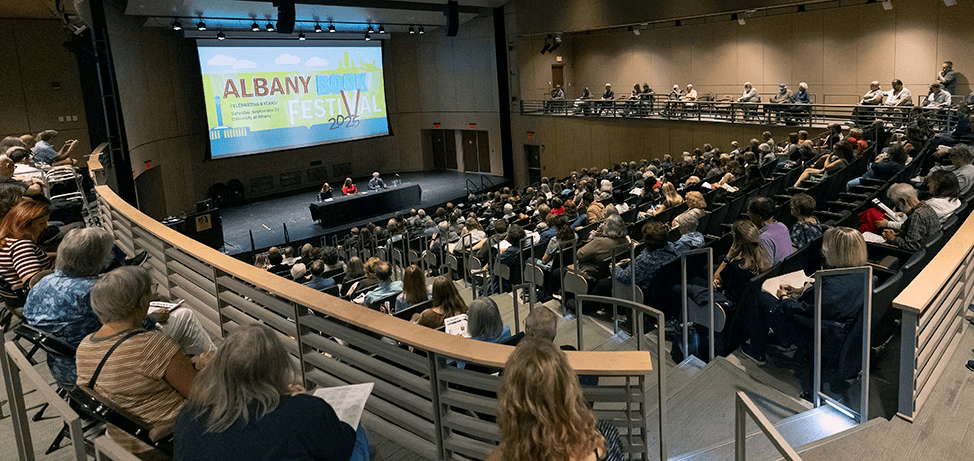
That was the problem at the heart of the Albany Book Festival, where the University at Albany transformed into a book lover’s playground filled with authors, readers, and enough temptation to seriously test anyone’s self control. The ninth annual festival, presented by the New York State Writers Institute and UAlbany, brought thousands of readers together on September 26 for a day built around the simple but powerful joy of discovering a great book and the person who wrote it. Despite a steady downpour, readers turned out in force for conversations, panel discussions, book signings, children’s programming, open mic readings and a bustling marketplace of local writers and publishers.
Since its first edition in 2018, the Albany Book Festival has grown into a fall tradition for readers across the Capital Region and beyond. Paul Grondahl, director of the New York State Writers Institute, described the festival as a gathering built around “a shared love of books and ideas,” and that spirit was hard to miss as readers moved throughout the Uptown Campus in search of their next great read.
The 2026 lineup offered plenty to chase.
Elizabeth Kolbert discussed her book Life on a Little Known Planet, while Namwali Serpell explored the work of former UAlbany professor Toni Morrison through On Morrison. Carol Gilligan and Gish Jen brought their perspectives to a conversation about Bad Girls, while Keith McNally and Kelly McMasters discussed their memoir. Thriller fans had John Katzenbach and Canwen Xu, while Amir Ahmadi Arian, Arash Azizi and Porochista Khakpour gathered for a conversation about Iranian identity and the Iranian American experience.
That variety was where the festival really earned its keep.
You could spend the morning listening to a celebrated novelist talk about family, wander into another room for a conversation about history, and then find yourself browsing the work of a Capital Region author you had never encountered before.
It felt less like attending one literary event and more like spending an entire day wandering through a giant bookstore where every aisle had something different to offer.
And then there was the local literary community.
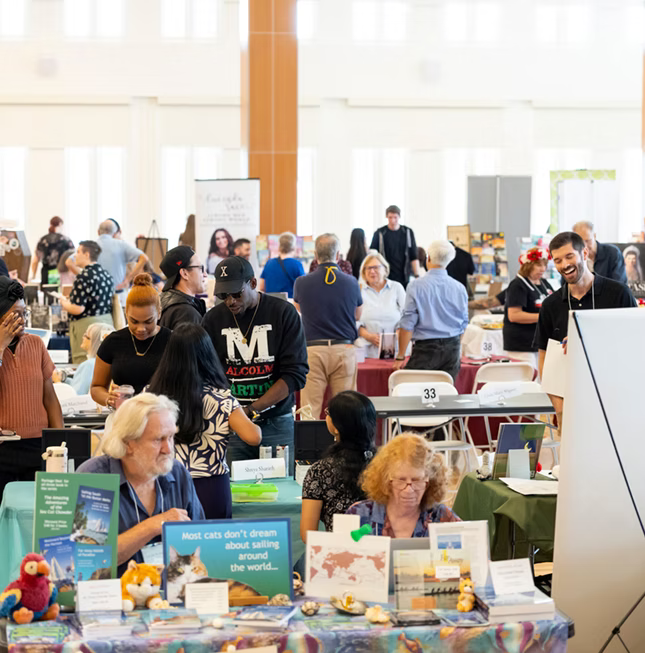
More than 60 local authors, along with publishers and literary organizations, filled the Campus Center Ballroom and Great Hall. The local author marketplace gave writers from the region a chance to put their books directly in front of readers, while publishers and literary organizations helped showcase the larger ecosystem behind the books that eventually land on shelves.
That part of the festival mattered because getting a book published can feel like the finish line when, in reality, it is often the beginning of another journey. Authors met readers. Readers discovered writers. Publishers introduced new voices. Conversations continued after panels ended, often with a book in hand and a signature on the title page.
The festival also made room for younger readers, with children’s activities and open mic opportunities helping make the event feel like something bigger than a gathering for serious literary adults. Online workshops expanded that mission as well, including programming aimed at aspiring picture book authors interested in learning more about the publishing process.
A sense of possibility was everywhere. Human connection was central to the festival’s identity. As Grondahl put it, the goal was to create a connection among the people who “write, publish, sell, and read books.” That connection was especially meaningful on a day when the weather could have easily kept people home.
Instead, readers showed up. They carried stacks of books. But mostly, they carried curiosity.
For one day, UAlbany became a place where curiosity was the main event. The Albany Book Festival reminded everyone that even in an increasingly digital world, there was still something wonderfully satisfying about sitting across from an author, hearing a story in their own voice, and walking away with something new to read.
There were plenty of books, but never enough time. And that was exactly the point of such a generous festival.