11/13-22, Saratoga Arts, Saratoga Springs
Photos provided by iTheatre Saratoga
“It feels very important, like I have to do this.”
The one-act, 90-minute play I SAW HITLER may be the most meaningful work that Mary Jane Hansen has ever adapted. During our interview, Hansen’s voice breaks in emotion as she reads an excerpt of writing from journalist Dorothy Thompson, whose work takes the stage in iTheatre Saratoga’s world premiere of I SAW HITLER.
“It feels very important, like I have to do this,” reveals Hansen.
Based on the writings of Dorothy Thompson, I SAW HITLER examines the beginning of fascism taking root in Germany. Thompson, an American journalist, traveled to Berlin to report on the response of German citizens to their lost sovereignty and reactions to the Night of Long Knives, the Nazi purge of its own revolutionaries.
Almost instantly, she was issued an Order of Expulsion as punishment for an unflattering interview with the future Führer conducted three years prior. With just 24 hours before she would be forcibly removed from the country, this was unprecedented action against a foreign correspondent. The play tracks these uncertain hours as Thompson must fight for more time and the opportunity to conduct her interviews on behalf of the free press.
In I SAW HITLER, the title reflects what it means to recognize evil for what it is. An analyst of the Little Man prototype and unable to believe that citizens would hand over their freedom, Thompson observes— which Hansen meticulously recounts— “I was really put out of Germany for the crime of blasphemy. My offense was to think that Hitler is just an ordinary man, after all. That is a crime in the reigning cult in Germany, which says Mr. Hitler is a messiah sent of God to save the German people.”
Retrospectively, historians, scholars, and critics have regarded Thompson’s denunciation of Hitler as shortsighted. Thompson herself admitted that she did not think that Hitler would rise to power; she found few of his traits remarkable, besides his ability to tell lies to the German people.
“It does not necessarily follow that just because Hitler succeeded in creating the Third Reich dictatorship, Dorothy was a poor judge of his character,” explains Hansen. “Rather, she overestimated the German people in doubting their embrace of this most ‘gold-tongued of demagogues.’”
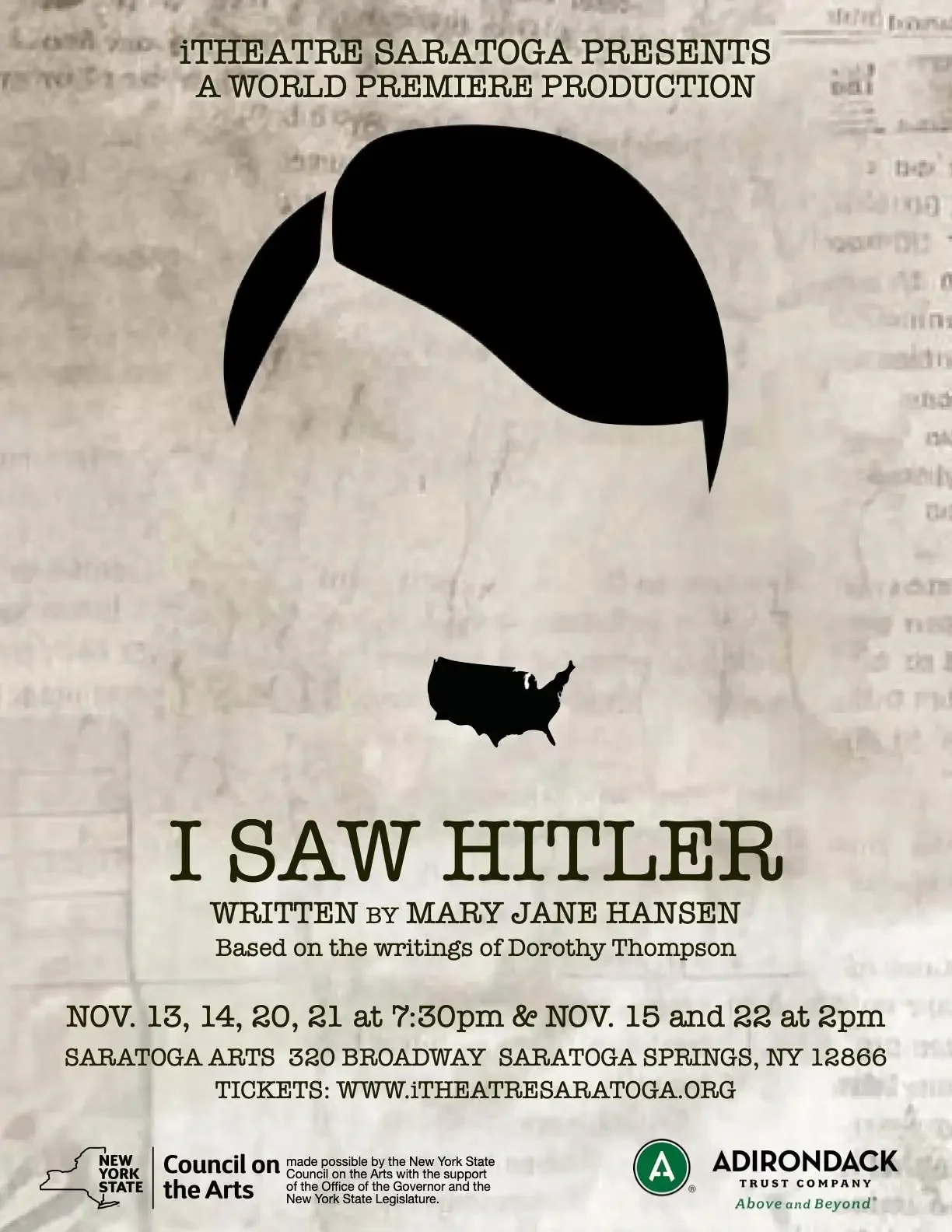
I SAW HITLER is a small production, with Hansen as Thompson and actor Sky Vogel as Raymond H. Geist, American Consul and First Secretary of the United States embassy in Berlin. The show also features a multimedia look at the interviews Thompson was conducting ahead of her expulsion, featuring some familiar faces in the regional theatre scene.
“We wanted to bring these interviews to life, and the way we did that is with projections,” says Hansen. “These interviews will be projected onto the stage.”
Hansen’s idea for the play story began while she was researching early radio broadcasts. Thompson was an early proponent of the medium, using her platform to espouse her ideas about the unfolding global political scenes.
“Dorothy saw how it could be used for evil and how it could be used for good, which she was trying to do,” she says. “She had a particular love for democracy.”
Hansen showcased an excerpt from the play at a benefit for the League of Professional Theatre Women in New York City at Theatre Row to great acclaim. Hansen is experienced with the world of theater, beginning her career at the New York State Theatre Institute, which hired her professionally right out of college.
When the Institute closed, the former members created the theater company that is now the current iteration of iTheatre Saratoga. “I’m one of those people who was lucky enough to have a clear vision of what I wanted to do,” she says. “[Theatre] is the only thing I wanted to do.”
I SAW HITLER covers just a few terse hours of Thompson’s life and is less a biography about Thompson herself than a reflection of the dangers of threatening the free press. Even after the war, Thompson continued to face censorship, this time from her industry peers, for her increasing support of Palestinians and growing criticism of Israel, which they called ‘professional suicide.’ Little has changed with the press under siege, and the overall relevance remains clear to Hansen, who weaves the threads from then to now in just a short 90 minutes.
Particularly, Hansen compares the attacks on the free press between the Trump administration and Hitler’s reign. “It’s short-sighted to say that you can’t compare the two, because there are certainly similarities,” she notes. “Perhaps there are still just enough roadblocks built into our government and ample voices of dissent—Americans not only in name and empty patriotism but in action and spirit— blocking the current administration from pursuing an agenda in the vein of the Nazi program.”
The crux of I SAW HITLER unfolds over just a few hours, but Hansen amplifies her modern message through the historical lens. At the end of the play, her urgent theme is picked up once more, when Geist encourages Thompson that it is essential they— and, metatextually, the actors and audience members— must “keep the pressure on” for democracy, justice, and speaking truth to power.
Performances are November 13, 14, 20, and 21 at 7:30 p.m. and November 15 and 22 at 2 p.m. at Saratoga Arts. Tickets are available at: https://itheatresaratoga.ticketspice.com/i-saw-hitler.