
INTERVIEW: Unsaid: An Exercise in Processing Grief
January 23-25 2026 @ Saratoga Film Showcase
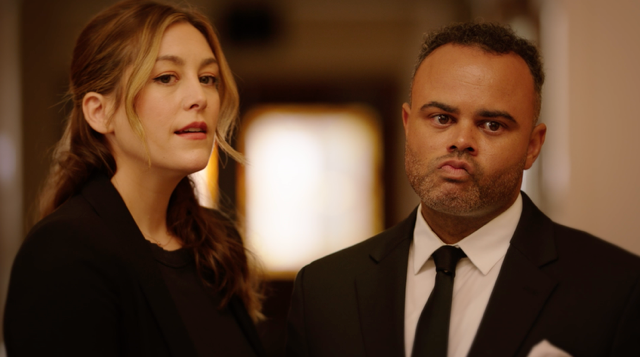
“I’ve been to these film festivals where every short in the block is an emotional gut-punch and it’s unrelenting. This has that emotion, but there’s also a lot of jokes.”
The Saratoga Film Showcase will be screening 28 different short films over the course of three days from January 23 to January 25. Prior to the festival, we had the opportunity to view one of the shorts — Unsaid, directed by Monique Moses. — and talk with writer and lead actor Robert King, who conceptualized the film.
Robert King is a multitalented and multifaceted guy. He is a writer; he’s currently writing for Hollywood Squares on CBS (he also serves as a producer) and before that wrote for The Chase on ABC as well as a number of other series and short films. He’s also a published author; his memoir, No One Here Is Like Me, was published in 2022. He is an actor; he currently can be found playing Dr. Fred Miller on HBO Max’s The Pitt (a spiritual successor to ER, but like, really freaking good!) and has been steadily appearing on TV and on the big screen since 2009. Some internet sleuthing also led to a viewing of a parody of Drake’s music video for “Find Your Love” and he’s not unconvincing as Champagne Papi.
Personally, he’s a husband and a father of two boys. He is also a biracial man whose mother is white and father is black. His maternal grandmother also recently passed. These last two pieces of information are the foundation of his deeply personal short film, Unsaid.
For the majority of his life, King was very close with his grandmother. “I spent a lot of time with her throughout my childhood and she raised me in a lot of ways,” he said. “She never showed me anything but love from the time I was born.”
As an adult, the relationship became more fraught as the past — including things that King had never known about — was brought to light. In his words:
“I didn’t meet my biological father until I was 30. I found out later on that my grandmother was very much against my biological parents being together. It was the early ‘80s and she basically said: ‘We don’t do that. I don’t want you dating a black guy.’ So when my mom got pregnant, for many reasons — racism being one of them and pressure from family — they did not stay together and he was out of the picture. I never would have known any of this if my mother hadn't told me these stories. Towards the end of my grandmother’s life, I never talked to her about that; I never had closure with her and I started to build resentment. In my head, I was like: ‘I didn’t know one side of myself, for all my life, because of you.’ Finally, at her funeral, I didn’t know what to do and I wasn’t really able to say goodbye to her.”
During the grieving process, that resentment and lack of closure started to really eat at King. He decided to write something. He tried to imagine what he would have done and said. This became the script to Unsaid.
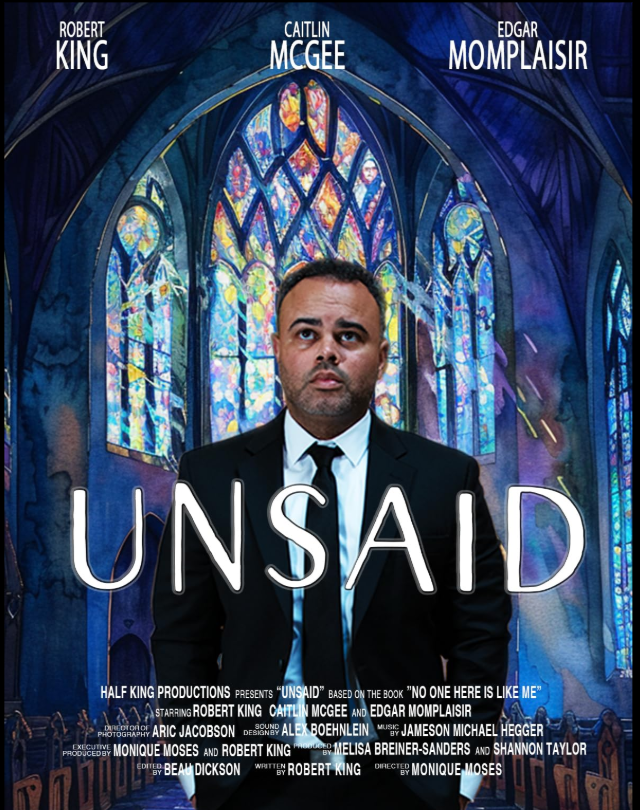
The film opens with a tight closeup on Nate (King) that slowly zooms out to reveal the setting. He’s in a black suit and tie. He’s standing by himself, surrounded by church pews and shadowy figures.
The sound design and score here does the heavy lifting. There’s a high-pitched, consistent hum with somber piano laid over the top. Just beyond that, there’s an argument. It’s too muffled to make out the words but it’s clear tensions are running high.
For anyone who’s experienced grief or anxiety or depression, that high-pitched hum can feel like a death knell. It dampens everything leaving you unable to feel. You exist, but only as an empty shell. The opening 10 seconds capture this perfectly.
It cuts to a flashback. We’re inside of a house and through the window we see an older white woman out in the street shouting: “Jessica, please! You don’t belong here.” Inside the house, a young couple — Jessica, and a black man — are scared and uncertain, hiding behind the curtains.
The flashback cuts as Nate is joined by his friend KB, played by Edgar Momplaisir. The hum slowly dissipates as the two settle into their conversation. The next five minutes of the film are centered around two separate conversations. One with KB and another with Nate’s wife, Harper, played by Caitlin McGee. In writing this sequence, King imagined these two characters as the two sides of his conflicted internal dialogue.
KB encourages Nate to just let it go and move on.
KB: You know your grandma loved you, right?
NATE: Yeah man, I know. It’s just tough because I just found out that she was kinda against my mom keeping me.
KB: Yeah, but, that wasn’t about you. That was probably because your daddy black as hell.
NATE: I mean, you’re joking, but that’s pretty much what it was about.
The conversation moves towards Michael Jackson as KB makes a poignant connection: “You get to define what people mean to you and your life.” Finally, KB breaks out into Jackson’s “You Are Not Alone” pleading with Nate to join him in song.
The whole exchange is humorous and moving in equal measure. It’s a perfect portrait of how male friendships operate. One guy tries to cheer the other one up, in the only way he knows how.
As KB departs to go flirt with Nate’s handsome cousin, he’s replaced by Harper, Nate’s wife. She encourages Nate to go talk with his grandma and tell her how he feels.
NATE: I’m good. It’s done. I let it go.
HARPER: Okay, honey, I love you, but you’re lying to yourself. You didn’t let it go. You’re going to hang on to this forever and then months from now you’re gonna blow up at me for loading the dishwasher wrong or something.
NATE: You do load it wrong a lot.
I’ve never felt more seen by any other exchange in the history of cinema. Most of my marital quarrels center around the dishwasher. It’s an intricate puzzle that– Right, back to the point.
King credits director Monique Moses with helping to develop and flesh out these exchanges. Originally, they were mere table settings for Nate’s monologue with his grandmother to conclude the film. In its final form, these conversations add levity to what otherwise could have been a challenging short film to sit through.
“I’ve been to these film festivals where every short in the block is an emotional gut-punch and it’s unrelenting,” King said. “This has that emotion, but there’s also a lot of jokes.”
These conversations aren’t just about humor though. They also add gravity to the climactic monologue with his grandmother. As a viewer, you understand the turmoil Nate is going through as he finally steps up to the altar to say goodbye to his grandmother.
…
To avoid spoilers, let’s shift back to King. Here is his story about writing the scene:
“My wife and I, before our second child was born, went on a little babymoon to Paris. I had written the majority of the movie prior to the trip, but stopped right before the monologue. I figured I had an eight hour flight and I could just write it on the plane. It was an overnight flight and everyone was sleeping around me and I’m writing this scene and tears are just streaming down my face. It’s very cathartic and I'm feeling all of these emotions, but I’m also taking a moment to pop out and see myself on this plane. All these people are snoring around me and my wife is laid out next to me and I’m just ugly crying while writing these words to my grandma.”
The process of writing and making Unsaid provided King with the closure he never got while his grandma was still alive.
“As artists, that’s how we process these things. We put it into our work.”
Unsaid will be screening on Saturday, January 24th at Saratoga Arts as a part of the “Coming to Terms” block. The screening will begin at 12:00 pm. For more information about the Saratoga Film Showcase, visit: https://www.discoversaratoga.org/events/saratoga-film-showcase/