INTERVIEW: Matthew Morrison on Bobby Darin, Show Up and What it Takes to Do Just That
**A condensed version of this interview appeared in our April 2026 print issue. Consider this the director’s cut version, with nothing cut for space.**
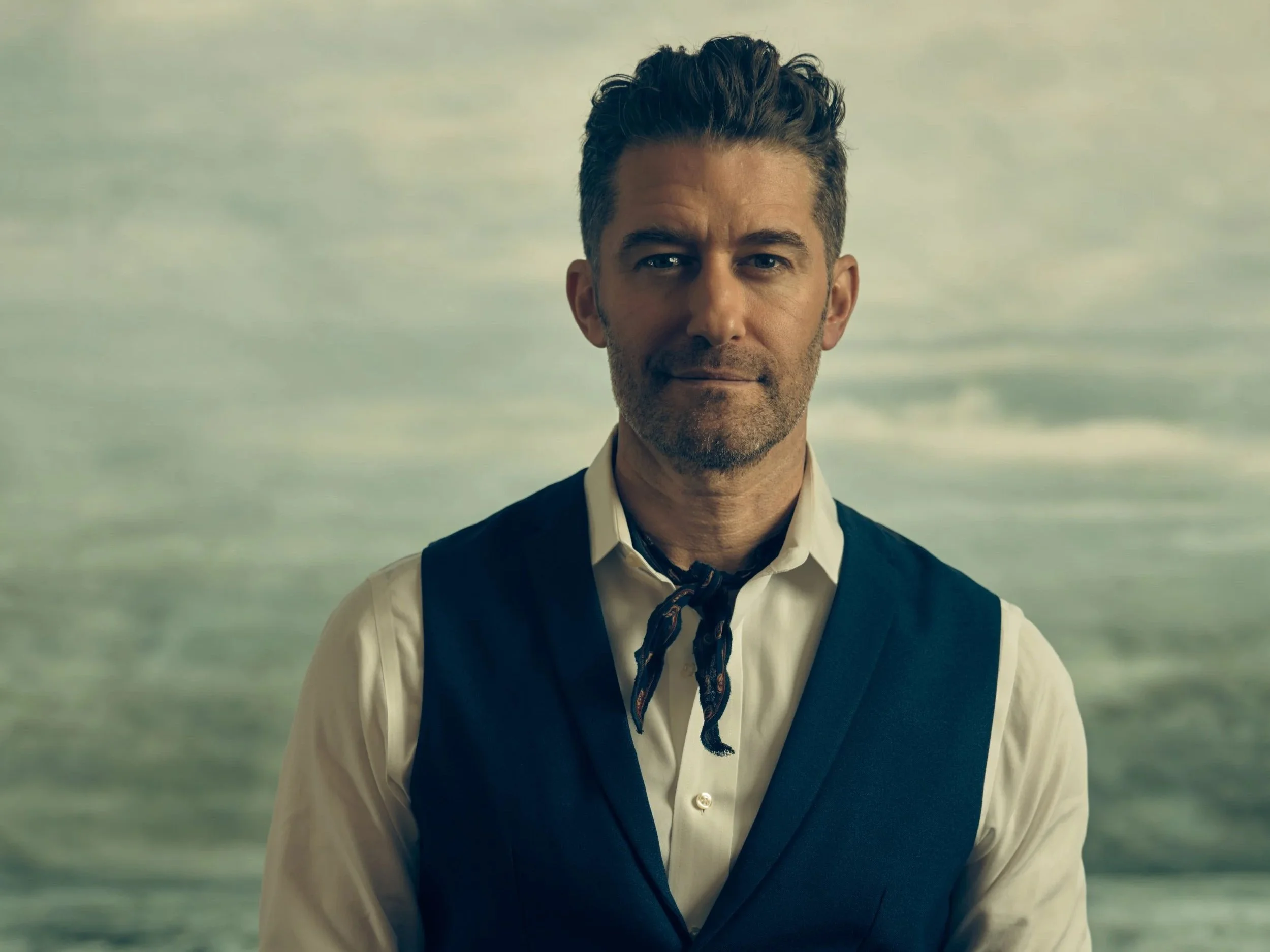
Photo provided
"since I’ve become a father and practicing slowing down, I feel like I’m really able to grasp the here and now of what life is. I’m so grateful for that.”
Matthew Morrison is an icon. A handsome, dimpled face associated with L-shapes on foreheads, jump scares, covers of Journey songs, Sisqó’s “Thong Song,” and an unforgettable rendition of Young MC’s “Bust a Move.” He is more than a meme, the leading role of glee director, Will Schuester, on Ryan Murphy’s Glee, or — perhaps his earliest, most recognizable role — the heartthrob Link Larkin, who falls in love with an unexpected girl in Civil Rights Movement-era Baltimore in Hairspray.
Matthew Morrison is a man of theatrical whimsy. It is stitched into him, seamlessly, like a well-tailored suit. This peculiar combination gives him a rare gift: shapeshifting. Actor of the stage, actor of the screen, actor of the song, everything in between… and father, his most important role of all — the role that demands the most honesty and vulnerability.
But being a shapeshifter does not mean inauthenticity. Rather, it is adaptability and a capacity for change.
I’ve been fortunate enough to see Morrison in different environments. First, as I was positioned punctually in front of my roommate’s stolen TV to watch Glee my freshman year of college. Then face to face (kind of) on a Zoom call, and finally, on stage as he performed his Show Up tour at Universal Preservation Hall (UPH) on March 5. This juxtaposition of his multifacets offered such a unique insight into who he was, and his malleability to become each version of himself.
In the interview with my colleague Amaris Ford and I, Morrison explains with easy candor how Glee molded him as a performer. “I did six Broadway shows before I got Glee [...] it was a beautiful trajectory of learning and growing my craft. I don’t think I’m the best singer, dancer, or actor, but when you put all three of them together at once, I do it well. I got to home in on all three [skills].
“It was the perfect show for me,” he continues with a wistful smile. “In theater, you’re playing to the last person in the house. On TV, you have to be more intimate and smaller. But Glee was a hybrid. You could be a little over-the-top — obviously.” Here, he laughs in a way that only acute self-awareness can conjure. “We got to be a little dramatic. There were scenes in that show where I got to learn by watching myself — with millions of people watching it as well.”
The name of his tour, Show Up, is more than a double entendre of showmanship. It is an amalgamation of everything he learned to be and what he hoped to project into the audience.
“I feel that in society today, people go to a show and as soon as they shut their car door afterwards, they’re onto the next thing. I wanted to create something more impactful. I’m telling my stories in a [curated] way, but connecting. It’s opening a door into you as an audience, to find something new that comes alive.
“I used to go on stage and want to impress an audience. I don’t care about that anymore; I’m not trying to prove anything. I just want to connect — I think that’s the thing that’s changed everything for me. I can feel it with an audience.”
And on March 5, his audience leaned forward in their seats as he waxed poetic in his life stories, quiet expectation on the faces he couldn’t see with any clarity in the darkened house.

With his hand splayed across his heart, he explains, “Show Up is like lighting a candle in a dark room. It starts out as just a flicker, but as we share in the stories, music, and moments of truth, that light spreads. As the audience leaves, I hope they’re not just carrying that light with them, but they’re using it to connect a little deeper — to see themselves a little more clearly, and bring a little more warmth to the room around them.”
The audience at UPH seemed to accept his challenge. Bright cheers, brighter smiles, and reverberating applause after every closing note and choreographed spin. But scripts, choreography, and familiar songs are only one piece of “showing up” at Show Up.
“I used to chase perfection, but we’re all human beings. We’re all showing up with whatever we went through that day — whatever weight we’re carrying on our shoulders. And I do that too; that’s who I am today, and this is what you’re going to get. It’s a beautiful give and take.”
It was recently announced that Morrison was going to return to Broadway for the first time in a decade, taking on the temporary lead role of Bobby Darin in Just in Time. Amaris asked him, “Show Up is keeping with the spirit of Bobby Darin already. What does it mean to step into the character?”
“I haven’t worked for the past couple years intentionally, because I have two kids,” he admitted. “I feel better about dipping my toe into work and being away from home now that they’re older, but I’m reminded that saying yes to a dream always costs you a little time somewhere else. Show Up is part of the journey, and [Just in Time] is another part of it. But I’m also excited to show up for myself and my family after this run. Go back to real life.”
When I asked what about Darin he was most excited to embody, he replied, “I don’t start Just in Time as Bobby Darin. I start the show as Matthew Morrison and spend the first ten minutes of the show in a monologue trying to convince you that I’m Bobby Darin.”
Morrison chuckled quietly and paused to consider the liminal space sitting between himself and the late crooner. “There’s this part of the show that is a fight Bobby has with Sandra Dee. He’s saying, ‘I can’t be with you all the time. I can’t entertain you. I need to work. This is my life.’”
With an exhale that seemed to ground him, he offered us a moment of delicate vulnerability. “I connect with that — the old version of me connects so deeply. It was always about work and the next thing; the momentum of my career. And I think that since I’ve become a father and started practicing slowing down, I feel like I’m really able to grasp the here and now of what life is. I’m so grateful for that. I connect to that part of [Darin] so deeply — seeing him as me and me as him, where I used to be. But also having the gratitude of where I am now. To see the macro of where I am now.”
Morrison’s meditations on the then and now would soon have to translate into something else entirely: a room flanked by towering stained glass, audience members with glimmering gemstone eyes, and hot stage lights. Morrison “showed up” with it all at UPH.
He had the larger-than-life gravitas of a seasoned stage performer, singing arrangements of big songs like “Go the Distance” from Hercules and Natasha Beddingfield’s “Unwritten.” He had charismatic conversations with a room full of fellow theater kids as he sang medleys from Hairspray or Finding Neverland, and had them sung back at him with equal enthusiasm. He had the quiet authenticity of sharing anecdotes about chapters of his life, underscored by heartwrenching, sweeping ballads like “Fix You” by Coldplay, or Sondheim’s “Send in the Clowns.”
And yes, there was the cheeky fan service to the Gleeks in the room, taking the familiar arrangements from the show — “Don’t Stop Believin’,” “Tell Me Something Good,” and “Thong Song,” complete with the melodrama and questionable gyrating.
“I’m living in the moment,” Morrison had told us of his shows during the interview. “I’m there for whatever comes my way.”
Wearing the same megawatt smile, with all of that theatrical whimsy radiating from him… Matthew Morrison showed up.
And the room did too.