REVIEW: Jason Vieaux Inspires Awe and Deep Reflection at Tannery Pond
Photos by Morgan Minear
“Sitting at the back of the room, I saw heads shake in disbelief as Vieaux executed gesture after breathtaking gesture.”
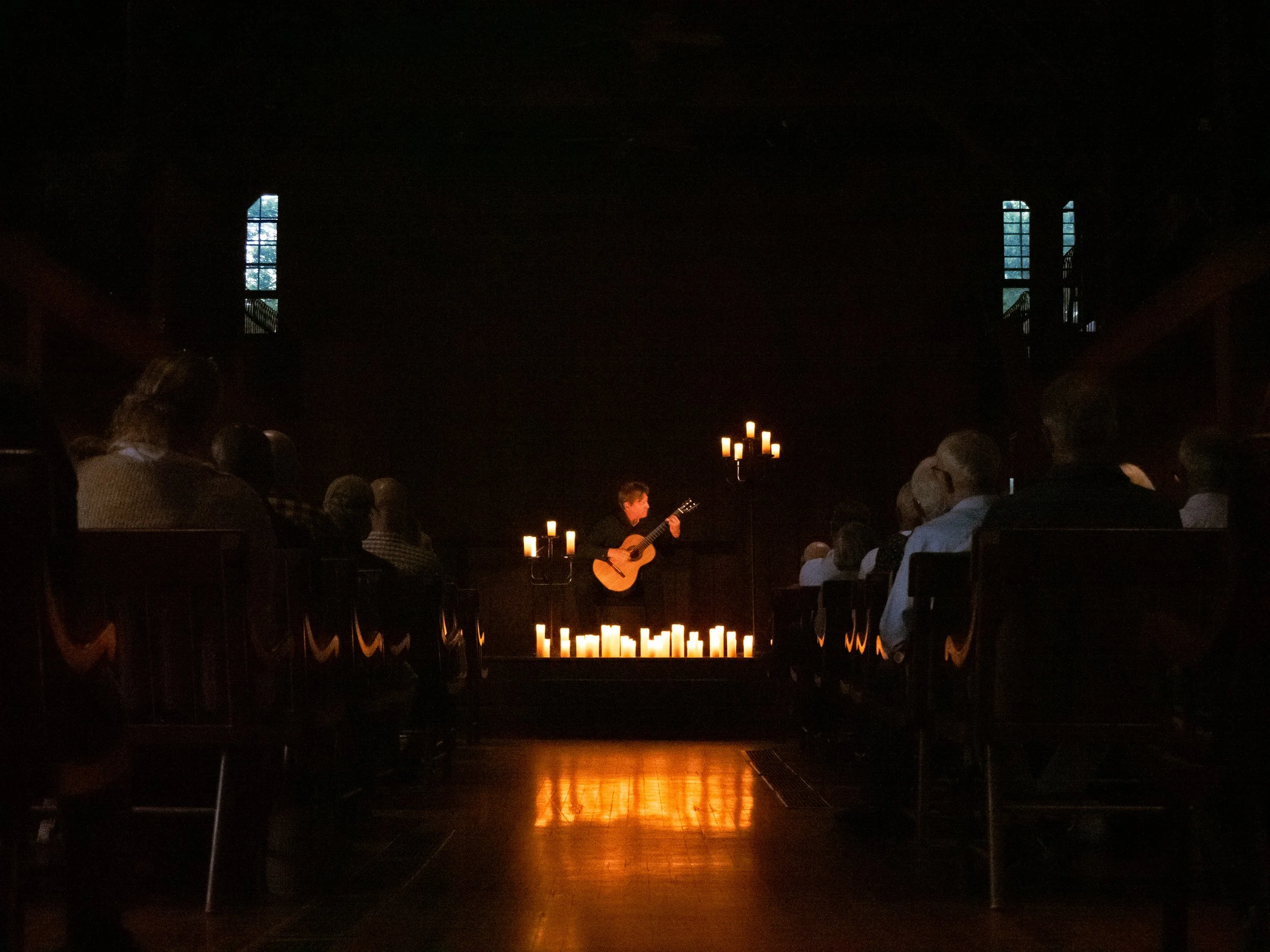
With one push of a button, Derek Delaney, Artistic Director for Capital Region Classical, lit the array of electric pillar candles that surrounded a single black chair placed center stage. Originally a tannery for the Shaker community of 19th century New Lebanon, NY, the Tannery Pond barn at the Darrow School played host to Grammy-winning classical guitarist Jason Vieaux who performed a dazzling 70-minute intermissionless concert Saturday night.
Vieaux took a single bow before leaping into the opening work, Danza Brasilera by Argentinian composer Jorge Morel, a thoroughly catchy number made even more enthralling by Vieaux’s ever-controlled technical flair. Ending with an arpeggiated phrase that found his left hand traversing the entirety of the fretboard and punctuated by four thumps of the hand on the body of the instrument, the piece illustrated so much of what makes Vieaux the consummate performer he is. Knowing that the guitarist’s career includes a repertoire that spans more than 500 years of classical, jazz, and popular music from across the globe, it made sense that he would open with Danza. Following the piece, Vieaux explained that he’d been so taken with Morel — who himself was an avid transcriber of popular tunes and jazz standards — in a masterclass he attended at 15 years old, that he would make a point throughout his career to incorporate the same wide body of material as a standard part of his own musical activities.
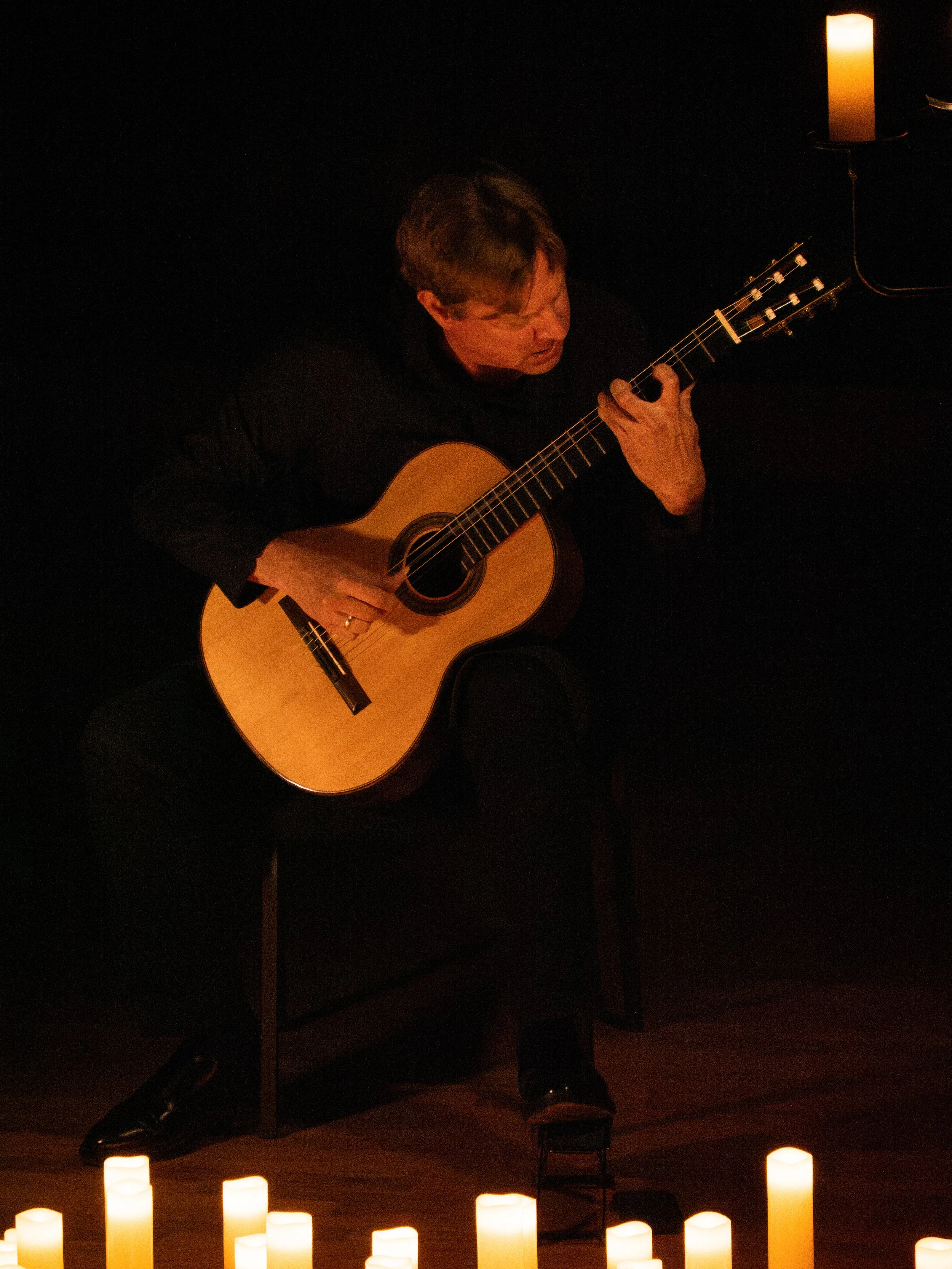
This practice was evident in the second piece, Tidal Pools, a composition by Vieaux himself from his forthcoming album Gratitude (available everywhere September 18). While holding its own as an instrumental work, Tidal Pools could be mistaken for a lost Fleetwood Mac instrumental as a result of Vieaux’s incredibly lyrical melodic writing. The work’s binary form alternated between this folk style and more idiomatic classical writing for the instrument — big leaps, stretched hands and the like, all elegantly but precisely executed.
It was Tidal Pools, more than most other pieces on the program (maybe because of how familiar it sounded), that allowed me to take note of the barn’s surprising acoustics. Despite the lack of amplification, even Vieaux’s most pianissimo gestures could be discerned clearly. And there was something about how the nightly croaks, chirps, and honks of the pond frogs, crickets, and geese outside (and, of course, the occasional yell from an adolescent boy; we were at a boarding school after all), which gently filled the silences as a kind of unplanned counterpoint, emphasized the history of the guitar as an instrument of the public sphere, one whose resonance (especially in the hands of someone as gifted as Vieaux) compliments any space it finds itself in.
For me, the highlight of the evening was the first movement Four Paths of Light, a piece written by guitar virtuoso Pat Mertheny specifically for Vieaux (not as a commission, I should add, but purely out of Metheny’s recognition of Vieaux’s musical prowess). This incredible opening section is nothing less than a modern day masterpiece. Vieaux navigated through the wealth of textures and timbres with ease, combining staccato and legato gestures simultaneously in his steady right hand. What’s more, he maintained the fidelity of several concurrent melodic and harmonic voices (I heard three at one point) with the same clarity of line found in, say, a Glenn Gould Bach fugue recording, and with five fewer fingers to do it! Even in all its dissonance, Four Paths was an audience favorite. Sitting at the back of the room, I saw heads shake in disbelief as Vieaux executed gesture after breathtaking gesture. I was shaking mine along with them, thinking, “No one should be able to do this. And yet….”
Vieaux kept his interstitial banter brief, taking no more than a few minutes between pieces to impart a bit of historical context about the Merlin Suite or describe the musical connections between the Bach and the Tárrega there. The guitarist, while delighted to share relevant information, seemed to prefer letting the compositions and his playing speak for themselves.
As the wildlife once again made itself heard at the end of the performance during the quieter moments of Vieaux’s own Home (a road-tested composition he’s been performing live for several years), I pondered the origins of the piece which were relayed in the most lengthy introduction of the evening: it was written early on in the COVID-19 pandemic when all of Vieaux’s musical engagements were cancelled, when his days were spent inside with his two young children, when he felt confused about how to continue on as a musician when he had nothing on the horizon to rehearse for. Built out of improvisations, Home felt like an elegy for a time when the outside world was terrifying at its worst, confusing at its best. Sitting in the barn, time halted for a moment as, no doubt, each audience member, myself included, contemplated their individual pandemic experiences as they related to the idea of place: being stuck at home, forced to go home, or stranded far from home. The persistent yet melodic long-tone tremolos that defined the piece were aural manifestations of our collective years-long anxiety stemming from the relentless stasis, the unwanted push from behind, and the unbearable longing of those respective realities. In that barn, guided by a musician with the ability to embody both contemporary and ancient historicities, we remembered why community is not just important, but an indispensable part of the human experience, without which humanity would have neither the ability to endure nor (perhaps less vital but nonetheless valuable) have such a transfigurative musical experience.