
REVIEW: The “Shackeau” That Laughter Built
10/01 @ UPH, Saratoga Springs
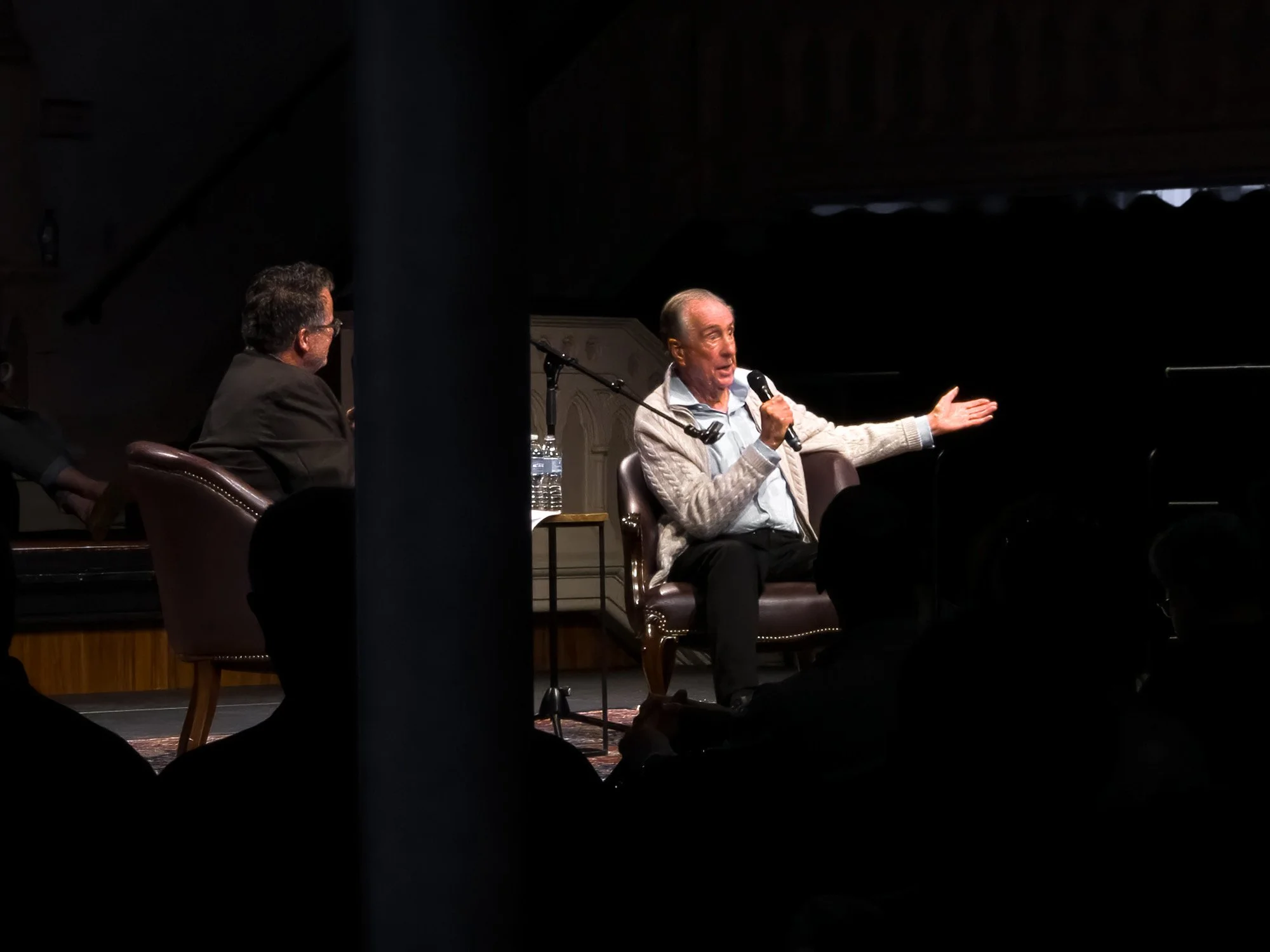
Photo by Pete Perry
“Through stories of renovations, friendships and a career that helped reshape comedy, Idle showed how a place far from the entertainment industry became an essential part of his life.”
In Provence, even a ramshackle house can become the stuff of legend. For Eric Idle, the sun drenched corner of southeastern France where he bought a crumbling property in 1971 became a refuge, a gathering place for famous friends and a running comedy of repairs that lasted more than half a century. He called it his “Shackeau,” and earlier this month, the Monty Python icon brought his story to Universal Preservation Hall in Saratoga Springs, offering a warm, wonderfully absurd look at the life that unfolded beyond the spotlight.
The occasion was Idle in Provence: A Brief History of Thyme, Idle’s memoir about restoring that home while building one of the most remarkable careers in comedy. The sold out event, presented by the Saratoga Book Festival and Northshire Bookstore, and moderated by WAMC radio host Joe Donahue, brought Idle’s British humor to a room ready to celebrate him. But the evening was about more than a greatest hits collection. Through stories of renovations, friendships and a career that helped reshape comedy, Idle showed how a place far from the entertainment industry became an essential part of his life.
Idle took the stage to a standing ovation, immediately finding a connection with the Saratoga audience by noting that the city was the birthplace of David Hyde Pierce, who played Sir Robin in the Broadway hit Spamalot. From there, he moved effortlessly between the Provence house and the early days of Monty Python’s Flying Circus, which debuted in 1969 and quickly established a new kind of television comedy.
Even now, Idle seems amazed by the show's longevity. The Pythons benefited from a late Sunday night slot on the BBC that gave them room to push boundaries, build bizarre worlds and leave conventional punchlines behind. Their sketches eventually reached audiences around the globe, although the road to American acceptance was not exactly paved with roses. Idle recalled the troupe’s early appearance on The Tonight Show, when their humor failed to connect and the performers hurried through their material before heading outside to laugh at the experience themselves.
That ability to find comedy in failure has always been part of Python’s appeal. The group treated embarrassment, authority and the rules of polite society as invitations to misbehave. Decades later, the material still feels alive because it never depended on playing things safe.


Provence offered a different kind of freedom for Idle. Away from the relentless attention that comes with fame, Idle and his guests could enjoy a degree of anonymity that was increasingly difficult to find elsewhere. One of his favorite visitors was Robin Williams, who was already famous for Mork & Mindy. In America, Williams could hardly go anywhere without someone greeting him with “Nanu Nanu.” In France, the two comedians could head to a dance club without being recognized. Idle recalled Williams eventually jumping onto a table and announcing, “Hey everyone, I’m Mork!” to a room full of unstartled faces.
The house also welcomed Paul Simon, Art Garfunkel, Penny Marshall and other friends over the years. These anecdotes gave the memoir its appeal beyond celebrity name dropping. The Shackeau was a place where public personas could fall away and friendships could unfold without an audience.
One story, however, brought together Idle’s comic instincts and the extraordinary generosity of a friend. When Monty Python needed financial help to make Life of Brian, George Harrison stepped in, even remortgaging his home to help fund the film. When Idle asked why he would take such a risk, Harrison reportedly gave the simplest answer imaginable: he wanted to see the movie.
Idle turned the story into a punchline about “the most expensive movie ticket anyone had ever purchased.” It was a perfect example of his storytelling. A remarkable act of friendship made even more memorable by its sheer absurdity.
The evening also touched on Idle’s appearances as host of Saturday Night Live and his role in National Lampoon’s European Vacation, reminders that his career reaches well beyond the Python universe. Yet his influence remains inseparable from the troupe’s peculiar brilliance, a body of work that helped generations of comedians understand that a joke could be a philosophical argument, a theatrical stunt or simply a man arguing with a dead parrot.
Then came the song everyone hoped to hear. As the conversation wrapped up, Idle performed “Always Look on the Bright Side of Life,” the song he wrote for Life of Brian. The audience joined in, filling the former Gothic Methodist church with a chorus of cheerful defiance. The setting made the moment even sweeter. There was something perfectly Python-esque about a room full of people singing an anthem of optimism that emerged from one of cinema’s most provocative comedies.
For Saratoga, Idle’s appearance made for an inspired opening to Saratoga’s Book Festival. His memoir celebrates the improbable intersections of creativity, friendship and home, showing how a battered property in France could remain a constant through decades of professional triumphs and personal change.
Idle has given the world plenty of reasons to laugh. In Provence, he found a private place to live between making the world laugh. And after 55 years of repairs, stories and visitors, the “Shackeau” has become a monument not to fame, but to the life that makes fame worth having.