
PREVIEW: Those Damn Kidz!: Bringing Club Kid Realness to Albany
06/13 @ Ophelia’s, Albany
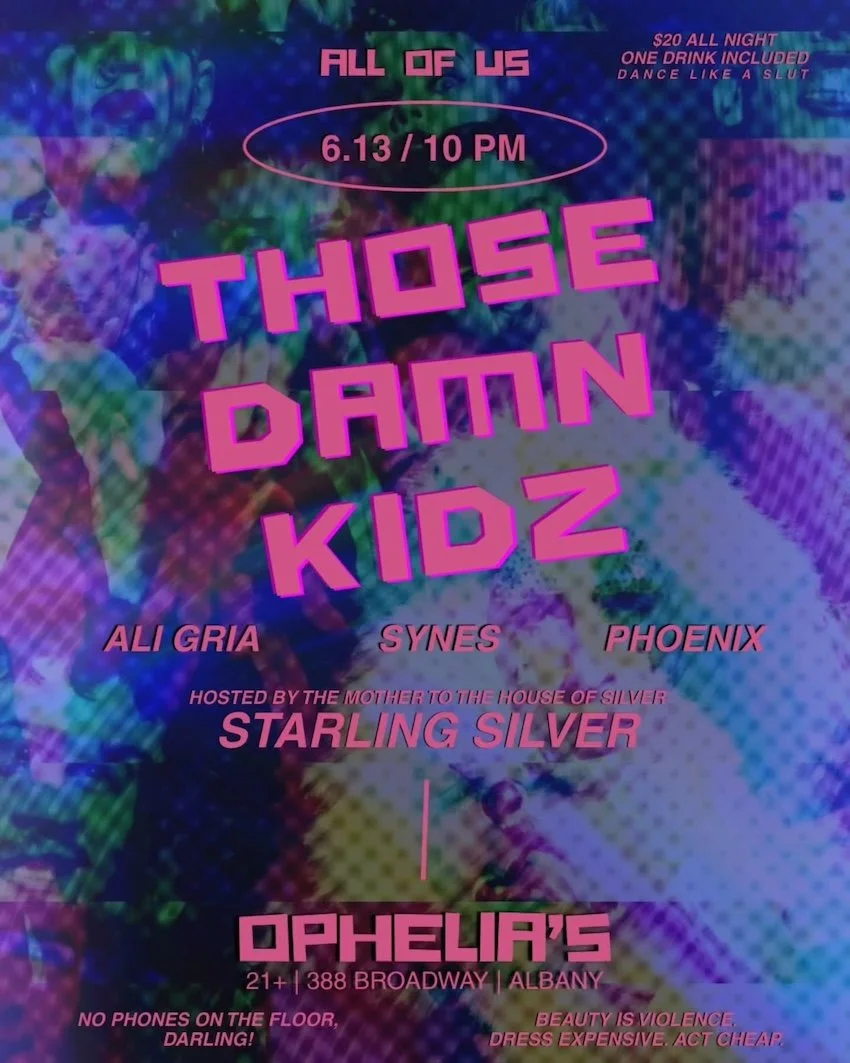
“Come dressed like your hometown would hate you.” – Shane Stiel
Those words live on the flyer for Those Damn Kidz!, an upcoming event put on by All Of Us Events, bringing the club kid era to the Capital Region. They also live in the heart of what the club kid era itself has always represented.
A lot of the club kid era is remembered for beautifully filthy and expressive fashion, the iconic spaces for communal celebration like The Limelight, Club USA, or The Tunnel, and polaroids of queer nightlife legends like RuPaul, James St. James, Amanda Lepore, Lady Bunny, and countless others.
All of those people, places, and things do very much define the era; to not remember them would be a huge disservice to the history of queer nightlife as a way to express oneself and find community. But woven into the fabric of the elements that shaped queer nightlife and the club kid era is something much more radical.
Event organizer Shane Stiel recalls watching a Geraldo Rivera segment that featured some of these club kids in which an audience member asked them why they wanted to “dress like freaks.” Poignantly, one of them answered that they finally felt accepted there — they never felt like they belonged in the outside world.
“That answer always stuck with me,” he says. “It was about finding your people, it was about creating a home when home didn't always feel safe,” he says. “The dance floor became a sanctuary where artists, misfits, queer kids, outsiders and dreamers could exist without apology.”
When thinking about this idea of sanctuaries, Shane recognizes that the ‘80s and ‘90s were periods of time where spaces like these became essential. He looks at the AIDS crisis, and the way that clubs and nightlife allowed communities to simultaneously care for one another and release the weight of that responsibility, all while much of society looked away.
“Without queer nightlife, we may not have the Pride celebrations we know today, we might not have the visibility and progress we’ve fought so hard to achieve,” Stiel says. “It’s about honoring the spaces and communities that helped shape culture and made so many of us feel less alone.”
When working to capture the feeling of a night out during the club kid era, it’s also important to recognize the technological differences between then and now. This distinction led Shane to establish a no-phone policy for this particular event.
When I ask him what we get out of policies like these, his answer is simple yet powerful.
“Human connection. Bottom line,” he says.
“You gain eye contact, you gain mystery, you gain the freedom to dance badly, cry, flirt, connect and be completely unfiltered without worrying about how you'll look online tomorrow,” Shane continues. “Young people today have very little experience with what nightlife felt like before everyone carried a camera in their pocket,” he says. “In the '90s, you went out to experience something, not document it.”
Some of Shane’s fondest memories and deepest friendships were born out of existing in nightlife without a constant reminder of social media and the internet in his pocket. “I’ve shared incredible highs and painful lows with people I’ve met in clubs,” he says. “Those experiences were sacred because they belonged to us, not to the internet.”
That philosophy may also explain why younger generations continue to gravitate toward club kid culture decades later.
“I don't know if it's fascination as much as recognition,” Shane says. “I think young people today are searching for the same thing we were searching for in the ‘90s: freedom, creativity, belonging and authenticity.”
This once again echoes the tag line for the event, encouraging attendees to arrive “dressed like your hometown would hate you,” and Shane embraces that idea wholeheartedly. When I ask him to speak a bit more about it, he says, “It means wearing the fishnets, the purple wig, the platform boots, the glitter, the PVC, or whatever you've been afraid to wear because you're worried about what people might say… Silencing the voice that says ‘People are going to judge me.’”
And to that, Shane says: “Good. Let them.”
I ask Shane what he hopes people get out of this event and why events like these are so important.
“There is so much heaviness, division and noise in the world today,” he says. “So I hope people come and feel liberated. I hope they laugh. I hope they sweat. I hope they make friends. I hope they leave feeling lighter than when they arrived.”
He ends it on a beautiful note, one that fully captures what scenes like these have always been about.
“Most of all, I hope they discover what so many of us discovered decades ago; when the music is right and the lights go down, the club kids will always welcome you with open arms.”
Those Damn Kidz! will be held on Saturday, June 13th at Ophelia's; 388 Broadway, Albany, NY, 12207. Doors open at 10PM and the party continues through 3 AM. Entry is $20 and includes one drink!