
PREVIEW: “Objective Form : Subjective Disorder” At Saratoga Clay Arts Center
On display through May 2 @ Schacht Gallery, Schuylerville
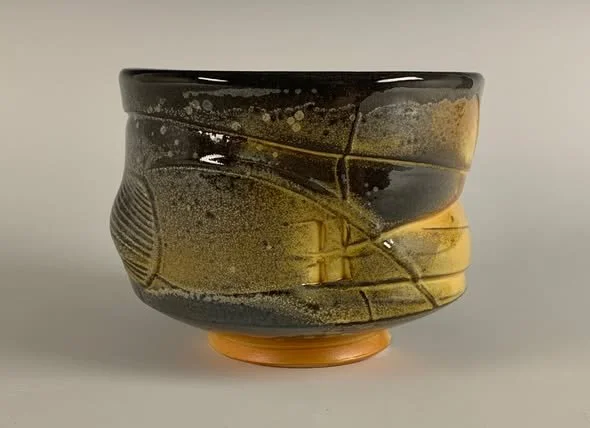
Images provided by Saratoga Clay Arts Center
With a title like Objective Form : Subjective Disorder, the exhibition stops you for a second. It doesn’t fully explain itself right away. The work inside the Saratoga Clay Arts Center’s Schacht Gallery follows that same idea with familiar, functional forms that don’t stay as fixed as you might expect.
The duo exhibition brings together Maria Rosenblum and W.D. (David) Pitney, two artists working with clay from different starting points, but meeting somewhere in the middle. Some of the pieces feel grounded in function — bowls, vessels, objects you recognize — while others push past that into something more expressive. Objective form, subjective disorder.
“The name popped up after a long exchange of free form ideas, many of which were poking fun at ourselves,” Pitney said. “Middle age is a funny time to try and break out into an, admittedly local, art community. I think the title touches on our two different approaches to process.” Rosenblum described a similar shift behind the work.
“We were both, actually, breaking out of our molds, our comfort zones,” she said. “Disorder was about how we felt as we tried to find a new voice, a new vocabulary in our experiences with creating ceramics.”
In all honesty, I don’t know too much about ceramics, however, that tension still comes through pretty clearly. There’s a push and pull between structure and looseness, between something that looks usable and something that feels more like it’s meant to be looked at.
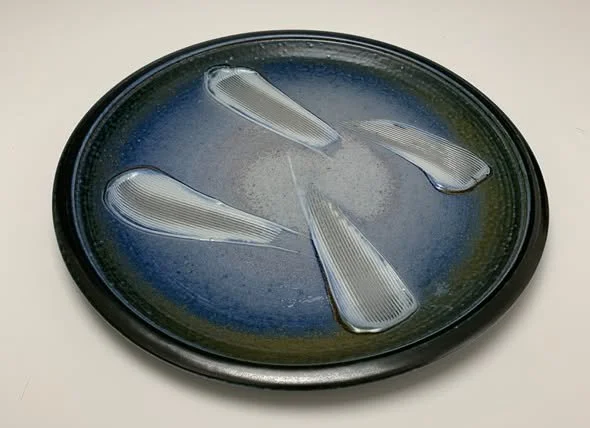
“Unlike most traditional art forms, ceramics has a distinctly functional craft tradition,” Pitney said. “The movement to break with function and focus on expression with clay really only dates back to the post-war period.” That’s the idea behind a lot of Rosenblum’s works. Starting in that functional space, but refusing to stay there.
“I loved seeing my bowls filled with food and my cups brimming with coffee, but Lucy Rie helped me to see beyond utilitarian pieces,” she said. “Clearly, they’re bowls… but on the precipice.”
A great example of this comes from Rosenblum’s “Shallows” series, pulled from her time in Nova Scotia; shaped by the coastline and what’s left behind when the tide pulls back.
“The ‘Shallows’ are snapshots of what is left after the tide recedes and the secrets of the coastline are revealed,” she said. Pitney, on the other hand, focuses more on what happens when those familiar forms start to shift.
“How do you take an almost mundane object, something that is used in our everyday lives, and infuse them with something that elevates to a place of expressive value?” he said. “There is a lot of letting go happening and when things work out well, that space can be filled with a more subtle hope of finding community.” That idea of letting go comes up a lot, especially in the firing process, something neither artist pretends to fully control.
“Every time we think we have gained confidence and skill in firing, some unexpected challenge reminds us that we are never fully in control,” Pitney said, recalling a winter firing where equipment froze mid-process. “That firing produced some of the most unexpected pieces either of us have made.”
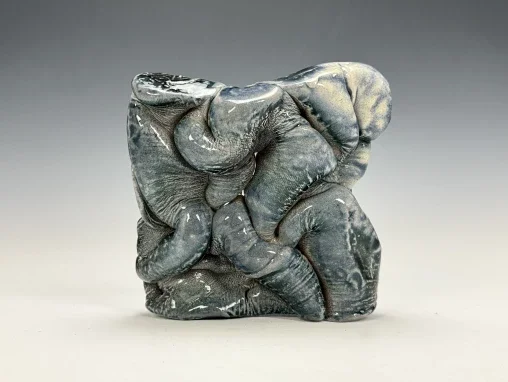
“We have control over certain elements, but the results are out of our control,” Rosenblum said. “It’s all a matter of how that actual flame moves within the kiln. This is what makes it all so unpredictable and exciting.” The two have been working together for years, sharing the long process of firing, sometimes more than 20 hours at a time.
“I trust her instinctively,” Pitney said. “She meets every challenge with a positive attitude and a willingness to laugh at herself and each other. I can’t overstate how important that is.” Installed together, that connection becomes clearer.
“We are definitely in dialogue, tonally and experimentally,” Rosenblum said. “Being surrounded by all our work, we are effectively cohabiting the same space.” Both artists pointed to the Saratoga Clay Arts Center as part of what makes that kind of work possible.
“SCAC is a really special place,” Pitney said. “Every level of maker from beginner to professional can find community, opportunity, and hopefully creative fun.”
“Within a month, I began working there, developing relationships, and absorbing the energies of all the amazing artists in this shared space,” Rosenblum said. “SCAC is community.”
For visitors, there’s no single way to move through the exhibition. Both artists lean into this, appreciating the way each piece, and the exhibition as a whole, becomes a personal experience for each and every guest.
“I hope they enter with curiosity… to take some pleasure, to meet and laugh and talk with someone they don’t know,” Pitney said, “and to recognize what a special thing it is to make things that can be shared.”
Objective Form : Subjective Disorder is on display through May 2 at Saratoga Clay Arts Center’s Schacht Gallery in Schuylerville.