
PREVIEW: Soaring High with Mahogany L. Browne at the NYS Writers Institute
03/18 @ The Alice Moore Black Arts and Cultural Center, Albany
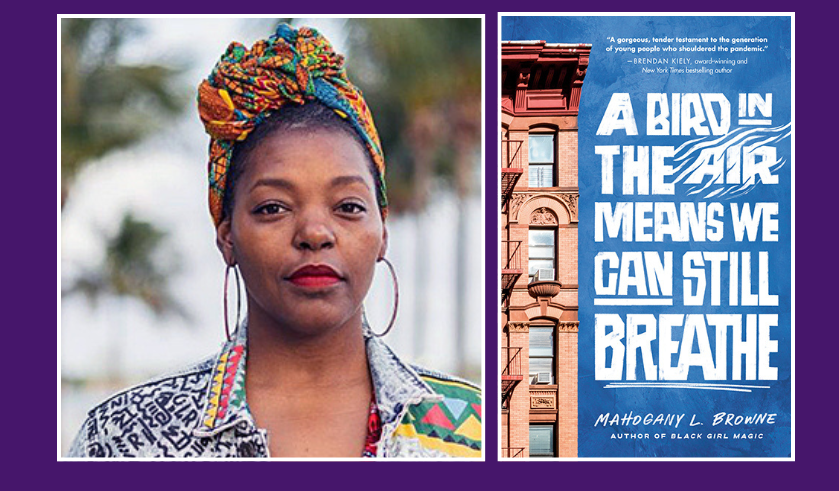
Photo by Jennie Bergqvist
“I wanted the poetry of our everydayness to permeate the page and encourage the reader to look at their lives with the same appreciation as they would marvel at art hanging in a museum.”
The air is still, and the city is silent. “Everyone is listening to the news, and no one is listening to their hearts,” begins A Bird in the Air Means We Can Still Breathe (2025). It’s a shattered mosaic of an uncertain time, yet its relevance has never been greater. As part of the NYS Writers Institute’s March programming, the community is invited to sit down with its award-winning author Mahogany L. Browne and discuss her work.
“I hope attendees can join for a conversation on hope in a time of uncertain chaos,” encourages Browne.
On Wednesday, March 18, at 6:30 p.m., a conversation and Q&A with Browne will be held at The Alice Moore Black Arts and Cultural Center at 135 South Pearl Street. Browne is a poet, writer, organizer, educator, and the first-ever poet-in-residence at New York City's Lincoln Center.
Longlisted for the National Book Award, A Bird in the Air Means We Can Still Breathe is a powerful blend of fiction and poetry that shares the adolescent perspective in New York as it goes into the COVID-19 lockdown. As the communities around them bear the brunt of the pandemic, the young narrators seek meaning and connection in an unfamiliar new world.
“This season, our 43rd, highlights writers who are grappling with the big emotional and social questions of our time,” says NYS Writers Institute Communications Specialist Michael Huber. “Public health, identity, grief, and resilience — Mahogany fits right into that. Her novel about teens navigating the lockdown and her poetry collections like Chrome Valley and Black Girl Magic are about community and finding the strength it takes to persevere and overcome obstacles.”
Earlier the same day, Browne will visit and creatively collaborate alongside students at various elementary schools in Albany, the effort funded by the Carl E. Touhey Foundation at no additional cost to the schools.
“We will write and archive their memories,” says Browne. “The world does an incredible job of silencing our young people, and I am always excited to cultivate a space that encourages them to speak up and out.”
“This is the heart of what we do,” adds Huber. “Bringing writers into classrooms is essential to our mission.
“We’ve seen how students look in amazement when a published author walks into their auditorium. In many cases, these school visits are the first time these kids have met a published writer or the first time someone has given them a book for free.”
Browne describes writing as a ‘privilege’ fueled by a passion to create relatable stories for young people. “I am always honored to be in conversation with young people,” she continues. “They are the reason I move forward fearlessly… I write to remind young people they are the leaders in training.”
A Bird in the Air Means We Can Still Breathe is an act of remembrance, a hand outstretched to a generation that lost time with friends and family, homecoming dances, and graduations. Browne writes for this generation, whom she feels was forgotten in the desperate push for normalcy after the immediate lockdown ended.
“If we forget what was forbidden, what was lost, what was missing, and who struggled the most, then we are bound to repeat the conditions that made the self-centeredness of the pandemic so incredibly painful and difficult to overcome,” reflects Browne.
The characters of Electra and Hyacinth, Malachi and Tariq, along with Zamora and Mohamed, reflect this tension at that vulnerable young age, caring for sick family members, struggling with depression, and attempting to keep their community’s spirit alive. The resilience and humanity of the story shine through as it uncovers poetry in everyday life, from to-do lists to emails. Through the specific medium of poetry, Browne discovered an emotional, effective storytelling tool that resonates deeply with her young audience.
“Poetry has the capacity to both question and ponder,” says Browne. “With such a powerful tool, it felt like the easiest mode of sharing different stories without losing the texture of the city, the pain of the silence… and the hope that grew despite the cold concrete of a city that fed on the energy of the essential workers.
“Everyday life is mundane and ordinary and beautiful. I wanted the poetry of our everydayness to permeate the page and encourage the reader to look at their lives with the same appreciation as they would marvel at art hanging in a museum.”
Community is the heart of the story. It lives on the streets of New York and inside the characters who are holding their lives together, either by a thin thread or by their arms wrapped tightly around each other. This is one of the takeaways that matters most to Browne.
“Let's start moving like we are a community rather than centering the individual needs. What does it mean to think about the collective? How much stronger would we all be if we had the space and grace to take a deep breath and just be?”
Mahogany L. Browne will visit the NYS Writers Institute on Wednesday, March 18. The event is free and open to the public. For more information, please visit https://www.nyswritersinstitute.org/mahoganylbrowne-2026