
PREVIEW: Arts Day Albany — Finding the funds for arts and culture
2/10 @ Hearing Room A, Legislative Office Building, Albany
“There is a lot of volatility coming from the federal government and we wanted to explore how this could impact New York State.”
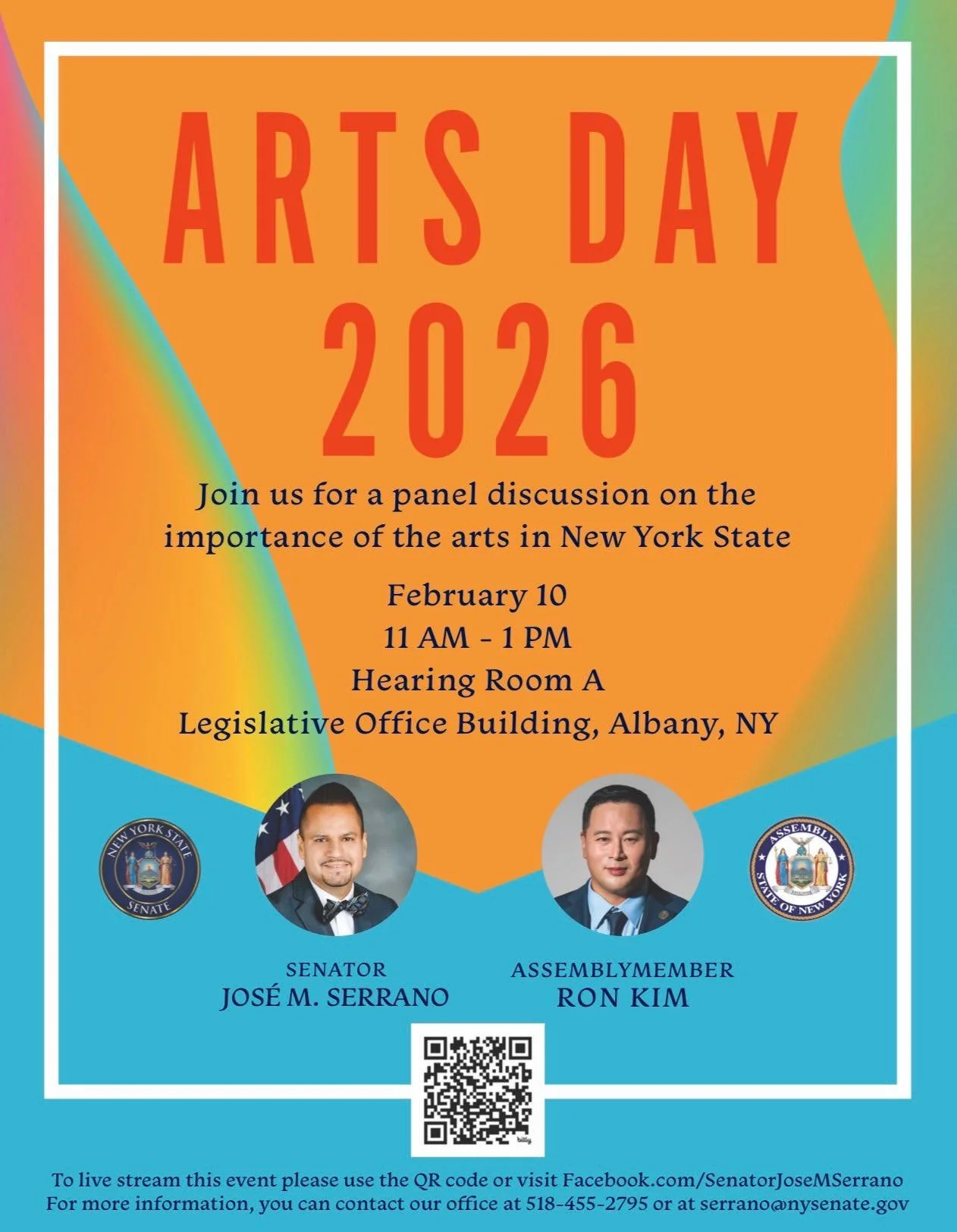
Tuesday, February 10th is Arts Day Albany, an advocacy event held within the NYS Legislature that focuses on the positive effects of the arts and culture in anticipation of the budgeting season. As federal funding remains in limbo for many programs and organizations across the country, it has exposed a major reality for New York State — a heavy reliance on federal funds through both the National Endowment for Humanities (NEA) and the Institute for Museum and Library Services (IMLS). Happening on Tuesday, there will be a panel discussion happening from 11am-1pm in Room A of the Legislative Office Building, hosted by NYS Senate Chair Jose M. Serrano and Assembly Chair Ron Kim, which will be followed immediately by a press conference hosted by ArtsNYS and New Yorkers for Culture and Arts to highlight new groundbreaking reports by UPenn’s Social Impacts of the Arts Project and Gonzalo Casals of Culture & Arts Policy Institute, the latter of whom I had the chance to chat with.
Casals is the Co-Director of Culture & Arts Policy Institute, whose job is to help inform policy changes, addressing systemic challenges in the Culture and Arts sector of New York State through research and data. With the constant threats of federal funding cuts, they created a briefing of how and where federal funds have been allocated over the past five years. This briefing can then be used as guidance for advocacy groups and politicians.
“There is a lot of volatility coming from the federal government and we wanted to explore how this could impact New York State,” Gonzalo points out.
With New York State relying on federal funding for this sector more than the national average across the states, uncertainties in funding have to be taken very seriously. Looking at grants awarded by the three agencies, the NEA, NEH, and IMLS in 2024 and using them as a baseline. Culture & Arts Policy Institute broke down the potential financial impacts felt across the state by regions and organizations by size and budgets. Their findings spell trouble for the entire arts and culture sector, particularly for small organizations and areas with less population density.
“When you look at areas like the North Country, where there are very few cultural organizations in that region and you remove the funding, you’re impacting the entire ecosystem,” Gonzalo tells me.
An ecosystem that has far reaching impacts and implications beyond economics, creation, and entertainment. Implications that are laid out in the groundbreaking report by UPenn’s research group, the Social Impact of the Arts Project (SIAP), of which Stern is a part of. While the report focuses on NYC’s neighborhoods for its data, it's a good overall representation of what can happen statewide, particularly in the Capital Region.
From the press release for this event, Stern says,
Our new research found that areas with “cultural clusters”, meaning lower-income neighborhoods with more cultural assets than we’d predict—drive a set of measurable social benefits. When we control for the effect of socio-economic status, compared to lower-income neighborhoods with few cultural resources, these civic clusters enjoy a better quality-of-life (2025) with respect to illness, birth outcomes, and school effectiveness.
The event can also be livestreamed here. For more information, call 518-455-2795 or email serrano@nysenate.gov.