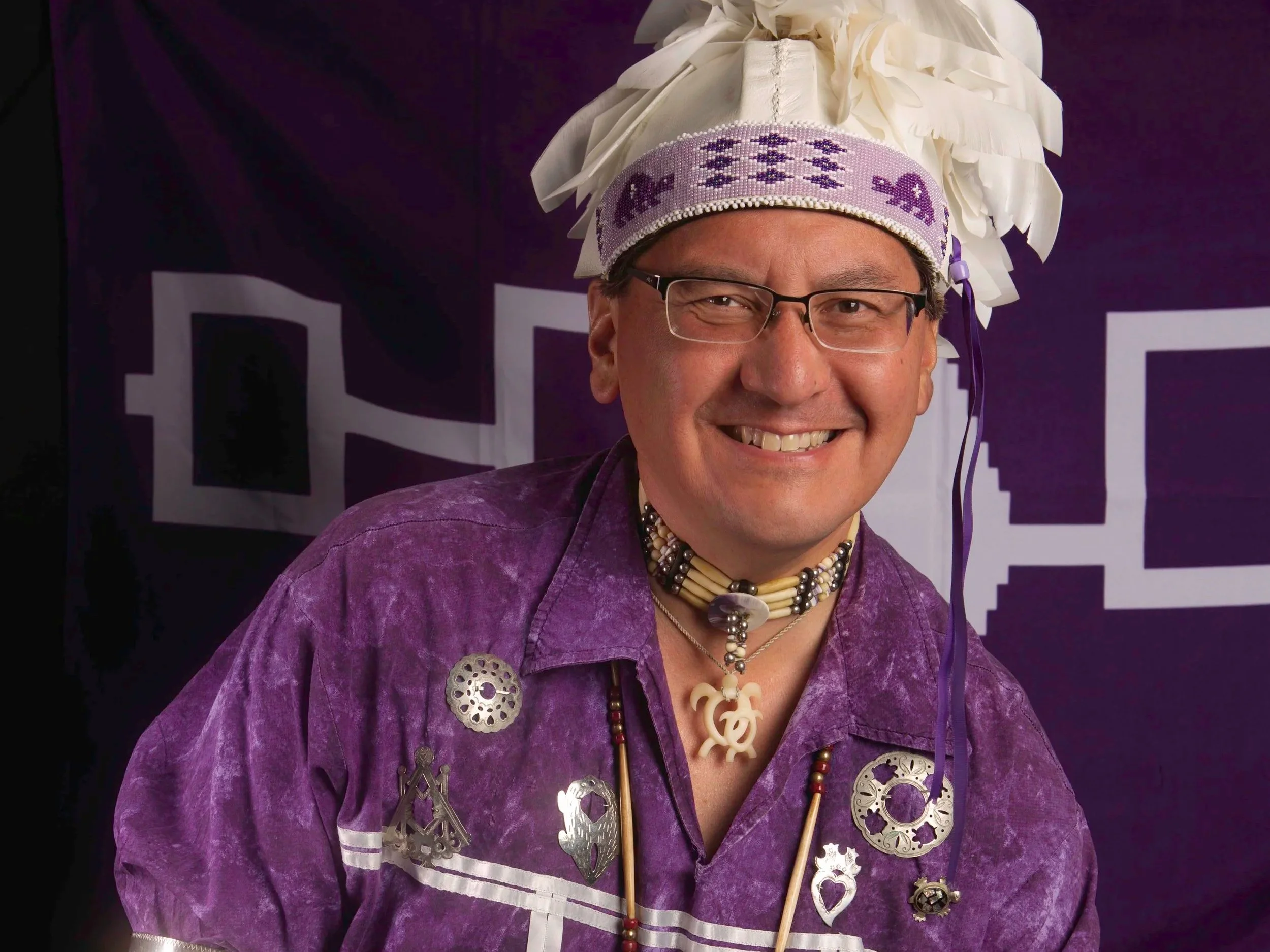
Photos provided by Perry Ground
11/11 @ Albany Institute of History and Art, 11/14 @ NYS Museum
“The fact that I’m wearing the full regalia and telling the stories shows that we’re a living, vibrant community, and we are members of the 21st century. Here we are, practicing our traditions.”
Halfway between two microscopic dots on a map, Perry Ground drives his trusty car into the barren parking lot of a Tops Friendly Market. Inside, it’s quiet, and he is the only customer. An employee is arranging the first Halloween candy display of the season.
Ground eyes it — he’s going to need a cart-full before he reaches the next school on the map.
*
Ground recounts this anecdote from a nondescript hotel room in Watertown. He’s between shows in two different school districts, squeezing in this interview before he hits the road again. “It’s a lot of hotel points,” he jokes in his conversational, gregarious way. His events reflect this with effusive, engaging, and dynamic teaching.
Teaching is Ground’s job, but it’s also his calling. For over 40 years as a Traditional Storyteller and member of the Onondaga Turtle Clan, Ground shares Haudenosaunee stories with schools, community centers, museums, and festivals nationally and internationally.
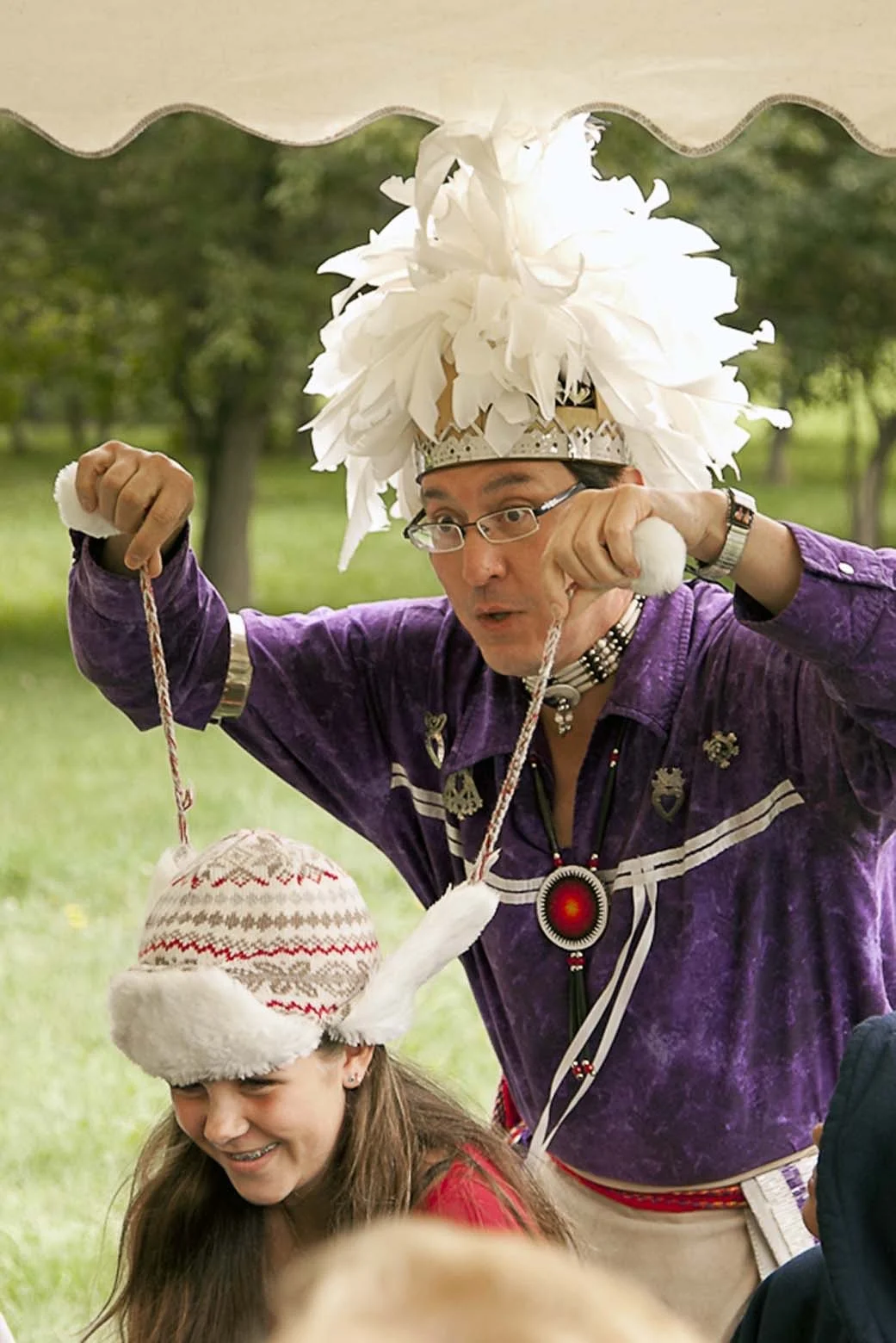
Ground’s shows and talks do more than discuss the past; they remind us of the thriving Haudenosaunee today. He performs his programs in his traditional regalia, designed by people from the local Haudenosaunee communities, and each element reflects his connection to the Turtle Clan, from the intricate turtle detailing to the headdress’ intentional feather arrangement.
“The fact that I’m wearing the full regalia and telling the stories shows that we’re a living, vibrant community, and we are members of the 21st century,” he says. “Here we are, practicing our traditions.”
On November 11 at the Albany Institute of History & Art, Ground will appear for the first time at the State’s oldest museum in conjunction with Family Free Day and the new exhibition Albany, c. 1776, which explores Albany’s past during the Revolutionary War. He will present Stories From the People of the Longhouse, an in-demand program with the year’s 250th theme.
“With every exhibition and program, my team’s priority is to showcase diverse perspectives for all who come to learn with us. Having Perry Ground share Native American stories from the Revolutionary era on a day that is free and accessible to the public was a natural fit,” says Director of Education Megan Brown.
“I hope families gain insight into a perspective on the American Revolution that they may not be as familiar with, one that remains deeply relevant today,” continues Brown. “Native Americans play an essential role in our nation's history. Through interactive programs like Perry Ground’s storytelling, our Family Free Day, and our upcoming exhibition, Albany, c. 1776, we aim to bring forward the diverse stories from the Revolutionary era that are too often left untold.”
While in Albany, Ground will make his annual appearance at the New York State Museum. He will arrive on November 14 and return again in February. For his November program, he will be sharing his timely Re-Thinking Thanksgiving talk.
“I think it’s important we understand the full story of what happened and how it became a holiday and why we do the things we do on that holiday,” he begins. For a brief moment, he lapses into explaining all the reasons why the holiday is not what it seems but catches himself mid-sentence — the full story is a surprise for the audience members to experience for themselves.
It’s a misconception to believe that his presentations are just designed for children. It’s true that on November 14, he will also be visiting the Voorheesville Library to tell Native Stories for Younger Listeners, but he will then be at the Avila Retirement Community and the East Greenbush Library on November 24 for all-ages programming.
The members of his audience that leave with the most revelatory reactions are almost always adults. Adults can enter with preconceived notions about Indigenous communities or stereotypes that they’ve generated in their minds over the years. Most of all, adults often believe they’re past the age of enjoying stories, forgetting that they can also learn and enjoy themselves.
“When they see me, hear the stories and the things I’m teaching about Native Americans, I’m helping to break down some of those stereotypes, and they realize that I’m teaching them something different, and they want to listen,” says Ground. “Adults are surprised by how much they enjoy it. Children go into it thinking that they’re going to enjoy it; they love the voices, the talking animals, and the fun of the stories.”
On the day of the interview, Ground is visiting a small school district, La Fargeville, a place that he’s never been to before. It’s a sparse, tight-knit rural community in Jefferson County, with less than 1000 residents. Going into these environments is Ground’s speciality, a prime example of his ability to go into any place — museum, school, or retirement center — to spread his message.
“It’s great to go to a place like this and have that opportunity to give them the chance to meet Native Americans that they might never have and share this cultural teaching with them,” he enthuses.
This teaching is a full-time job, but he’s been involved in it for his entire life. Ground's career in public education began right out of college at the Iroquois Indian Museum. Since then, he’s developed a diverse background in education, including involvement with the Smithsonian Institution, working as a school administrator in the Rochester City School District, and as an adjunct professor at Syracuse University and Rochester Institute of Technology.
As he tells it, there doesn’t seem to be a time in his life when he wasn’t actively involved in education, from curating museum displays to advocating for New York State to replace the word ‘Iroquois’ with ‘Haudenosaunee’ in school textbooks. Due to his previous experience, Ground understands what words resonate with children and adults — no one sits with a glazed-over stare in his audience.
Ground compares his experience in La Fargeville to a recent visit to a large school district attached to Fort Drum. As a multicultural community with a large school district, he saw a different reaction in the faces of the 400 students. “Every single kid in the room was raising their hand to volunteer and enjoying learning about Native Americans and this cultural education,” he recounts. “Even the teachers at the end were amazed at how engaged the students were and wanting to participate.”
Adults can have their preconceived notions change, but children are still shaping their opinions on the world. By speaking to students and families and showing them what past, present, and future Haudenosaunee culture looks like, Ground hopes that his shows change the narratives that exist around Indigenous communities.
“Children, in general, still have a sense of wonder and amazement about Native Americans,” says Ground with a small shrug, as if to say, ‘Is that better or worse? I don’t know.’ “Part of that is not understanding how Native Americans have evolved and changed over time, which is part of what I’m hoping to teach them, that we’re modern people, but that our traditions are still important.”
He laughs that perhaps, most of all, attendees of his presentations love the free candy that he hands out to anyone who answers a question correctly — beleaguered teachers ask specifically for him to bring it.
This brings the interview full-circle back to the anecdote he shared about buying bags of candy in a desolate Tops ahead of one of his many November shows. “You’re buying Halloween candy already?” the store employee had asked him in disbelief.
“No,” Ground explained. “I’m buying it for Thanksgiving.”
“What?”
*
Ground finds that this autumn is especially busy with the plethora of America 250 events and people dwelling on the origins of Thanksgiving. But he wants to remind people that Indigenous communities live, work, and contribute to America all year. This is the motivation behind him amassing hotel points, driving hundreds of miles, and sharing his stories with everyone he meets.
He is a person of many words and stories, but he keeps his reasons why simple. “I love what I do.”
Ground encourages teachers, community centers, and museums to contact him for booking inquiries at Talking Turtle Stories on Facebook or at TalkingTurtleStories@gmail.com. To check out his upcoming event schedule, visit his Facebook to learn more.