NEWS: Radix Center Unveils Alice Green-Way Trail System
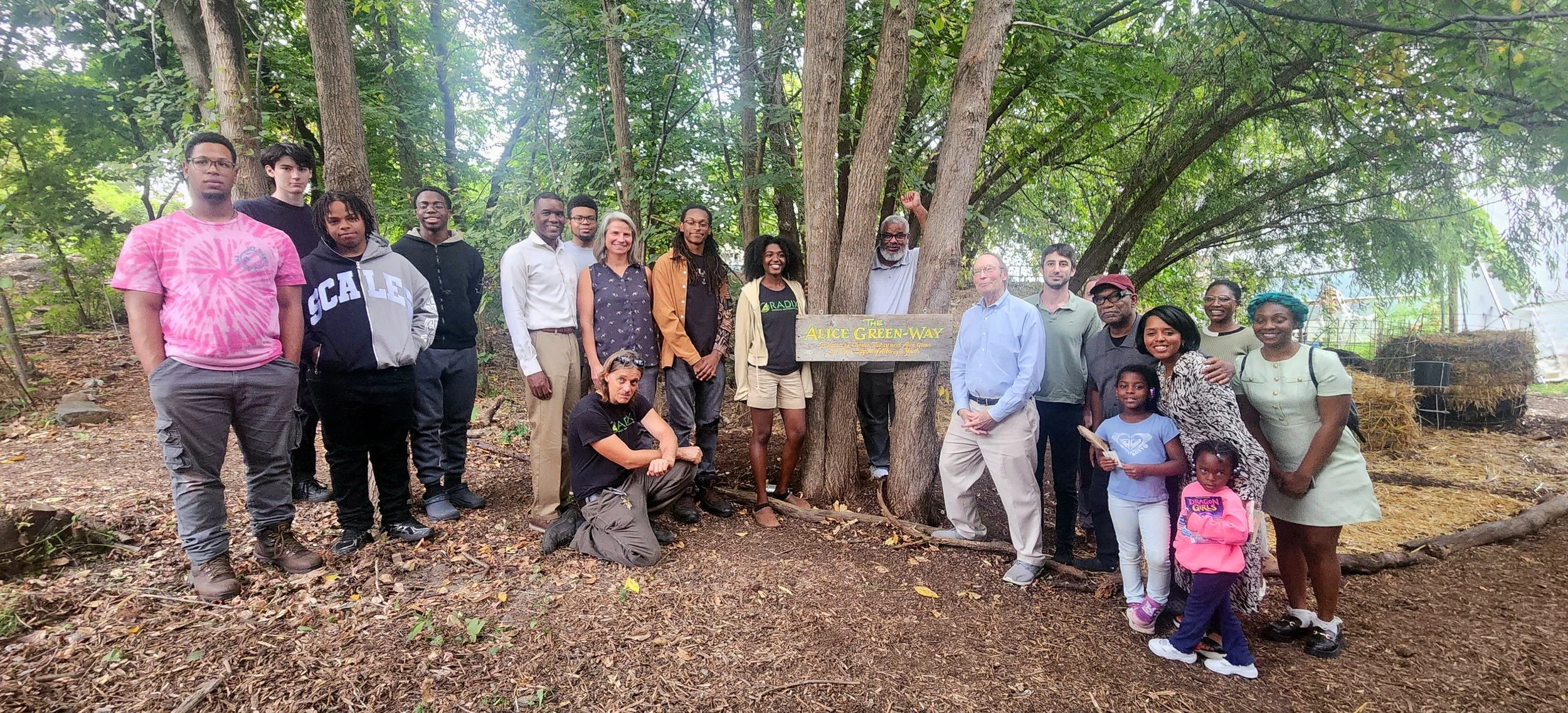
Photo provided
“We want to be thinking about what biodiversity conservation means through a lens of equity and justice; we're starting to think about and answer those questions.”
Albany’s Radix Ecological Sustainability Center celebrated the completion of a nature trail project years in the making earlier this month, named to honor the legacy of Dr. Alice Green as well as her husband, Charles Touhey.
The construction of the newly christened Alice Green-Way trail system involved help from the Eco Justice Associates Youth program as well as the Mohawk Hudson Climate Corps, part of SUNY Albany’s Institute for Transformational and Ecosystem-Based Climate Adaptation. The project involved an extensive amount of work including the removal of invasive species like Buckthorn and Bittersweet plants and replacing them with over 50 native understory plants as well as repurposing some concrete from the formerly county-owned lot to serve as trail markers. It was constructed on the lot adjacent to the original Radix Center property, which the center acquired from the city in 2014 at an extremely generous discount.
“It was essentially donated and sold to us for $1, this one-half acre property from Albany County in 2014 which we're very grateful for,” said the Radix’s Educational Director, Scott Kellogg. ”It was in pretty rough shape when we first got here. A lot of asphalt, a lot of cars and garbage… These kids did a lot of work over the years to clean all that up, rip up the asphalt and build up soil and plant trees and gardens.”
Converting the lot from that asphalt and trash into a nature preserve was no small feat. In fact, Kellogg described it as daunting. The steep hillside terrain made working the land a challenge, but it was one that was well worth it to provide a green space within Albany’s South End where Green and Touhey were instrumental in supporting the neighborhood youth as well as initiating environmental activism.
“There’s a word that we use called ‘bio-cultural diversity,’ which is a way to think about how biodiversity syncs up with social justice because historically, those two things are thought of as sort of separate,” Kellogg explained. “We want to be thinking about what biodiversity conservation means through a lens of equity and justice; we're starting to think about and answer those questions. What does it mean for urban residents, particularly in potentially disadvantaged communities, to have access to healthy environments and species diversity?”
Many in attendance at the announcement ceremony echoed this sentiment, and noted that historically environmental movements have not always looked like the people in the neighborhoods they’ve served. That makes the emergence of local neighborhood leaders in environmentalism from places like the Radix Center all the more fulfilling. There was ample discussion about the benefits of getting inner city kids in touch with the soil, and the ways that Dr. Green, Mr. Touhey, and the Touhey foundation put their money, time, and effort into doing just that.
“I'm always happy to say a few words about the giants that make Albany so great,” said Dorcey Applyrs, one of the many prominent figures from the city or county government in attendance. “Dr. Green leaves behind such a legacy and a blueprint for all of us and so many others to follow. The word that always comes to mind is ‘accountability.’ I don't care who you were — Dr. Green was going to hold you accountable and the community loved, cherished and respected her for it. While she was short in stature, she was mighty in her presence and so many people stood on her shoulders. We continue to stand on Dr. Green's shoulders.”
Applyrs went on to thank those in attendance and the Radix Center themselves for helping to honor Dr. Green’s legacy, and lauded Green and Touhey for prioritizing the communities in Albany that are often overlooked and disinvested in.
Another attendee further emphasized the importance of projects like this one that bring the fight for ecological justice straight to people of color. “The Radix Center is going to create those African American environmentalists, or environmentalists of color, right in their neighborhood,” they explained. “That's what I see in this place. I see the growth of those opportunities that young people in our neighborhood didn't have, growth of those outlets to fulfill that drive about the environment, to learn about trees and plants. Now we have it right here in our South End neighborhood, and that could not have happened without support, without the vision.”
People like Dr. Alice Green and Charles Touhey, as well as all of those within the South End neighborhood who’ve come together at the Radix Center, are certainly a part of such a vision. The establishment of this trail system along with all of the work being done by Dr. Scott Kellogg, Dr. Stacey Pettigrew and all of the students working at the Radix Center have carved out a space for the seed of conservationism to be planted. With this level of community support and a tradition of pouring time and energy into their neighborhood, that seed will only continue to grow into a thriving local movement.