INTERVIEW: Sarah Gross’ Staying Power is Being Realized Faster Than Ever
07/28 @ No Fun, Troy
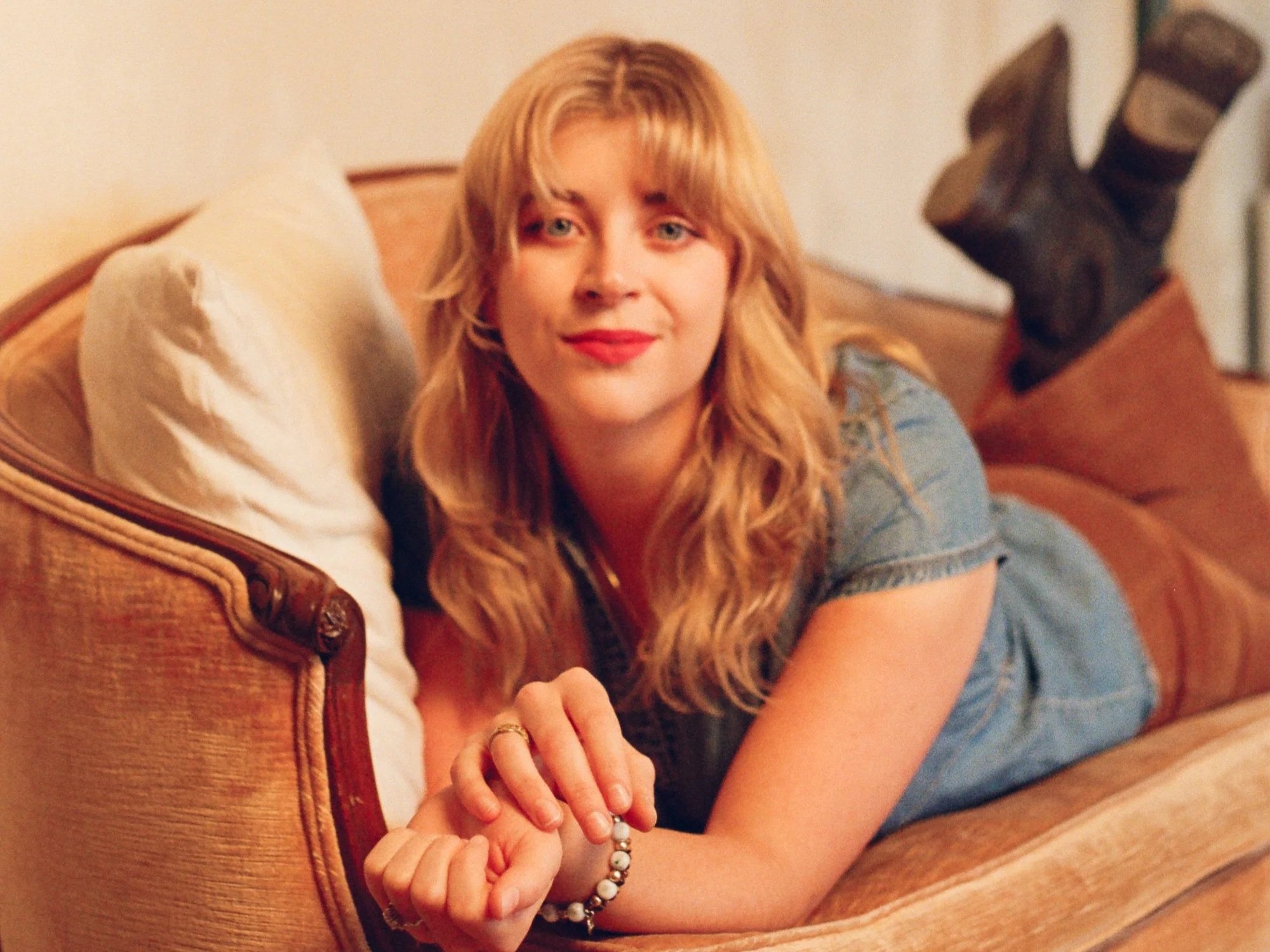
Photos provided by the artist
“I think that when we as artists get very wrapped up in everything that comes after the writing process, it gets so muddled and you're not making the best art you could possibly make.”
In the visualizer for the lead track off her brand new album, The Old Side of Being Young, Sarah Gross appears as the quintessential American girl. Blue denim overalls over a white and red baseball tee, complete with a red bandana and bright red lipstick, she’s captured within the walls of an auto body garage, posed in front of shelves overflowing the detritus of past tool boxes or sitting in the driver’s seat of an ancient red convertible.
Yet, if you slow down and listen to the lyrics of “Faster Than Ever,” you realize that Gross is much more nuanced than any one-dimensional portrayal of a Long Island-born pop-country singer. She is intentional, lyrically gifted, and uses the imagery she creates in her songs to pose questions around the intersections of personal and geographic identity, modern relationships, and coming of age in your twenties.
“I had started songwriting on the side, probably when I was about 12 is really when I started taking it seriously,” she tells me as we begin our conversation. “It wasn't until college where I found that there was a real appreciation for original music. Maybe I couldn't see it because I was too young, but I didn't feel like there was a lot of original music being supported on Long Island within my immediate community.”
In fact, it was our own Troy-based artist, Delaney Hafener, frontwoman of The Belle Curves, that helped grow Gross’ musical world. “Delaney and her dad Bill are really the reason I got into original music on Long Island,” Gross says. “They really showed me the ropes. They were the first people to really take interest in my music in my community. They mentored me in many ways.”
Once entering Syracuse University to study audio engineering, Gross discovered her peers’ affinity for writing their own music, propelling her into not only writing on her own, but looking to form bands. Also at Syracuse, she joined an acapella group, which she credits with bringing her out of her shell and giving her lifelong friendships.

In Gross’ music and writing, you can hear the influences that have guided her throughout the years, from Joan Baez to Tom Petty to Brandi Carlisle, creating a folk-country sound with a modern flare. In “White Lace and Black Leather,” the entire atmosphere of the song summons the inklings of “Rhiannon” by Fleetwood Mac, especially the bewitching delivery of the line “Well if you wanna free the artist, well you’ve gotta free the muse. ‘Cause once it’s lost its luster, it's lost its grip on you.”
In fact, the whole song is about following the art where it takes you rather than where society tells you that you’ll find success, something pivotal to Gross’ own philosophy. “I think that when we as artists get very wrapped up in everything that comes after the writing process, it gets so muddled and you're not making the best art you could possibly make,” she says.
“I see that a lot, especially now with social media being the main way that people are finding music. It seems like people are aiming to make music so they become viral on social media and not ‘this song became viral because of social media, but it's the song that's the priority.’”
Though Gross herself had a viral moment on social media after singing onstage with Zach Bryan for his duet “I Remember Everything,” tracks like this are proof that moments like that aren’t what define her artistry. “I think that line was a response to that [social media], where if you want to feel truly connected with your art, you need to live — you need to make the art the priority and not what the art can do for you after it's done,” she concludes.
That being said, Gross understands the power that social media can wield in getting an artist’s music heard widely. In addition to that moment with Bryan in 2024, which currently has 23,000 views on YouTube alone, she’s had various TikToks garner massive views. It’s a tool she’s still trying to figure out, not just algorithmically, but emotionally as well.
“I do feel like I had to have some serious reevaluation with what my boundaries were with social media and what kind of value I got out of social media,” she explains. “When you're getting all of that attention, it actually could be too much. And you don't know how to process that. You kind of don't feel human. And then eventually it stops because, of course, it has to cycle.”
Whether she’s in what she terms “300 view jail” or getting a million views on a video, Gross explains how consistency is key despite social media being a fickle beast — she’s had viral videos result in no new followers to her music, while a relatively small video results in a new fan coming to a show because she had covered their favorite artist.
In fact, she’s even gained views from getting into a “feud” with John Mayer. In a silly TikTok explaining “what the microphone you use says about you,” Gross called the SM7B basic. “It’s honestly not an insult. It's just the thing that you see at every single studio and now every single podcast known to man. And John Mayer commented on it. He was like, ‘It's not basic. It's my favorite microphone,’” she laughs. There’s no hard feelings on her part, though, as she listens to his radio every day and is available if he ever wants to remedy the situation.
Social media or not, sharing original music, especially songs with deeply poignant lyrics like Gross’, asks artists to decide just how vulnerable they’re willing to get with strangers. For a storyteller like Gross, that question becomes even more complicated. “I'm an open book and I also approach songwriting with a lot of artistic liberties. I think I did that firstly by accident, but now I really love it. Because I'm like, now nobody knows what's true and what's not,” she laughs. “Some of them really are 100% this is the truth and that's the end of it. But, you know, Dolly Parton has songs about killing men and I would be surprised if she ever killed anyone!”
Bringing up Dolly Parton, it begs the question of who a female country storyteller like Gross is influenced by when so many of those greats are male. “I am so influenced by those men like Tom Petty and Bruce Springsteen and Neil Young, those are the people that we were kind of fed growing up as the great storytellers,” she reflects. And while we do have inspirations — Gross cites Kacey Musgraves, Brandi Carlisle, Taylor Swift, and Haim as more recent examples — “there's not enough women at the forefront, that are in that sentence immediately.”

What makes Gross’ sound so unique is that it’s not just these modern women or men she’s listening to, but other eras as well. “I definitely pull from the Emmylou Harris's of the world and the Joan Baez people. That golden folk,” she says. It’s all these different influences, genres, and times that mesh into one with Gross.
Take “East Coast Cowboys,” for example. It’s classic western country, with twangin’ banjo, thumpin’ upright bass and tongue-in-cheek lines like “Those city folks come for the summer, they fill our roads with dumb and dumber, they buy our homes and hate the way we talk,” with characters popping up throughout the song. But within that traditional sound is a more personal, prideful connection to her hometown kin: “Well East Coast Cowboys have always been the only place a girl like me could fit in.”
It’s this same intersection of personal and geographical identity she grapples with on “Faster Than Ever,” beginning with “In New York for the day, taking pictures like I’m on holiday,” later followed by the admission “I’m not going anywhere better than this, they think I’m running off to the races. I’m going nowhere faster than ever.” Having left New York for Nashville, it’s only fitting the song ends with the line “Sweaty palms, shaky hands, I’m uncertain I’ll get a better chance,” those first two phrases a refrain from the beginning. That cyclical notion asks the listener to place themselves into Gross’ circle of fear mixed with growth, substituting their home and “unmade plans” for her own.
Identity, unmade plans, and uncertainty are themes throughout the record, fitting for its title, which Gross said she thought of at 24, though now she’s nearly 27. “I think it's the first time in your life when you really are expected to put on your big girl pants and figure things out,” she says of that age. There can be such intense pressure to achieve “success” by milestone ages like 25 and 30, but as Gross has come to realize, these expectations are unrealistic. “I feel like we really need to stop with giving ourselves those deadlines of when I'm 25, I'm going to be successful. When I'm 30, I'm going to be married with two kids, and I have a house. Placing these really large expectations on ourselves is so silly.
“Time can feel like a thief,” she continues. “But time is also grace. It's giving yourself grace for a lot of things. I don't have it all figured out right now, but I have faith that it's going to work out. And I'm not going to be afraid of not knowing things anymore.”
This concept is part of the reason this record has what Gross believes is staying power. “I think my hope for this record is that it just continues to find people,” she tells me. “I look back at Chappell Roan, who put out an album, and it did pretty well when it was released. But then a year later, it was like, oh my gosh, ‘who is this girl?’ I think that this album has that kind of potential. And I think that it's gonna happen in due time. I don't want to ever give up on it because I think it's worth it.”
The other piece of the equation that gives the album staying power is the fresh sound, which Gross refers to as “indie twang.” It’s the first record she hasn’t produced on her own after her manager encouraged her to connect with Colin Pastore and Jake Finch in 2024. “I quickly realized that they could take the songs that I was writing to a level that — and I'm not even saying this just to humble myself — but I just never could have made something like that on my own.”
Between the six-piece band and the novelty of the record, her stop at No Fun is not one to miss. She’s even got themed nights for her tour — Troy is slated to be “Off To The Races!” which her Instagram flyer describes as “Blue collar, auto mechanic, overalls and a bandana vibes. When in doubt, wear denim.” Grab your boots and your grease rag and get your East Coast Cowboy self down to the show.
Sarah Gross will be at No Fun on July 28 at 7pm, joined by Keta Ester, Sophia Corinne, and Russel the Leaf. Get tickets here.
Check out more about Sarah here: https://sarahgrossmusic.com/