
INTERVIEW: Archiving Joy, Rendering Power: The Technicolor World of Aysha Charise
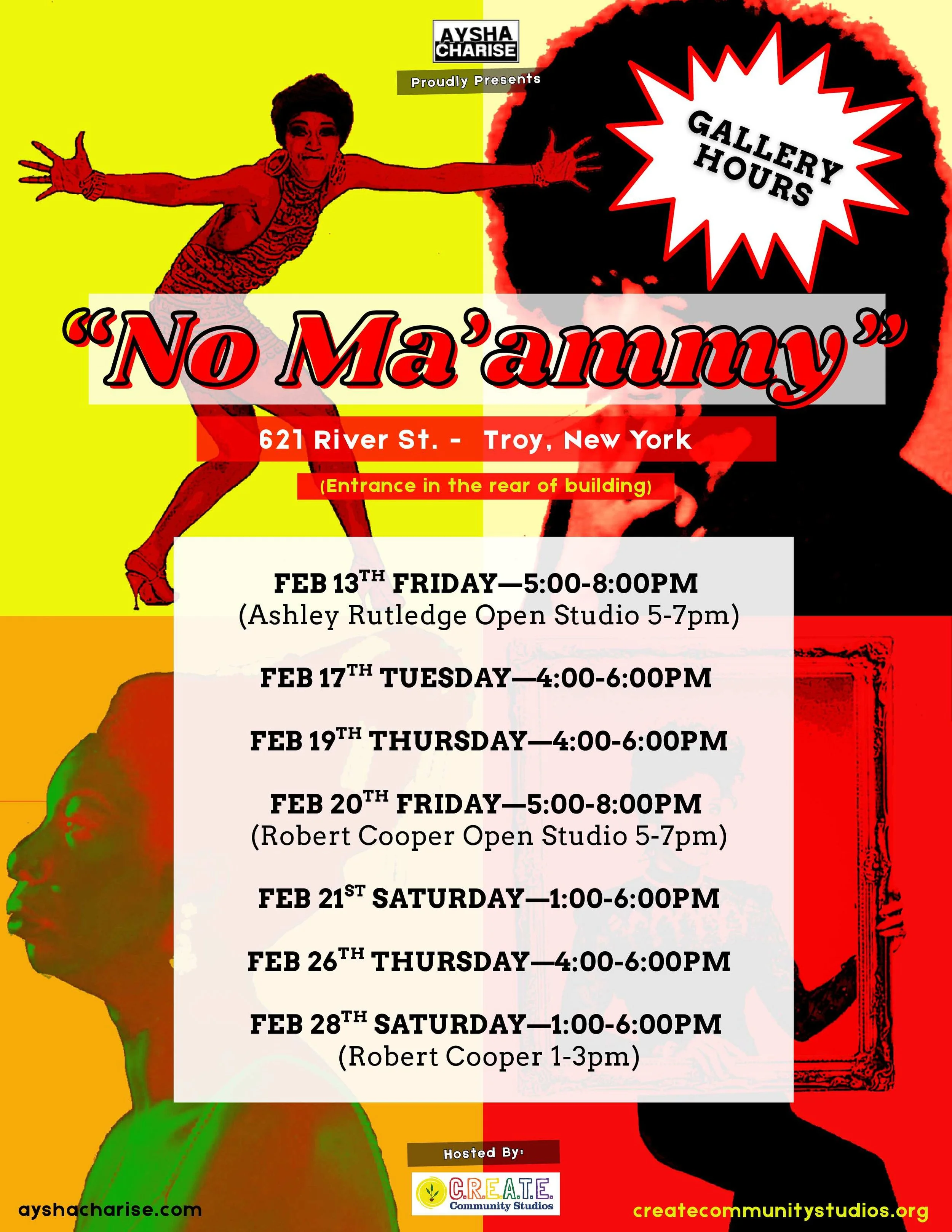
“No Ma’ammy” runs through 03/27 @ C.R.E.A.T.E. Studios, Troy
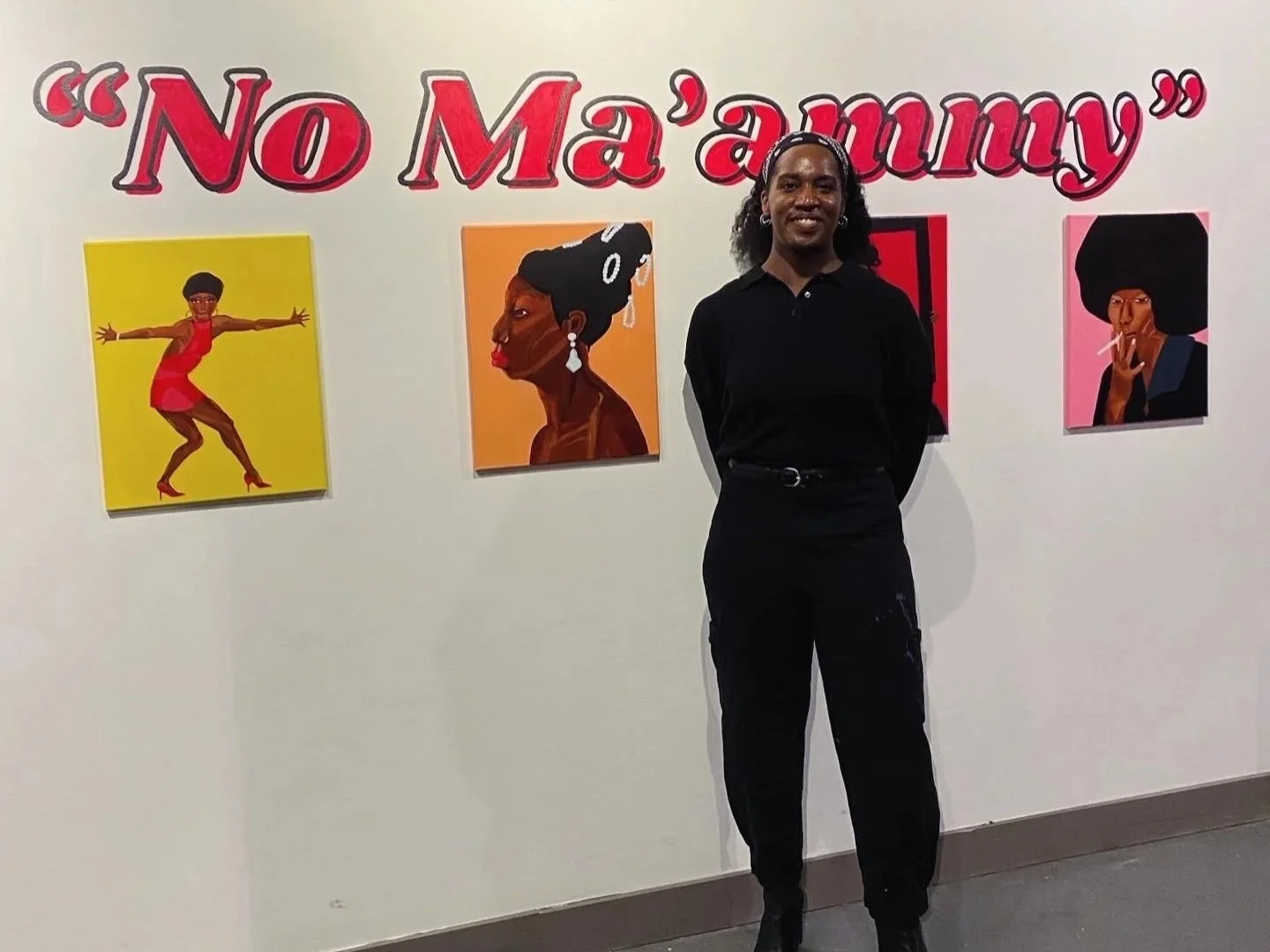
“I became angry with the expectation to be nice, keep my head down, or brush emotional abuse, colorism, and misogyny under the rug. Rather than focus on the reasons Black women have to be angry, I focused on why they should be celebrated.”
There’s something electric and incredibly inspiring about talking to Aysha Charise. Not loud or performative, but charged with memory, competition, history, and an almost defiant tenderness. She calls herself a natural-born artist, and when she says it, it doesn’t come across as branding; it simply comes across as a fact.
Her origin story is specific, reminiscent of something that has been on my mind as of late. Destiny, fate, and callings. The idea of that “Aha!” moment that shifts the trajectory of someone’s life. Picture this: a seven-year-old Aysha sitting at a table with her mother, coloring, watching, studying, and ultimately feeling something shift.
“I remember around the age of seven, I asked my mom to color with me, and I was instantly bothered by her educated technique of applying more pressure with her crayon next to the printed coloring lines and then using the crayon lighter to fill in the rest of the shape,” she says. “It felt like when adults don’t let children win in a race; however, that wasn’t her intention. I didn’t know I was a naturally competitive artist.”
That line, a naturally competitive artist, is not just about talent but about awareness. She wasn’t upset because her mother colored ‘better.’ She was upset because she noticed the technique. She was already studying pressure, depth, and contrast — already measuring herself against the standard of somebody with a level of training that some people can’t achieve until later in life.
Raised in Upstate New York — by family, and, as she puts it, partially by cable television — Aysha’s visual language formed early. Not in theory classes, but in living rooms.
“Tom & Jerry, Rugrats, Mad TV, Jumanji, The Wiz, Prince Of Egypt, The Terminator 1 & 2, Alien, Aliens, Titanic, Jurassic Park,” she lists. “The Sandlot, Power Rangers, Degrassi, and HBO’s Happily Ever After: Fairytales For Every Child are all TV shows and films I can pretty much recite by heart.”
That list alone tells you what shaped her eye: absurdity and slapstick timing, myth and epic, sci-fi spectacle, Black reimaginings of classic narratives, melodrama, dinosaurs, apocalyptic machines, teen angst, fairy tales reframed. Color. Scale. Movement. Stakes.
“I was given morals by my family; however, I learned to read pretty young. While I knew I was watching programs above my age range, I knew what I couldn’t reenact in real life and learned to be entertained by storytelling and good composition.”
Even as a child, she was analyzing things that can sometimes go beyond many individuals in that age range: framing, pacing, silhouette, and body language. She was absorbing how power looked on screen.
After growing up in Schenectady, Aysha went to the Fashion Institute of Technology (FIT). It wasn’t some grand master plan, but instinct — or maybe inspiration from the stories she’d been watching her whole life.
“Honestly, I was just following what I saw on TV, that people with big dreams go to NYC,” she says.
There’s something beautifully honest about that. No myth of destiny. Just: this is what the dream looks like, so I’m going.

She had spent her life shopping on Fordham Road and 125th Street. The city became familiar terrain, but when she arrived at FIT, it didn’t immediately deliver that oh-so-romanticized cinematic inspiration.
“The first year, I didn’t feel inspired and was rather bored with my classes. But then in the spring semester, I got involved on campus, which led to becoming an RA and finally getting paid internships,” Aysha explains. “I was surrounded by people who wanted to work and be seen for their talents; it was kind of like a hive-mindset.”
That hive-mind energy, collective ambition, seems to matter as much as any single class. It’s one thing to learn history or technique; it’s important, but while learning those skills, Aysha also learned firsthand how artists move through systems. How they position themselves, how they’re seen.
Even getting into FIT required adaptation. When she first said fashion design was the goal, she didn’t have the portfolio to match.
“My high school art teacher asked me what my dream college was, and when I told her ‘The Fashion Institute of Technology,’ she asked if I had fashion design work. I was instantly discouraged because I’d only sewn accessories and not apparel,” Aysha says. “She was quick, though, and suggested I consider Illustration because I had a lot of artwork, and that would at least be a way into my dream school. Luckily, I listened to her.”
That pivot from fashion design to illustration wasn’t a failure, not by a long shot. It was an alignment. Illustration allowed her to experiment with texture, line, color, and narrative. It widened the lane instead of narrowing it.
But if you want to understand the core of Aysha’s artistry, you can’t forget the importance of the library, the one-stop shop for information and inspiration, offering much more than the internet ever could.
“Working in libraries is definitely the foundation of my expertise,” she admits. “I loved going to the Schenectady Public Library as a young child and teenager. The movie Matilda had such an impact on informing me that libraries are safe spaces. I have a deep respect for the art of archiving and the power of learning history.”
That’s philosophy. Archiving is preservation. Preservation is resistance. History is context. Context shapes art. While attending FIT, Aysha had a minor in Art History; she’s proud of her Art History minor, and you can hear it. Museums and libraries were never an obligation for her. They were recreation, havens, and the key to combining her love for archiving and for art. Learning didn’t dull the experience; it sharpened it.
And then there’s the corporate side — production, design management, “playing the game.” She doesn’t romanticize that either. She recognized it as necessary armor. A different kind of literacy.
All of that culminates in “No Ma’ammy,” her current exhibition, a title that refuses to soften itself.
“‘No Ma’ammy’ does not intend to redefine Mammy. It’s rather a declaration not to participate in the role of servitude that is typically expected of Black women,” Aysha explains. “I became angry with the expectation to be nice, keep my head down, or brush emotional abuse, colorism, and misogyny under the rug. Rather than focus on the reasons Black women have to be angry, I focused on why they should be celebrated.”
That shift from explaining anger to celebrating power is radical in its own way. She doesn’t want pity. She wants recognition.
Another experience that Aysha references when it comes to media and memories that have influenced her is watching Angela Bassett as Tina Turner in What’s Love Got To Do With It.
“To me, I was watching the story of a woman with a musical gift who believed in herself while unable to safely leave a man who was jealous and used abuse as control. I was obsessed with her voice, how her music pivoted with the music of the decades, and how strong her body was,” Aysha says.
Strength. Pivot. Evolution. Survival. Those themes bleed into the exhibit. And when selecting work, she’s clear about her boundaries.
“The first thing I’m looking for regarding this show is if the Black woman is aware of herself in the work of art, or if a Black woman is clearly being represented in this work,” Aysha explains. “I’m also very adamant about Black people not being painted in gray scale, unless it’s a self-portrait. I think it sends our representation backwards in time, and it’s important to display the beauty and diversity of our skin.”
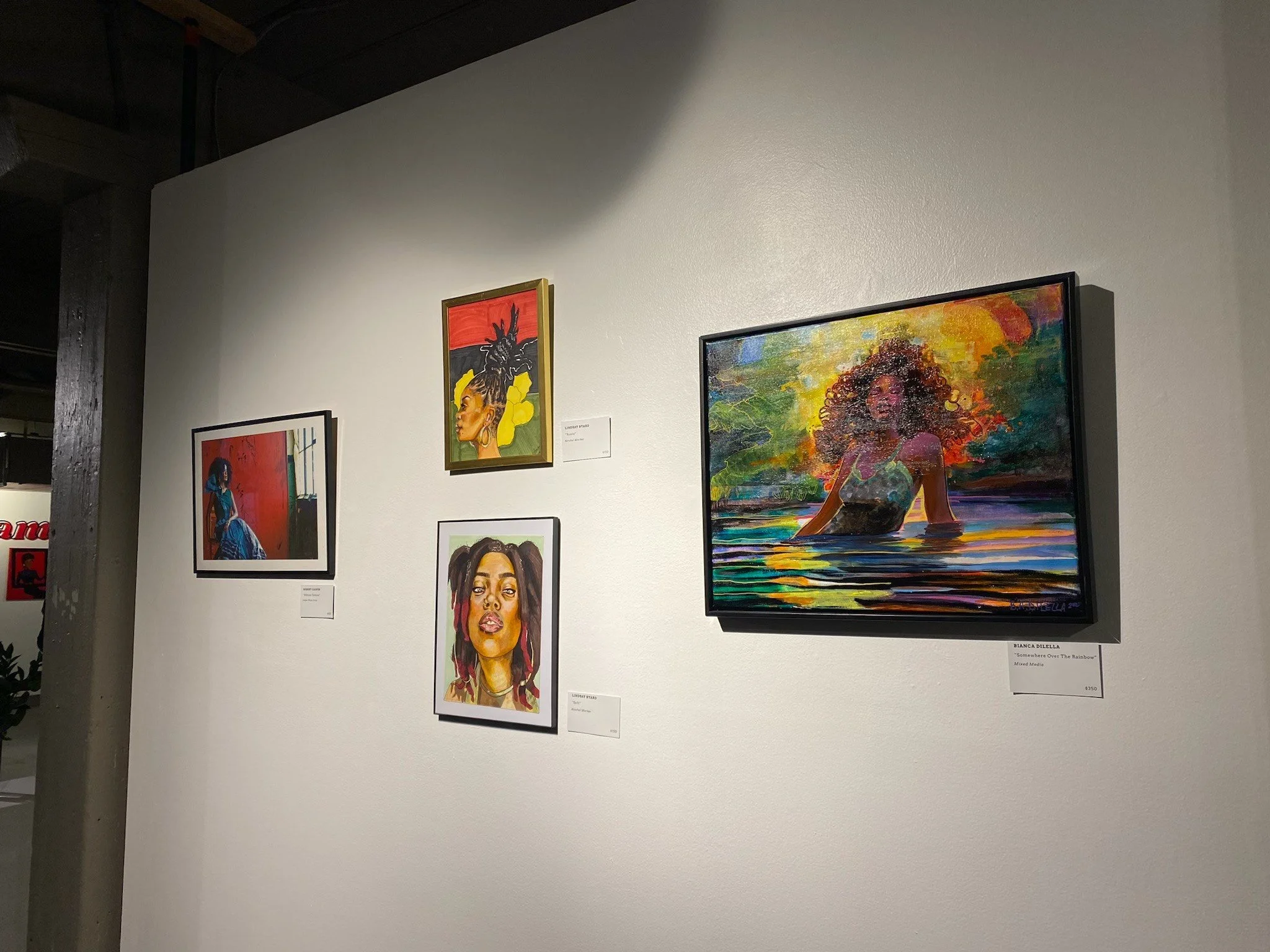
That insistence on color and vibrancy is deliberate. It rejects flattening. It rejects archival erasure disguised as aesthetic choice.
The first images of Black women that felt true to her weren’t gallery pieces. They were personal.
“The first images that come to mind are these large beauty shots I found of my mom and Grama as a child, and a children’s book I used to frequently read, Aunt Flossie’s Hats. I used to stare at the large photographs, amazed they were my family because they looked like vintage Hollywood characters, and I’d read that book so often because their skin was painted so vibrantly brown and the scenes reminded me of my own life.”
There it is again: vibrantly brown. Recognition without distortion. Beauty without apology.
“I hope that Black people feel a sense of pride in the matriarch of Black women who have paved the way for the freedom to be boldly beautiful, learn, work, and rest,” Aysha says of her exhibit. “I hope that non-black people carry an appreciation for the emotional and physical labor Black women work through in order to be great or even considered as good, and how instrumental they are to the strength of society. I hope no one pities Black women, because that’s a waste of emotion if not backed by action.”
That last line is the spine of the show. Pity without action is useless. Celebration without structural change is hollow. She’s not offering comfort. She’s offering clarity.
As for what’s next, she says, “I don’t practice telling my exact next moves, but I will say I do look forward to being involved in more community art projects. There are some clay, welding, and sewing classes I’m looking forward to trying in both Schenectady and Troy. I’ll have new artwork on display during Schenectady’s Art Night Out, and stay tuned for my next solo art show.”
Always expanding mediums. Always building.
If you asked her to freeze one moment from opening night, I imagine it wouldn’t be applause. It wouldn’t be a speech. It would be something quieter. A Black girl standing in front of a piece, seeing herself rendered in full color — not grayscale, not muted, not minimized, and realizing she doesn’t have to shrink to survive.
To me, that’s the real throughline of Aysha Charise’s work. Unabashed and unapologetic representation and joy.
Not just competition. Not just ambition. Not even just celebration.
Awareness.
Of line. Of pressure. Of history. Of self.
And the refusal — gentle but unshakeable — to color inside anyone else’s expectations.
For more information on Aysha, visit www.ayshacharise.com