
INTERVIEW: Tracing The Gaps: Carol Barre’s "15 Homes" Art Exhibit Explores The Fragments Of Memory
Through July 31 @ 344 Second Street, Troy
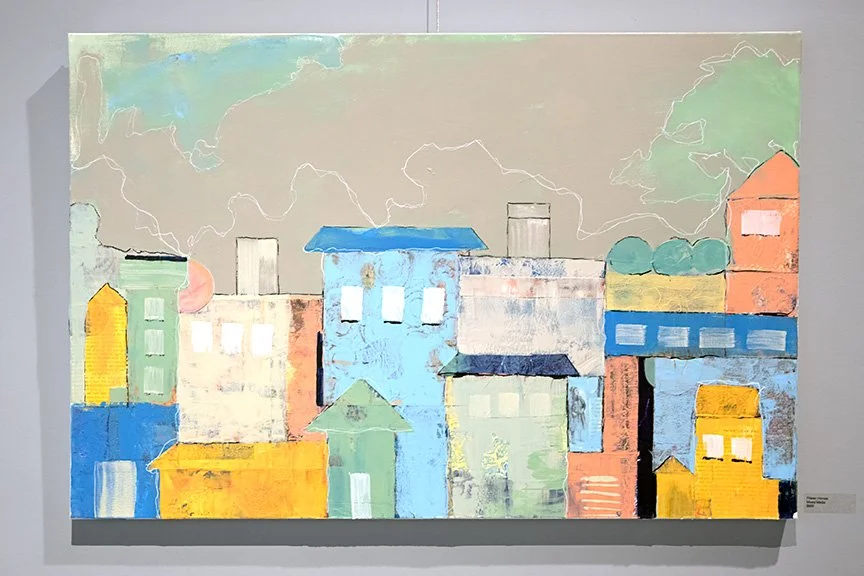
Photos by Tom Miller
“the exhibition is something much more nuanced and complicated: making peace with the memories that time quietly steals from you.”
Walking through Carol Barre's art exhibit "15 Homes," your eyes are immediately drawn to the bright colors layered across every canvas. Hidden beneath the acrylic paint are pieces of newspaper, textured brushstrokes and architectural details that don’t settle into complete realism. At first glance, you may believe the collection is a simple celebration of the homes that shaped Barre's life. However, upon closer examination through speaking with her and reading the poetry embedded in the gallery, it becomes clear that the exhibition is something much more nuanced and complicated: making peace with the memories that time quietly steals from you.
The exhibit, on display through July 31 at 344 Second St. in downtown Troy, features paintings of all 15 homes Barre has lived in throughout her life. Ironically, despite painting each one, she says she only has clear memories of living in seven of them.
"It all started talking to my sister," Barre tells me. In the midst of an otherwise typical conversation, Barre mentioned the seven houses she remembered growing up in, only to be corrected by her older sister who declared it had been far more than that. They talked through each one, calling up locations and memories from each one, even the ones Barre had forgotten.
Rather than moving past that abscess in her memory, though, Barre couldn't stop thinking about it.
Upon returning to her studio, where she created several series prior, she recalls "I just got to thinking... I wonder what I could do. It just came [to me]." She began writing down every address she had lived at. By the time she finished, the list totaled 15 homes, nearly half of which she could barely remember.
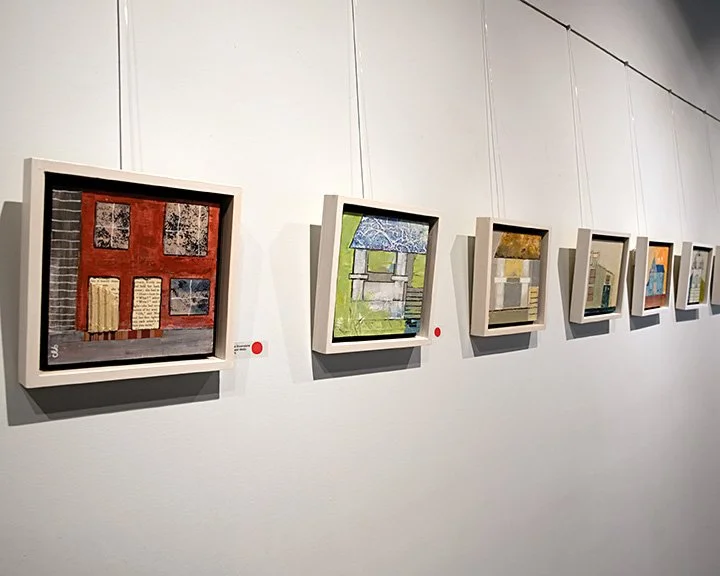
The paintings are only part of the exhibit, however. Barre also created another aspect to the series by transforming the two front windows of the gallery into installations built entirely from the fragments of memories she still carries with her.
One window is filled with the things she remembers seeing outside the homes she lived in — say, a weathered wagon surrounded by ferns, a bouquet of flowers resting inside — creating the feeling of looking back into a childhood yard.
The other window focuses on the interiors of those homes, displaying an antique table, a backgammon set arranged to appear to have been abandoned mid-turn and a collection of empty photo albums that quietly reinforce the central idea of the exhibit. That detail was one of the parts of the installation that stuck with me the most, a simple, yet gut-wrenching display of the message conveyed by the art inside.
While the paintings explore the gaps left behind by fading memories, the empty albums make those gaps tangible, serving as a reminder that sometimes there simply are no photographs — or memories — left to fill the pages. Even the backgammon board feels suspended in time, preserving one of the traditions Barre remembers most clearly, playing the game with her mother throughout the years.
To complete the exhibit, Barre visited every one of the homes before putting them on canvas. Some brought memories rushing back through simply staring at their architecture, while others left her standing outside searching for memories that never resurfaced, forever left behind. Three of the homes had been demolished entirely, leaving her with nothing more than bits and pieces of her own memories and stories told by family members.
One such building was torn down decades ago to make way for the highway, yet Barre still instinctively looks toward the spot where it once stood every time she drives along Interstate 787. "I look every time," often asking herself questions like "I wonder what that big window was," knowing that she’ll never find the answer.
The questions quickly became more important than the answers to her, especially in relation to her first family home, which she said was suspended above a bar.
"The Hudson River was behind our house," she explains, which now leaves her wondering whether there had been a fence separating the yard from the Hudson River, whether she had spent afternoons playing Barbies on the front steps and what color the house had actually been.
"So I made some little stories in my head about it," she tells me.
Deeper than just the basic physical attributes of the home and the things she had done while living in it, she wanted to know how she felt in it and if her parents were attentive and caring to her and her siblings.
“You know, it's just a curiosity, especially coming from a broken home. Was I happy back then? Did my parents play with us in the backyard?” she asks.
Some family members filled in a few of those gaps, but many remained unanswered, forcing Barre to rely on the same creativity that has guided her artistic career for decades.
A symbiotic relationship between memory and imagination has formed and is reflected throughout the series. Barre never intended the paintings to serve as exact replicas of the homes she once lived in, instead, she painted them the way they exist in her mind, allowing vibrant colors and abstract shapes and layered textures to communicate feelings that photographs never could. Even places familiar to her, like the chapel at The College of Saint Rose, where she studied studio art and art education, appear not exactly as they exist today, but as she remembers them.
As she spoke about the project, Barre repeatedly looked over at the paintings hanging around the gallery, almost as if she was hoping they might answer the questions that still linger in her mind. She admitted that creating the exhibition led her to call family members to ask questions she had never considered before and revisit moments from her childhood that had long been buried beneath decades of everyday life.
"I just want to know them," she says. "I don't know why."
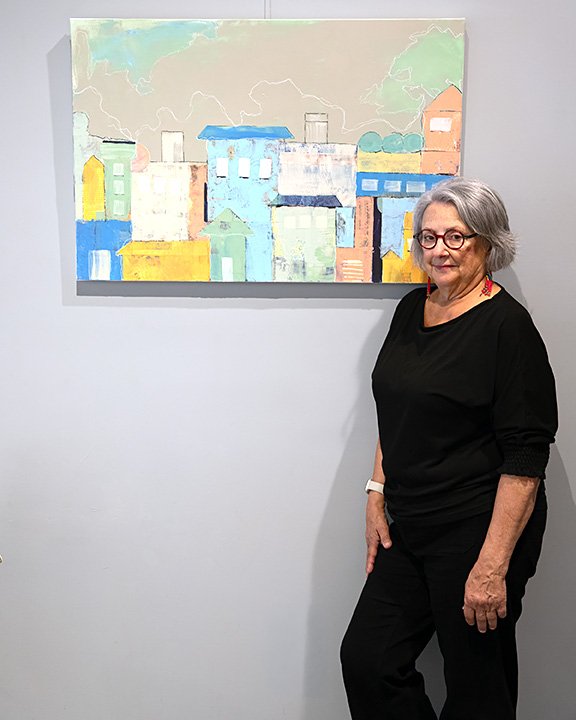
The exhibit also pushed Barre into unfamiliar territory by incorporating poetry alongside her paintings, something she admitted frightened her more than creating the artwork itself. Although she has spent years developing confidence in her painting, she admits, "I never thought that I was articulate enough to write a poem,” much less share it publicly.
Despite those doubts, she included poems throughout the exhibition, describing them as the most challenging part of the nearly 10-month process.
Barre's own artistic journey has been anything but straightforward. After graduating from The College of Saint Rose, she struggled to find a teaching position during a time when art programs were disappearing from schools. Marriage, raising a daughter, caring for family members and working other jobs meant painting was often squeezed into whatever free time remained. Even then, "It felt like something was missing," Barre says about the times when art was absent. "Art is everything — it's therapeutic — it's fun — it's educational," she continues.
Eventually, after retiring and finally regaining her time, plus building a studio into her home to create every day, she committed herself fully to painting, a decision she said she never imagined making years earlier. “I've never had confidence my whole life — but I always had a goal. And I have been fulfilling those goals,” she said.
Now, standing in a gallery surrounded by the homes that shaped her life, Barre hopes visitors leave thinking not only about her memories, but about their own. Several visitors have already shared stories about houses they grew up in after recognizing pieces of their own lives reflected in her work, something she considers one of the exhibit's greatest successes, with one visitor purchasing house number seven that depicts a house on a hill, one that looks similar to the one they had lived in in their childhood.
More than anything, Barre hopes people remember that creativity has no expiration date and to stop holding themselves back from doing what they love. "Don't let age stop you from doing what you're passionate about," she states. "Find something that you like, that you love, and go for it. You're never too old to learn a new tool or get out there and show people what you're doing."