
INTERVIEW: Aaron Moore: Turning Purpose into Platform for the Next Generation
**This article originally appeared in our March 2026 issue**
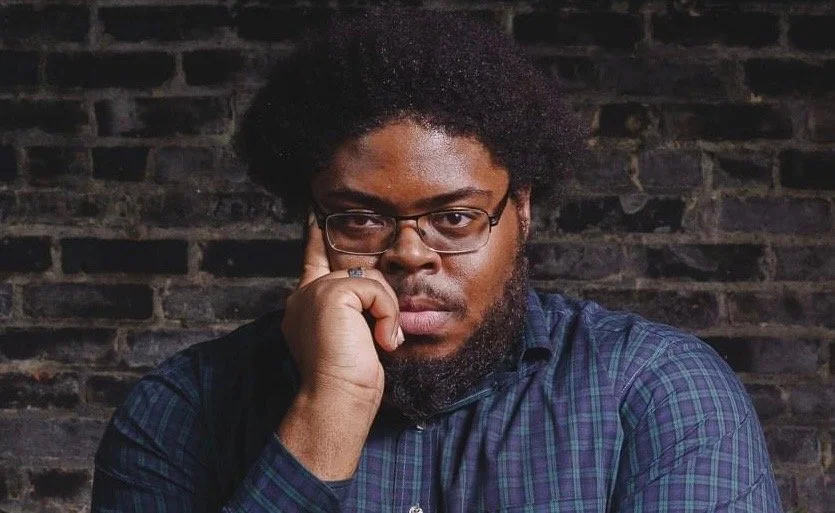
Photo by Jamal Mosely
“We’re multi-layered, faceted, generational beings. I love being able to share our vulnerability, our fun, our expressiveness, our food, our music, our dance, our hurt, our fear — all of it.”
Aaron Moore remembers what absence feels like.
Growing up in Albany with a love for theater, he didn’t see many spaces built for young Black artists who wanted to be on stage. Opportunities for enrichment existed, but they often lived elsewhere: sports programs, trade-focused initiatives, and dance spaces geared toward young girls. Theater, especially theater rooted in Black experience and voice, felt harder to find.
For Moore, that gap was personal.
“Growing up here in Albany, there weren’t many outlets for young Black artists pertaining to theater,” he told me. “If you were young and interested in theater, there wasn’t much outside of that.”
His first entry point came through family. Moore’s Aunt Wanda, a theater artist whose work stretched from Buffalo to Albany, brought him to his earliest productions, offering him a glimpse into what life in theater could look like. Later, Albany High School’s drama program became another formative space, led by educators who encouraged students to explore complex conversations onstage and off.
“It was open. It was inviting. It was diverse,” Moore said. “It was not only my connection to theater, but my connection to the world.”
That sense of connection between art, identity, and lived experience deepened when Moore encountered a production of A Soldier’s Play as a young audience member. It shifted something inside him.
“I remember sitting there watching all these Black men have these powerful, dedicated, prideful moments,” he recalled. “And I said, ‘This is what I want to do. I want to be up here. I want to be part of this.’”
That moment shaped not only his artistic path, but his purpose. Today, Moore’s work consistently centers Black stories, Black lineage, and Black lived realities, a focus he describes as intentional and deeply personal.
“Please call me a Black artist. Please call me a Black playwright. Please call me a Black theater director,” Moore said. “That’s what I am, and that’s something I’m prideful about.”
Through his performances, writing, and directing, Moore aims to expand how Black life is represented on stage, pushing beyond narratives that rely solely on trauma.
“We’re multi-layered, faceted, generational beings,” he said. “I love being able to share our vulnerability, our fun, our expressiveness, our food, our music, our dance, our hurt, our fear — all of it.”
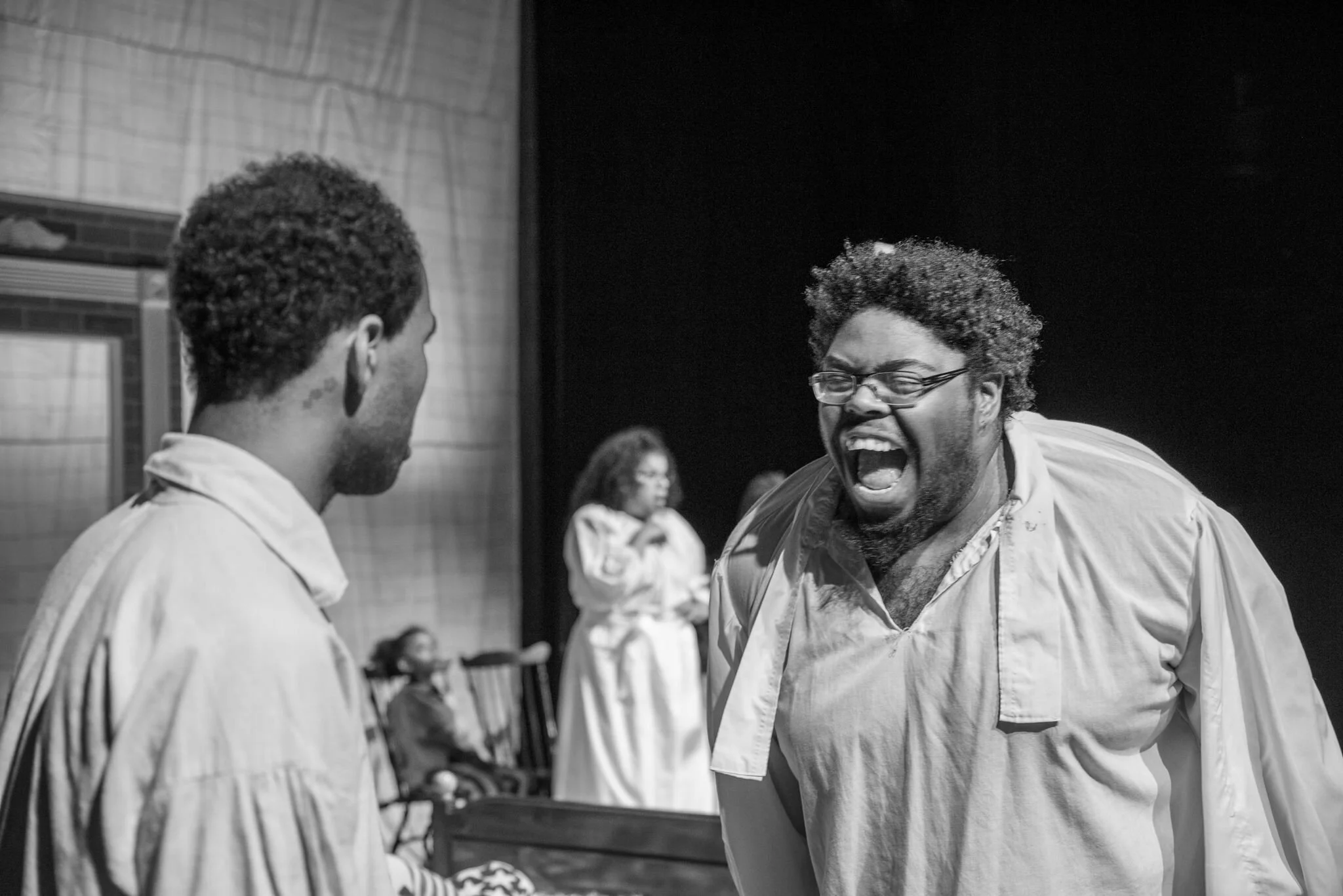
Photo by Patrick White
In the Capital Region theater scene, Moore and fellow Black artists have long discussed the limitations placed on Black storytelling, particularly within predominantly white institutions. He points to a history of theaters producing only a narrow selection of Black plays, often chosen based on perceived appeal to white audiences.
“It was always about what would connect with white audiences or bring in more money,” Moore said. “But there are hundreds and hundreds of Black plays out there.”
He also emphasizes the responsibility involved in portraying Black narratives authentically, advocating for storytelling shaped by artists with a direct connection to those experiences.
“It’s a heavy responsibility,” he said. “To witness, to build, to portray — that’s a lot.”
Moore has also worked to create visibility where it was previously lacking. In recent years, he helped launch an annual Black theater photo shoot in the Capital Region after noticing the absence of Black representation on theater walls and archival displays.
“There were walls and walls of photos, and almost all of them were white productions,” Moore said. “So we said, let’s honor ourselves.”
The project, now in its fourth year, brings together actors, playwrights, directors, stage managers, and educators in a collective celebration of Black theater presence in the region.
“It’s for us, by us,” Moore said. “And it shows there are so many ways to be part of theater.”
Moore’s artistic vision expanded further through training experiences in New York City at the Alvin Ailey American Dance Theater and Classical Theatre of Harlem. Seeing Black performers command professional stages broadened his sense of possibility, inspiring him to pursue directing and playwriting alongside acting.
“It opened my horizon,” Moore said. “Seeing Black bodies commanding the stage and leading the work that led me to want to direct, to write, to do more.”
That drive ultimately led to the creation of Acting with Aaron, a performance education initiative founded in 2014. The program provides accessible acting, directing, and playwriting opportunities to community members across the Capital Region, addressing financial barriers that often limit participation in arts education.
“At the time, programs were $800 to $1,000. The community I wanted to impact couldn’t afford that.”
Through grants, scholarships, and partnerships, Acting with Aaron has offered low or no-cost programming to participants ranging from youth to seniors, creating a space where curiosity about theater can turn into opportunity.
Moore speaks candidly about the personal stakes behind that work. Without mentors like his aunt and Albany High educators, he believes his trajectory might have looked very different.
“Those experiences saved my life,” Moore said. “They gave me purpose.”
That purpose has fueled a career defined by persistence as much as passion. Moore recalls commuting between cities by bus to teach classes, rehearse, and perform, often using his own money to support productions and fellow artists.
“It’s not easy. There were times I was broke, times I was sick, times I was using my own money to pay artists or rent spaces. But when you’re passionate about something, you keep going.”
For Moore, passion remains the dividing line between interest and calling; a distinction he frequently shares with students exploring careers in theater.
“There’s a difference between liking something and being passionate about it,” he said. “If you want to do this on a professional level, you have to feel called to it.”
Moore isn’t asking the Capital Region to “include” Black artists like a seasonal gesture. He’s asking it to step up. Pay people. Say their names right. Stop treating Black work as a February assignment. And for the young artists watching the way he once did, he’s trying to leave something sturdier than inspiration: a map, a network, a place to start.
Because Albany can be the kind of city where a kid sees A Soldier’s Play and thinks, ‘I belong up there,’ and then can turn to actionable resources and opportunities the second they walk out of the theater.
Keep up with Aaron by following along on his Instagram @actingwithaaron